
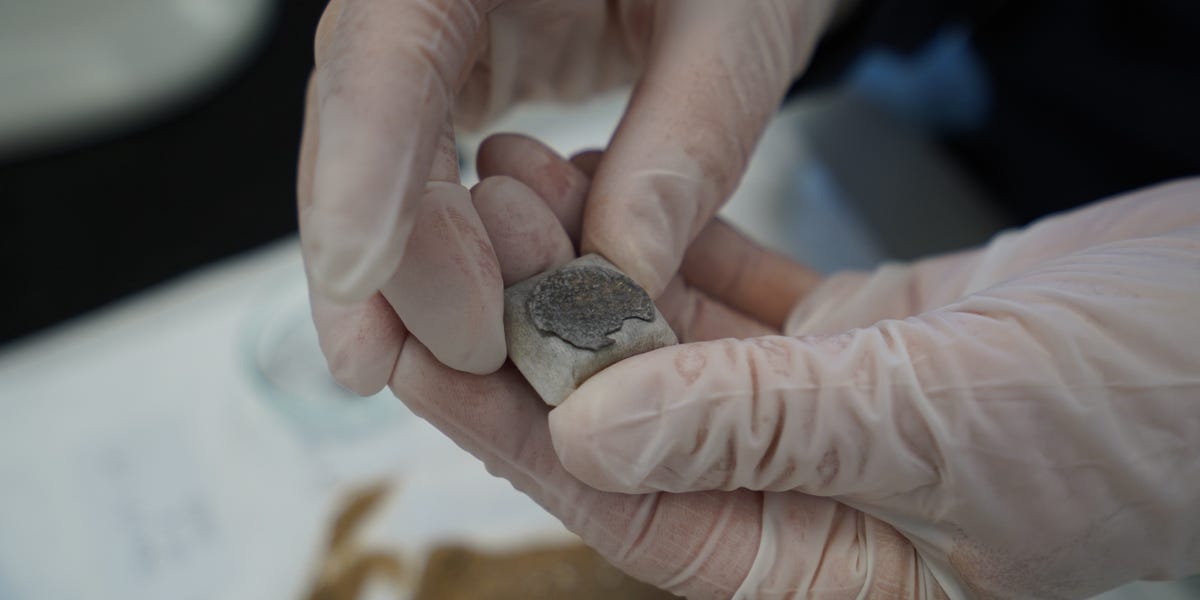
Experts cataloguing the largest Viking Age coin hoard ever discovered in Norway were stunned when one 1,000-year-old coin stood out from the more than 5,000 in the find. As archaeologist Anne Skogsfjord sorted and catalogued the coins, she found herself face-to-face with King Olaf Haraldsson, known as Saint Olaf. The coin’s inscription confirmed it: ONLAF R+ NORMANORV, which translates to “Olaf, King of the Norwegians.”“Could this really be a coin of Olaf Haraldsson that I was holding? And it was,” Skogsfjord said in a statement from the University of Oslo’s Museum of Cultural History. “It was a very special moment. I realized that we had found a national treasure.”The discovery came from what is already a remarkable find. Since its discovery in April 2026, the Mørstad Hoard has grown to about 5,500 coins, so cataloguing it is no simple task. Skogsfjord came across the Olaf coin while working through a group of Anglo-Saxon coins issued by Æthelred II, where it had first been sorted. However, its inscription soon revealed who had really issued it.The find is extraordinarily rare. Fewer than 20 of Saint Olaf’s coins survive today, and most have turned up outside Norway. Only four examples of the type found in the Mørstad Hoard were previously known, and just one of those was found in Norway, in a hoard uncovered during the restoration of the church ruins at Stein in 1924.“For those of us interested in Norway’s earliest monetary history, it hardly gets any better than this,” said Svein H. Gullbekk, professor of numismatics at the University of Oslo. “Here we have a coin bearing the king’s portrait and a cross, with another cross on the reverse. It is a Christianization coin on a grand scale. We can see how King Olaf used coinage to legitimize the new faith and to establish himself as a Christian king of European standing.”The coin was struck around 1024–1028, near the end of the Viking Age, and minting it was itself a political act. “This is branding,” Gullbekk said. Olaf himself appears on the coin, facing left and wearing a conical battle helmet, which gave this coin type the nickname “Pointed Helmet.”“Olaf Haraldsson himself decided what these coins should look like, and perhaps he was present when they were struck,” Gullbekk said. “It is entirely possible that this very coin from Mørstad was once held in the king’s own hand.”Yet the coin was more than a political statement, as it was, unsurprisingly, used as money. Both sides bear numerous small knife cuts, likely made to test the silver content during transactions. “On that basis, we may assume that the coin changed hands several times during the approximately 20 to 25 years between its production and its deposition in the Mørstad Hoard,” said Associate Professor Florent Audy, who leads the museum’s cataloguing of the hoard. “That is yet another fascinating chapter in the coin’s history.”The hoard itself was first found on April 10, 2026, by metal detectorists Rune Sætre and Vegard Sørlie in Rena, in eastern Norway’s Innlandet County. This autumn, the two detectorists searched the field again and, with landowner Ole Erik Hørstad, unearthed coin number 5,000. County archaeologists also carried out a follow-up investigation of the site in late September. And the count may keep climbing. “I am beginning to think that the hoard may soon exceed 6,000 coins,” Audy said.In the meantime, the public will get its first look at the find. The Olaf coin will be shown when an exhibition on the Mørstad Hoard opens at the Historical Museum in Oslo on November 20, while cataloguing continues behind the scenes.“When you think this Viking treasure cannot become any more exciting, new surprises emerge,” said Hanna Geiran, Norway’s director general of cultural heritage. “This St. Olaf coin is yet another reminder of how extraordinary this find is. The coin is not only a rare object, but also tangible testimony from a time when the foundations of the Norwegian kingdom and the Christianization of the country were laid.”Tim Newcomb is a journalist based in the Pacific Northwest. He covers stadiums, sneakers, gear, infrastructure, and more for a variety of publications, including Popular Mechanics. His favorite interviews have included sit-downs with Roger Federer in Switzerland, Kobe Bryant in Los Angeles, and Tinker Hatfield in Portland.
Archeologists Found a 1,000-Year-Old Viking Treasure That May Have Touched a Saint’s Hand
Full Article
Original Source
Read the full article at Popularmechanics →KhanList aggregates and links to publicly available news content. We do not host full articles from third-party sources. Always verify important information with original sources.