
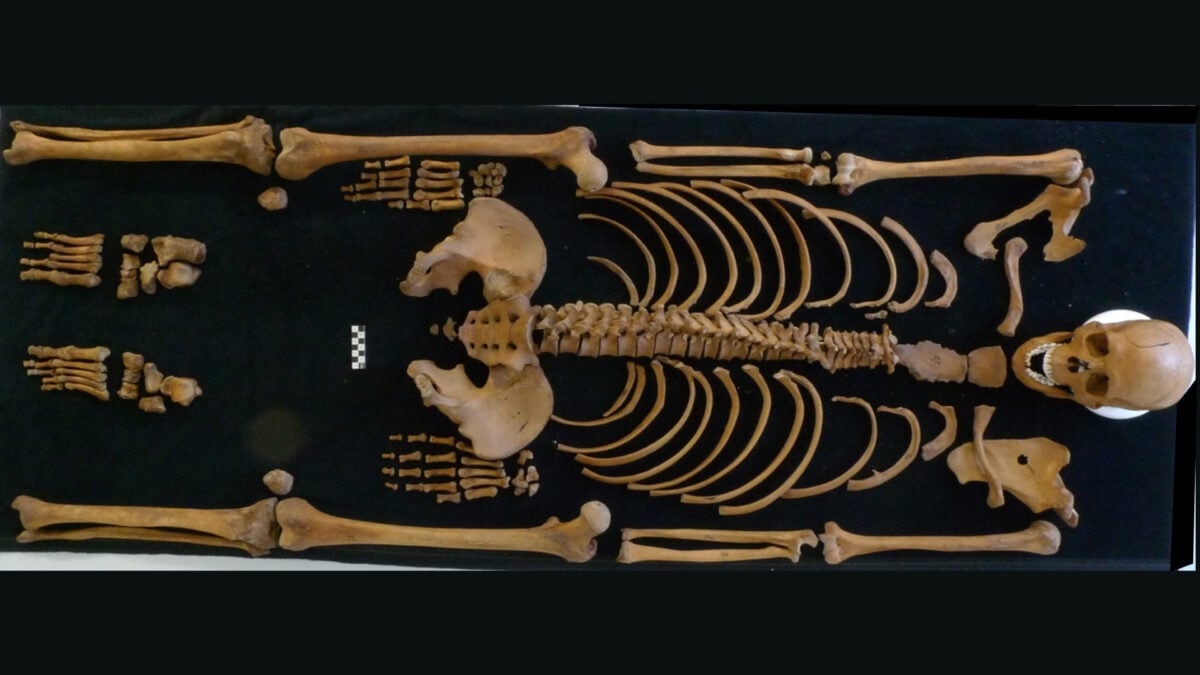
Around 2,000 years ago, a Roman soldier, presumably off duty, was stabbed to death. His body lay on the ground for a while and was eventually chucked down a well with broken weapons. Then, for good measure, someone—who must have really disliked this guy—threw in 165 pounds (75 kilograms) of millstones and a stick. An illustration depicting the placement of the man’s body in the well. Credit: Fred Marschall When archaeologists uncovered his remains in 1977, they were understandably stunned—just what had gone on here? Initial research linked his death with the Frisian revolt in 28 CE, which didn’t seem right to Mark Driessen and Carol van Driel-Murray, both archaeologists at Leiden University in the Netherlands. So, the pair reopened this ancient murder mystery, inviting experts in archaeology, history, and forensics to chip in—a collection that’s now available in the book the pair edited, Victims of Violence from the Early Roman Fort Velsen 1. After considering new evidence, the researchers now believe it is unlikely that the Roman soldier was killed in the tax revolt and was likely the victim of unusually cruel interpersonal violence. In a joint comment to Gizmodo, Driessen and Van Driel-Murray explained that the goal was to compile the evidence and present a “multiple-scenario approach” as opposed to a single theory on how the “murder” unfolded. As a result, the book doesn’t subscribe to a specific theory. However, the fresh round of research both revealed new data and provided a detailed assessment of each scenario, they explained. “At the end we brought it together in the six-scenario approach,” Driessen and Van Driel-Murray added. “This was too much for a normal article and thus was decided for a multi-author book.” The case file Here’s a basic profile of the man, as per the researchers. He was roughly 6 feet 3 inches (190 centimeters) tall and in his mid-twenties. At the (presumed) time of death, he was dressed in a Roman soldier’s “off-duty attire,” consisting of a patched belt set and dagger, a fine dagger sheath, a closed military cloak pin, one sandal, and a signet ring. According to chemical isotope analysis, it’s likely that the man spent his youth in the Mediterranean region. A dagger and sheath retrieved from a well studied in the latest research. Credit: Driessen and Van Driel-Murray, 2026 3D reconstructions of his skeletal remains—with many cuts and punctures—and Roman weapons indicate he was “tortured” and killed with a pugio, or a Roman military dagger—probably the broken one found next to him, the team explained. What’s more, there were pupae of flies found near his body, suggesting that he was left out in the open long enough to attract bugs during the warmer months. An archaeological mismatch Modern technology can extract much more information from human remains than was possible in the 20th century. In a statement from Leiden University on the book, the team explained that the man’s unusual height led archaeologists in the 1980s to believe that he was a member of the Frisii, an ancient tribe that occupied what is now the Netherlands. Then they connected the discovery to classical texts on the tribe’s revolt against Roman taxes in 28 CE—and the theory kind of stuck. A historical illustration depicting events leading up to the Frisian revolt against Romans in 28 CE. © Peter Johann Nepomuk Geiger via Wikimedia Commons “Written sources and archaeological finds often tell different stories,” Van Driel-Murray said in the university statement. For one, the classical texts referenced here actually contradict archaeological samples, which indicate that the Romans occupied the region long after 28 CE, when they allegedly retreated. But that’s not all. Improved dating and analytic techniques allowed researchers to get a much closer look at the wounds on the man’s bones. Forensic pathologists consulted for the study reportedly told the team that the wounds weren’t typical for a “warlike combat situation,” and pointed to a “profound personal anger against the victim.” Images showing punctures to the pelvic bone. Below is a recreation of the dagger. Credit: Courtesy of Mark Driessen For a sense of how severe the wounds were, consider that these experts regularly encounter violence as part of the Dutch national forensics service, the researchers told Gizmodo. Yet even they hadn’t seen “such stabbing wounds before,” the team recounted. Still open, kind of Again, the book doesn’t subscribe to a specific scenario, although it does offer several. One scenario somewhat follows the historical interpretation, that the man was murdered by the Frisii tribe. One theorizes that he deserted his military post, whereas another explores if he was murdered by one or more members of the local population. The team ultimately decided to “leave it open to the readers and future researchers” to decide which scenario they find most compelling. But Driessen and Van Driel-Murray did share their choice in the university statement, namely that fellow soldiers killed the man in retaliation for misconduct. “This was truly a fantastic and challenging research project, not [just] because it gave us the opportunity to work closely together with so many specialists,” the team told Gizmodo. “It is not often that, as an archaeologist, you get so close to a person from the distant past and, in this case, become so deeply moved and connected to the horrible fate this man had to endure.”
Archaeologists Thought This Roman Soldier Was Killed in a Tax Revolt. The Truth May Be Much Worse
Full Article
Original Source
Read the full article at Gizmodo →KhanList aggregates and links to publicly available news content. We do not host full articles from third-party sources. Always verify important information with original sources.