
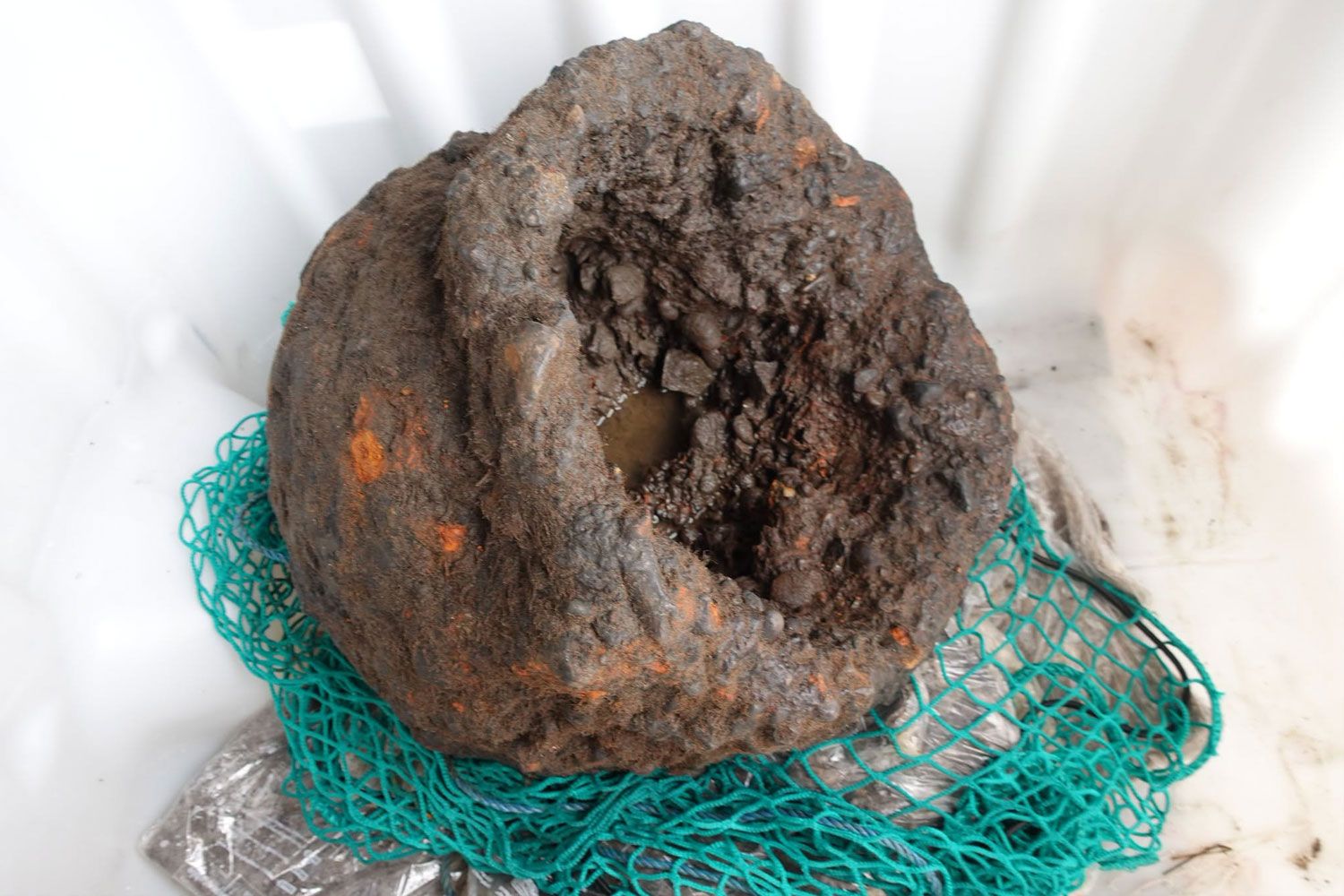
Nobody knows how the three-legged iron cauldron ended up in the River Wear. Weeks before Halloween, it finally returned to the surface October 27, 2026 2:06 p.m. Researchers are examining the cauldron to learn more about its origins. Gary Bankhead When the divers ducked beneath the surface, they knew their target: a mysterious iron cauldron at the bottom of England’s River Wear. They had no idea how the vessel had ended up there, though they were fairly certain it had been underwater for hundreds of years. Their mission was to recover it from the watery darkness and bring it back to the surface. The operation unfolded “like clockwork,” Gary Bankhead, an underwater archaeologist at England’s Durham University, tells the Northern Echo’s Andrew White. “It was very much like a military operation. Everybody had a specific job.” After freeing the artifact from debris, the divers secured it in thick green netting inside a metal cage. Team members on a recovery craft above then slowly pulled it up into the late morning sun. It arrived back on land for the first time in centuries—but just how much time had passed? Researchers have a few loose theories. The three-legged cauldron was found alongside a trove of ancient Roman artifacts, but its design isn’t consistent with the Roman era. Experts’ best guess is that it’s medieval. Their second-best guess is that it dates to the Iron Age. The Wear is located near the city of Sunderland in northern England. In recent years, volunteers investigating the riverbank have discovered roughly 800 Roman whetstones, which soldiers used to sharpen swords and other tools in antiquity, as well as coins and stone anchors. Quick fact: Ancient Roman whetstones Researchers analyzed the sediment layer the whetstones were found in to determine their age, according to a statement from Durham University. The sediment samples dated to between 104 and 238 C.E. Researchers think the site was home to a factory that operated thousands of years ago. England was a Roman province for hundreds of years, beginning in the first century C.E., but Roman-era discoveries are rare in Sunderland. “It is only ten miles or so south of Hadrian’s Wall, so you would expect the Romans to be in Sunderland,” Bankhead told the Guardian’s Mark Brown earlier this year. “But there has been virtually no archaeological evidence.” Bankhead serves as president of the local Vedra Hylton Community Association, which has been leading the recent excavations. He spotted the cauldron while diving in the river in September 2025. Bankhead estimated that the vessel weighed nearly 70 pounds—too heavy for any one diver to lift from the riverbed. For months, he and his colleagues plotted out how they would raise the cauldron safely from the river. The team raised the cauldron onto a boat waiting at the surface. Gary Bankhead That day arrived earlier this month. When the cauldron emerged from the water, Bankhead was “blown away” by its scale, as he tells BBC News’ Pamela Bilalova. “I’d seen it previously underwater, and I estimated how big it was, but when you see it in the daylight, you just marvel at its sheer size.” Next, the team hopes to find out how old the object is. A few days after the recovery, Jemima Cowey, a conservation project manager at York Archaeology, posted an update on LinkedIn: “After a monumental effort from so many different people, the River Wear cauldron has arrived into the York Archaeology conservation facilities for treatment,” she wrote. Experts will need to carefully clean the cauldron, removing deposits that have formed over many years. Next, researchers from Durham University will take X-rays, which may “reveal important features currently concealed from view, including rivets, repairs, decorative elements, manufacturing details and evidence of how the cauldron was constructed,” Bankhead says in a statement. They’ll also look for surviving food deposits, which could allow them to learn what was cooked inside the cauldron—or to use radiocarbon testing to determine its age. The team had been preparing for the recovery for months. Gary Bankhead Bankhead tells the Sunderland Echo’s Neil Fatkin that a cauldron of this kind likely came from a “high-status settlement” or a monastic community. Given its value, the team isn’t sure why the cauldron ended up in the river. As Bankhead says to BBC News’ Bilalova, he wonders whether it played a role in some sort of ritual or offering. The archaeologist hopes that the cauldron will eventually go on display at a museum along with other artifacts discovered nearby. In the meantime, he’s eager to get answers about its origins. “How many people did it feed? What conversations took place around its hearth?” he asks in the statement. “There is perhaps something fitting about the fact that it emerged from the river during the month of Halloween. Having lain hidden beneath the waters of the River Wear for centuries, the cauldron has returned with an air of mystery that seems entirely appropriate for the season.” You Might Also Like Get the latest stories in your inbox every weekday. More about: Ancient Rome Archaeology Artifacts British History Cooking Cool Finds England History Medieval Ages Mysteries Roman Empire
Divers Recover a Mysterious Cauldron That Had Been Hiding at the Bottom of an English River for Hundreds of Years
Full Article
Original Source
Read the full article at Smithsonianmag →KhanList aggregates and links to publicly available news content. We do not host full articles from third-party sources. Always verify important information with original sources.