
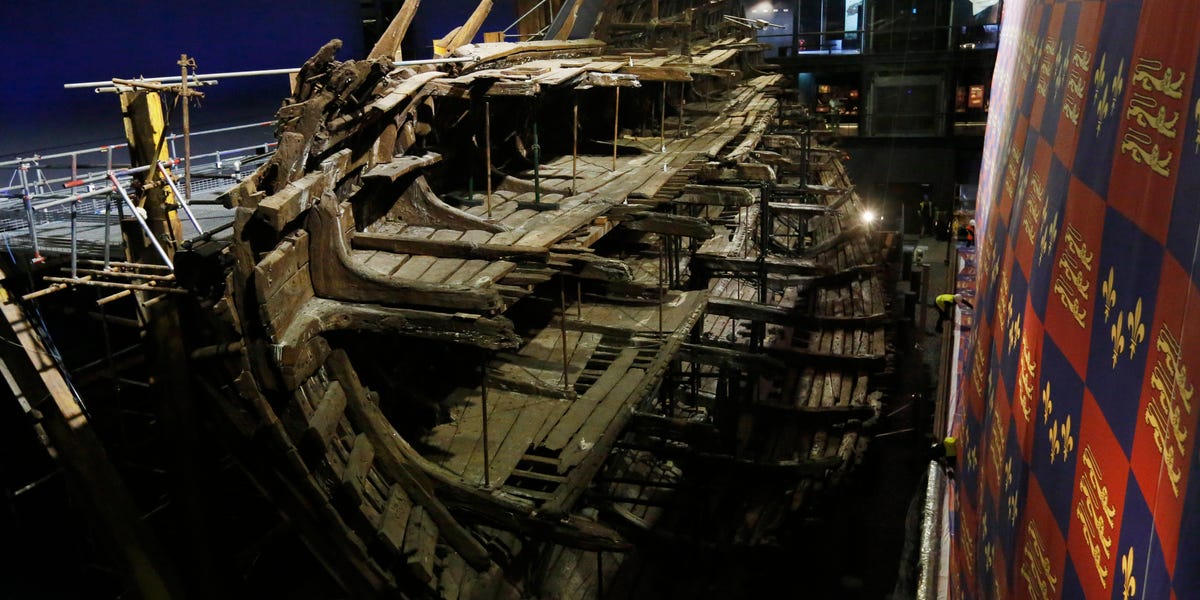
4 min readHere’s what you’ll learn when you read this story:More than 400 years after the famous Mary Rose sank outside Portsmouth, an impressive effort retrieved the ship.The Mary Rose was a warship commissioned by Henry VIII and a key precursor to the British Royal Navy.Recovery of more than 8,000 Tudor-era weapon artifacts from the sunken ship set a record. For 34 years, the Mary Rose was the pride of Henry VIII’s fleet. Then, in 1545, one ill-conceived maneuver doomed the 600-ton warship, sinking it in the Solent strait outside Portsmouth as the Tudor king watched from shore. Raising the Mary Rose from the seafloor would take more than 400 years—and yield record-setting discoveries.The Mary Rose is now the centerpiece of a museum at the Portsmouth Historic Dockyard—the very place where the ship was built. But getting it from the bottom of the Solent to that museum floor was a painstaking process that spanned generations.Henry VIII commissioned the Mary Rose in 1510 alongside its sister ship, the Peter Pomegranate. Both vessels were named for saints and Tudor royal symbols—Mary Rose for Saint Mary and a House of Tudor emblem, and Peter Pomegranate for Saint Peter and another royal symbol. According to the Mary Rose Trust, Henry VIII favored the larger of the two ships, deploying the Mary Rose in multiple battles over its 34-year career before its demise in 1545.During the Italian War of 1542-1546, Henry VIII launched a military campaign in France, and the French retaliated by attacking Portsmouth, the base of Henry’s navy. The French arrived at the nearby Isle of Wight in July 1545 with over 200 ships and 30,000 soldiers, dwarfing the 80 ships in the English fleet.Early in the fighting, the Mary Rose made its move in the Solent waters between Portsmouth and the Isle of Wight, firing guns on one side before attempting a quick maneuver to turn to fire guns from the opposite side of the ship. During this maneuver—aided by a strong wind—the open gun ports flooded, sinking the Mary Rose and taking all but roughly 40 of the 500-person crew down with it.Francois van der Delft, Imperial ambassador and eyewitness, reportedly wrote in code that the ship had foundered “through misfortune and carelessness.”Despite the loss, the British successfully defended the port from the French. Eventually, they hired a team of Venetian salvage operators to run cables under the shipwreck and use two other ships (the Sampson and the Jesus of Lübek) to pull it up. However, they succeeded only in breaking off the ship’s masts, and were fired from the job. The Mary Rose was eventually abandoned.The next time the Mary Rose hit the public consciousness was June 1836, when a fisherman snagged nets on the seabed. Divers investigated and pulled timbers and a bronze gun to the surface. The site was identified as the wreck of the Mary Rose and while guns were salvaged at the time, the ship was again forgotten and left mired in the muck.In 1965, Alexander McKee began investigating wrecks in the Solent, and while searching in the Navy’s Hydrographic Department, he discovered a chart from 1841 revealing the location of three historic wrecks, including the Mary Rose. Using side-scanning sonar and sub-bottom profiling, a team of divers, archaeologists, engineers, and scientists found the W-shaped ship beneath the seabed and eventually raised it. Dredgers, water jets, and airlifts aided the team in excavating and recovering stray pieces of timber. In 1970, they brought up a wrought-iron gun. By 1971, divers found multiple ship frames—one about 100 feet long with planking—which confirmed they’d discovered the Mary Rose. It wasn’t until Oct. 11, 1982, that the Mary Rose finally rose from the sea.Experts chose to excavate the ship and then recover the empty hull. In March 1979, the salvage vessel Sleipner moored on site, housing hundreds of divers working to use their hands, trowels, and even paintbrushes to remove silt from the ship and artifacts. Raised artifacts and timbers were painstakingly logged during the multi-year process.Through 28,000 dives and decades of research, the team brought up 19,000 artifacts and found 179 partial or complete remains of fallen crew. The discoveries resulted in a Guinness World Record for the most medieval weaponry recovered from a shipwreck—more than 8,300 weapons, ordnances, and affiliated artifacts were salvaged, including 10 bronze guns, nine iron swivel guns, five handgun stocks, eight gun-shields, four pieces of cast-iron hail shot, 44 linstocks for lighting gunpowder, three incendiary arts, 172 longbows, nearly 4,000 arrows, 65 ballock daggers, one rondel dagger, 177 chain-mail links, and a single complete basket-hilted sword.Finally pulling the hull of the Mary Rose from the seafloor required a purpose-built lifting crane attached by wires to steel bolts passing through the hull at selected points. A tubular lifting frame was set in place over the wreck, supported by four legs embedded in the seabed. Hydraulic jacks on the frame raised the hull a few centimeters to reduce the suction effect of the silt. Then, the lifting frame attached to a hook on the crane barge Tog Mor pulled up the Mary Rose, placing it in a bespoke steel cradle. Towed to shore and dried, the ship now sits on display in the very dockyard where it was built over 470 years ago.Tim Newcomb is a journalist based in the Pacific Northwest. He covers stadiums, sneakers, gear, infrastructure, and more for a variety of publications, including Popular Mechanics. His favorite interviews have included sit-downs with Roger Federer in Switzerland, Kobe Bryant in Los Angeles, and Tinker Hatfield in Portland.
Archaeologists Recovered Henry VIII’s 400-Year-Old Lost Warship. What They Found Was Staggering.
Full Article
Original Source
Read the full article at Popularmechanics →KhanList aggregates and links to publicly available news content. We do not host full articles from third-party sources. Always verify important information with original sources.