
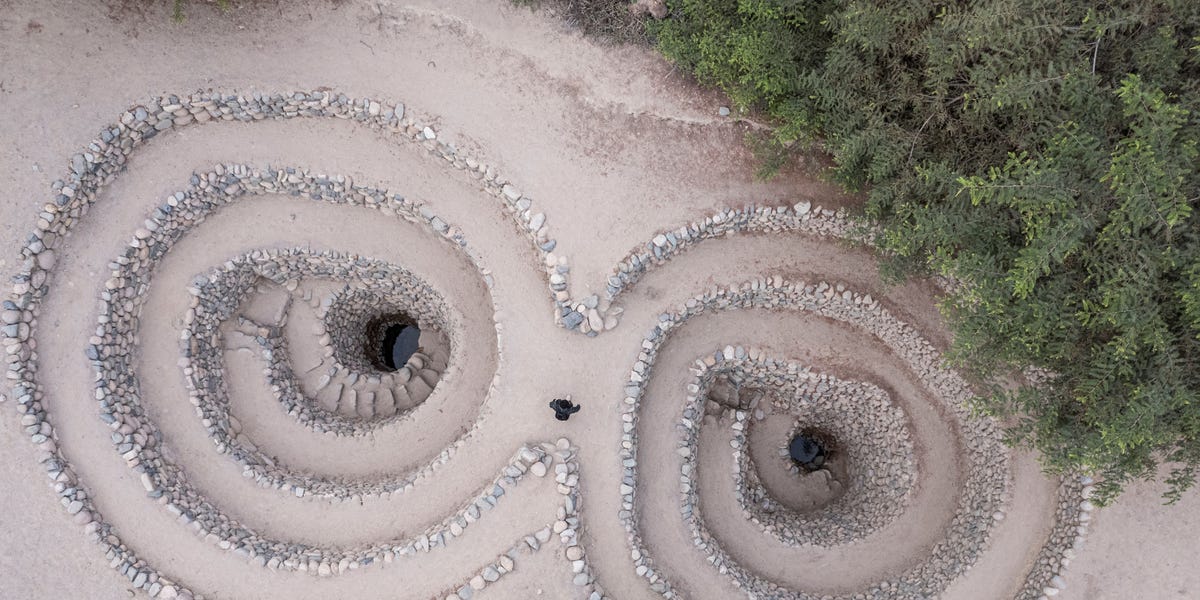
3 min readHere’s what you’ll learn when you read this story:Strange holes built in spiral shape sin Peru’s Nasca region have puzzled researchers for centuries. It took satellite imagery to help sort out the reason they exist—and how long they’ve been there.Researchers believe the spiraling holes were a clever strategy for sourcing year-round water in a region prone to droughts that last months, if not years. The Nasca region of Peru has puzzled scientists for as long as they’ve studied the site. Along with the famous geometric Nasca lines, the desert environment features funnel-like spiraling holes known as puquios. For centuries, nobody knew what the puquios were for. Or who made them. Or when.First discovered in the early 1600s, these spiraling holes pepper the dry region of Peru, which suffers intense drought for months, if not years, at a time. How pre-Hispanic populations lived there baffled researchers, but after some bird’s-eye research using satellite imagery, the puquios may provide a proper explanation.Rosa Lasaponara (from the Institute of Methodologies for Environmental Analysis in Italy) and her team wrote a chapter in the book Ancient Nasca World that helped solve the mystery. “The problem of drought was solved by the ancient Nasca by devising the puquios that are sophisticated hydraulic systems constructed to retrieve water from the underground aquifers,” they wrote.The satellite imaging used by the team showed how the puquios, which were positioned close to settlements, served as year-round water reservoirs that made habitation possible in the arid region. “The development of puquios made possible the transformation of one of the most arid areas of the world into ‘a green garden’ densely settled as archaeological evidence clearly testify,” Lasaponara wrote.There’s no way to carbon date the environmental structures, so the age of the puquios is slightly unclear. The team wrote that the puquios likely came from the people who lived there from 1000 B.C.E. to 750 C.E, but other research has suggested they’re likely from the middle period of the Nasca culture, around 500 C.E. Regardless, the construction of the spiraling holes is a revelatory feat for any ancient time period. “The construction of the puquios involved the use of particularly specialized technology,” wrote Lasaponara. “What is really impressive is the great efforts, organization, and cooperation required for their construction and regular maintenance.”The sophisticated systems retrieved water from underground aquifers via wells lined with small stones, which were formed together using waterproof clay. Underground canals modified the natural course of the water located deep underground throughout the year, and pebbles filtered the water as it diverted from valley rivers during the rainy season. Sometimes, the canals were purposefully shaped to slow the flow of the water toward the public reservoir.The puquios served—as described by the BBC in 2016— as the corkscrew-shaped chimneys of the tunnels, both to provide oxygen to the flowing water and to introduce wind into the tunnel to help keep the water flowing. “To assure the subsistence for agriculture and domestic use, the retrieval of water from an alternative source is mandatory,” Lasaponara wrote.Even though they’re centuries old, there are still some active puquios, including 29 in the Nasca Valley. Shockingly, some still function as they seem to have originally been intended. “The puquios were the most ambitious hydraulic project in the Nasca area and made water available for the whole year, not only for agriculture and irrigation but also for domestic needs,” wrote Lasaponara.“Over the centuries, the scarcity of water has propelled technical innovations and social transformations, and water was, has been, and remains the mainspring of civilization,” wrote Lasaponara. “So, water shortages were, have been, and are an engine of human innovation.”Tim Newcomb is a journalist based in the Pacific Northwest. He covers stadiums, sneakers, gear, infrastructure, and more for a variety of publications, including Popular Mechanics. His favorite interviews have included sit-downs with Roger Federer in Switzerland, Kobe Bryant in Los Angeles, and Tinker Hatfield in Portland.
Scientists Think They’ve Found the Reason for These Ancient Spiraling Holes
Full Article
Original Source
Read the full article at Popularmechanics →KhanList aggregates and links to publicly available news content. We do not host full articles from third-party sources. Always verify important information with original sources.