
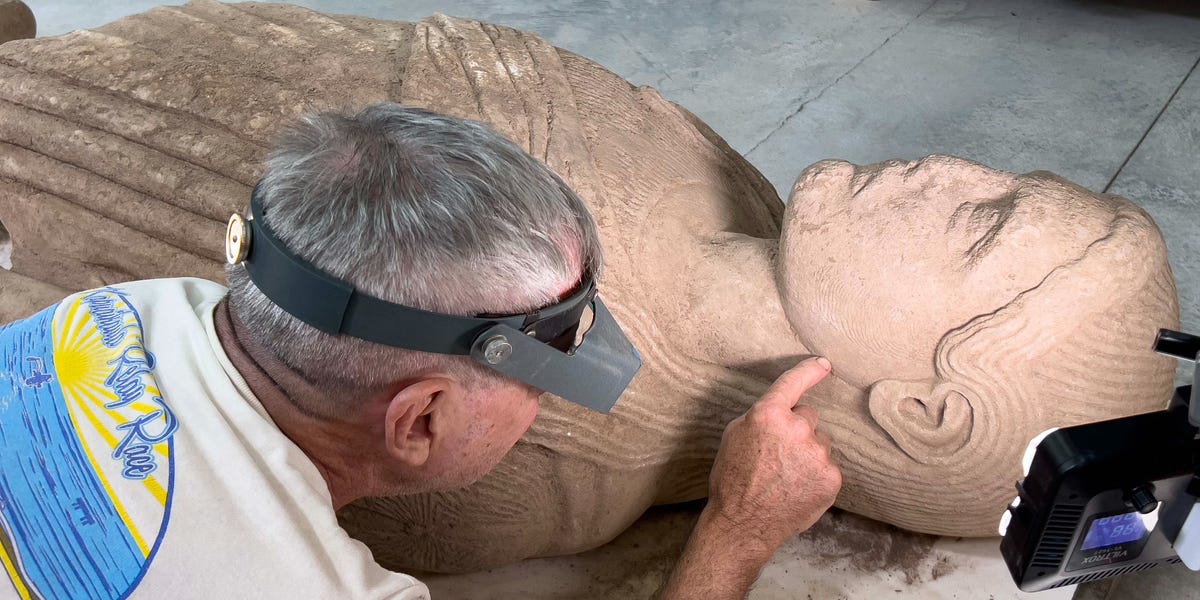
4 min readHere’s what you’ll learn when you read this story:Excavations in Sardis revealed a seven-foot-tall statue that was reused as road pavement. Sardis was the capital of the Lydian Empire—a powerful cultural center during the Iron Age.The statue’s origins remain a mystery because it’s been difficult for experts to date the style of the design. One resident of Sardis—the capital of the Iron Age Lydian Empire—was so important that he seems to have commissioned a seven-foot-tall statue of himself. However, much like the Lydian Empire, that prominence didn’t last forever. During a recent archaeological excavation that was part of the Harvard-Cornell Archaeological Exploration of Sardis, the statue was discovered lying face-down and broken in two just beneath the surface of an ancient Roman road. Clearly, the 2,500-year-old statue had been used to help pave a major Roman avenue.“It is very rare to find such monumental sculpture of this period anywhere in the Mediterranean, and this exceptionally well-preserved, unique monument casts important new light on the major arts of Lydia and on the Lydians’ ties to their own past,” said Nicholas Cahill, professor of Greek and Roman art and archaeology at the University of Wisconsin-Madison, according to the Harvard Gazette.Named a UNESCO World Heritage site last year, Sardis has so far produced finds that include a temple of Artemis, a luxurious synagogue, churches, villas, shops, workshops, and an Imperial bath-gymnasium complex. Now, experts can add a face-down statue to the list.Once the team realized what they had, careful excavation took place, which revealed information about the piece in slow bursts. “Then the guesswork started,” said Susanne Ebbinghaus, a curator at Harvard Art Museums. “Is this archaic? Maybe not, it looks a little later. Is it a guy? Is it a girl? When they started clearing the soil around the head, we saw he had sideburns, so that question was settled.”The statue once stood over seven feet tall, and depicts a figure clothed in a diagonally wrapped tunic with horizontal folds. Bahadir Yildirim, from the Harvard Art Museum, said the design is distinctive among ancient sculptures. “The surprising thing about this piece is that it has some features that haven’t been seen on a sculpture like that,” he said. “The drapery underneath, the distinctive horizontal patterning.”Experts said the upright stance, long hair, and tunic resemble Greek sculptures from the sixth century, but the highlighting of anatomical details (such as prominent veins) aligns more closely to an earlier period, likely the 470s to 450s B.C.E. At that point, Sardis was a Persian city, but the statue has no recognizably Persian traits.Another puzzling fact: the portrayal of clothing, which differed across cultures. The Greeks were known to sculpt men naked, while the Lydians dressed their figures. Yet the clothing portrayed doesn’t match the estimated period of the sculpture’s creation. “This sculptor knows about contemporary styles in Mediterranean and Anatolian sculptures, the interest in hands and the structure of the face and so forth, and yet [the statue is] wearing clothes from 100 years earlier,” Cahill said. “I think they’re very clearly looking back to their own past.”Teams continue to analyze the statue, and also have plans to analyze any flecks of paint preserved from the cleaning, hoping to eke out additional details about its history.The Lydian Empire controlled what’s now western Turkey from the middle of the seventh century to the middle of the sixth century B.C.E. The history of the empire, though, often comes from later writings—typically from the Greeks, Romans, and other Europeans. While not always portrayed in a glowing light by its enemies, the Lydian Empire was wealthy: it’s credited with the invention of the world’s first coins, and it played a significant role in the regional trade of perfumes and fine clothing.The well-to-do city of Sardis was home to monumental terraces, houses, and even a gold refinery. After the fall of the Lydian Empire, Sardis served as a regional capital of Anatolia and remained an important city during the Hellenistic, Roman, and Byzantine periods.Just whom the statue depicted—or where it once towered—was unfortunately lost to history once road builders used it as a paving stone, but the Harvard experts surmise it may have come from the sanctuary of Cybele. While that site hasn’t yet been found, historical documents tell of the sanctuary serving as a place where high-status individuals erected statues of themselves so that they could worship the goddess Cybele indefinitely.“You put yourself in a prominent place where your fellow citizens or subjects can see you, but also you are indeed worshiping the god—and if you’re a ruler, drawing legitimization from the relationship to that deity,” Ebbinghaus said. “So, it might well have been an important person being represented.”Tim Newcomb is a journalist based in the Pacific Northwest. He covers stadiums, sneakers, gear, infrastructure, and more for a variety of publications, including Popular Mechanics. His favorite interviews have included sit-downs with Roger Federer in Switzerland, Kobe Bryant in Los Angeles, and Tinker Hatfield in Portland.
Archaeologists Found a Mysterious 7-Foot Statue Buried Face Down in an Ancient Roman Road
Full Article
Original Source
Read the full article at Popularmechanics →KhanList aggregates and links to publicly available news content. We do not host full articles from third-party sources. Always verify important information with original sources.