
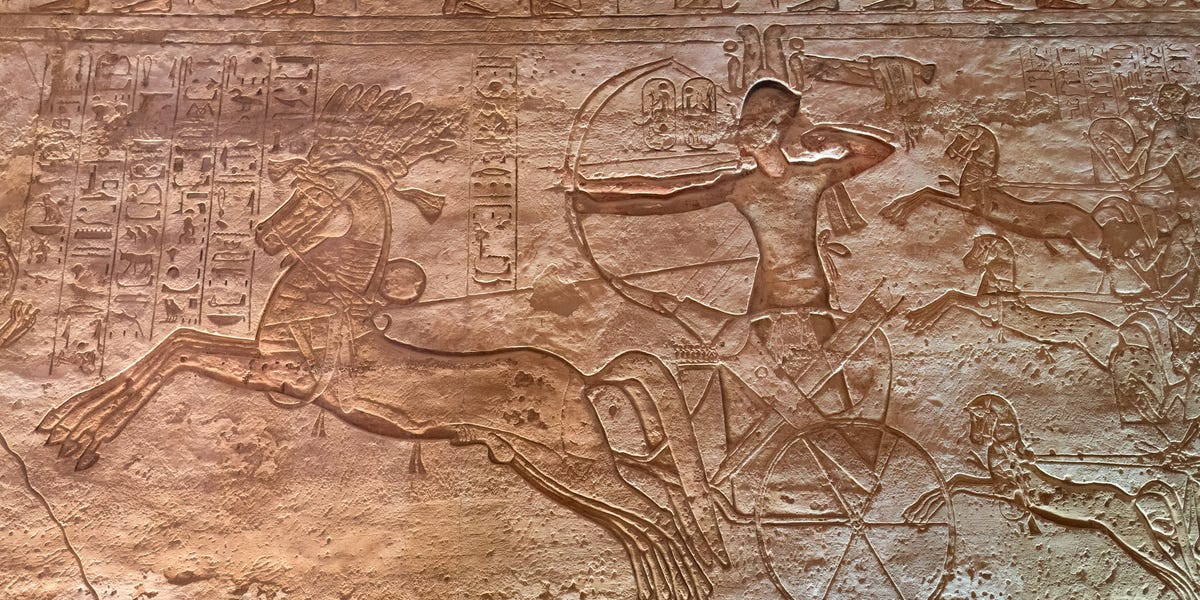
At a site now known as Tell Al-Abquain in Egypt’s Beheira Governorate, ruins of mud brick houses and other remnants from 3,200 years ago are scattered around an area that used to be an ancient fortress. In its day, it appears to have been a flourishing society. Along with weapons and barracks for the soldiers, archaeologists have uncovered what is left of grain silos, wells, and pottery ovens that also baked bread, a reminder of what daily life was like during the New Kingdom. Something unexpected had also been buried among these artifacts.As archaeologists were excavating the fortress, they unearthed the intact skeleton of what appeared to be a warhorse. Whomever the young male horse had belonged to must have been a military official of high rank, as the horse had been buried with honor, still wearing its alabaster and limestone chariot harness. Even in death, the horse had been positioned as if it was galloping into battle, further indicating elaborate funeral rites at the time. Most likely used to pull war chariots similar to those interred with Tutankhamun, who ruled as pharaoh during the same time period, the horse is thought to have been bred for fighting. Preliminary studies led by Mohamed Abdel-Badie, head of the Egyptian Antiquities Sector at the Supreme Council of Antiquities, found it to be a medium breed whose strengths were the speed and agility needed for war.“Among the most significant findings of the excavations was the complete animal burial of a young male horse,” the Egyptian Ministry of Tourism and Antiquities said in a recent press release, adding that “This breed is likely used for training, military activities, or pulling chariots during the New Kingdom. The horse's complete body position, the direction of its head, and the regularity of the burial suggest a deliberate and organized burial, likely a ceremonial one.”Who the horse belonged to is unknown. Thought to have crossed over into Egypt form the Levant with the Hyksos at the dawn of the New Kingdom, domestic horses were usually a luxury reserved for pulling chariots or carrying pharaohs. Most of what is known about the Egyptians’ relationship with horses is depicted on stelae, tomb murals, and temple wall hieroglyphics, but few actual remains of warhorses have been found. Most horses that appear in temple and tomb murals are decorated with military regalia and as they pull chariots carrying archers. These chariots were modified versions of heavier Levantine models. With the advantage of chariots that were lighter and faster than their predecessors, there are few existing images of riders, though some New Kingdom depictions that suggest riding survive.Tell Al-Abquain arose to protect Egypt’s western border as a defense from the Libyans and Sea Peoples. This is the same fortress that revealed a bronze sword inscribed with the cartouche of legendary pharaoh Ramesses II. Faience scarabs and a bronze ring, engraved with the names of deities, along with necklaces strung with beads of faience and carnelian in the shape of pomegranate blossoms, may have also belonged to him. Horses often accompanied royals and became a symbol of royal power. In the retelling of the Battle of Kadesh, in which Ramesses II prevailed against the Hittites, the names of his horses are mentioned: “Victory-in-Thebes” was named for the capital city of Egypt then, and “Mut is content” revered the mother goddess Mut. This is just one example of how highly regarded horses were in Egypt.Ramesses himself is said to have had 24,000 horses in his army. Other kings such as Thutmose III and Amenhotep II are pictured riding gloriously into battle, often compared to gods, and some, such as Amenhotep II and Tutankhamun were buried with their chariots. While they were associated with royalty, especially in royal propaganda that emphasized the king as a fierce warrior, horses were not exclusive. New Kingdom elites such as the royal family and high officials also owned horses and chariots. One relief shows the sons of Ramesses II riding, and horses in another transport Queen Nefertiti and the royal princesses of Amarna. Some officials were given titles such as “Master of Horses” or “Stable Master” to emphasize their rank. The burial of this warhorse is a reminder of how valued the animals were in Egyptain society.Also discovered at the site were more artifacts to add to the trove that had been exposed in the last excavation—jewelry, amulets, looms, and pottery vessels in the image of everything from lotus flowers to fish and baboons. Some were covered in sculpted crocodile scales. The archaeological team even came upon kernels of unhusked grain, which had stayed intact for millennia in the shadows of crop warehouses. Fragments of limestone stelae also memorialized events and royal figures. Carved into one is a prisoner of war, possibly a Libyan, bound and bent in submission. The others glorify Ramses II with his multiple names and liken his son Merneptah to the formidable god Seth.“This discovery adds a new dimension to understanding the system of military fortifications established by the ancient Egyptians to protect the country's borders,” stated Sherif Fathy, Minister of Tourism and Antiquities. “The residential structures, storage facilities, and diverse artifacts uncovered by the mission provide a comprehensive picture that extends beyond the military aspect of the fortress.”Elizabeth Rayne is a creature who writes. Her work has appeared in Popular Mechanics, Ars Technica, SYFY WIRE, Space.com, Live Science, Den of Geek, Forbidden Futures and Collective Tales. She lurks right outside New York City with her parrot, Lestat. When not writing, she can be found drawing, playing the piano or shapeshifting.
Archaeologists Found a 3,200-Year-Old Warhorse—Buried as If It Were Still Charging Into Battle
Full Article
Original Source
Read the full article at Popularmechanics →KhanList aggregates and links to publicly available news content. We do not host full articles from third-party sources. Always verify important information with original sources.