
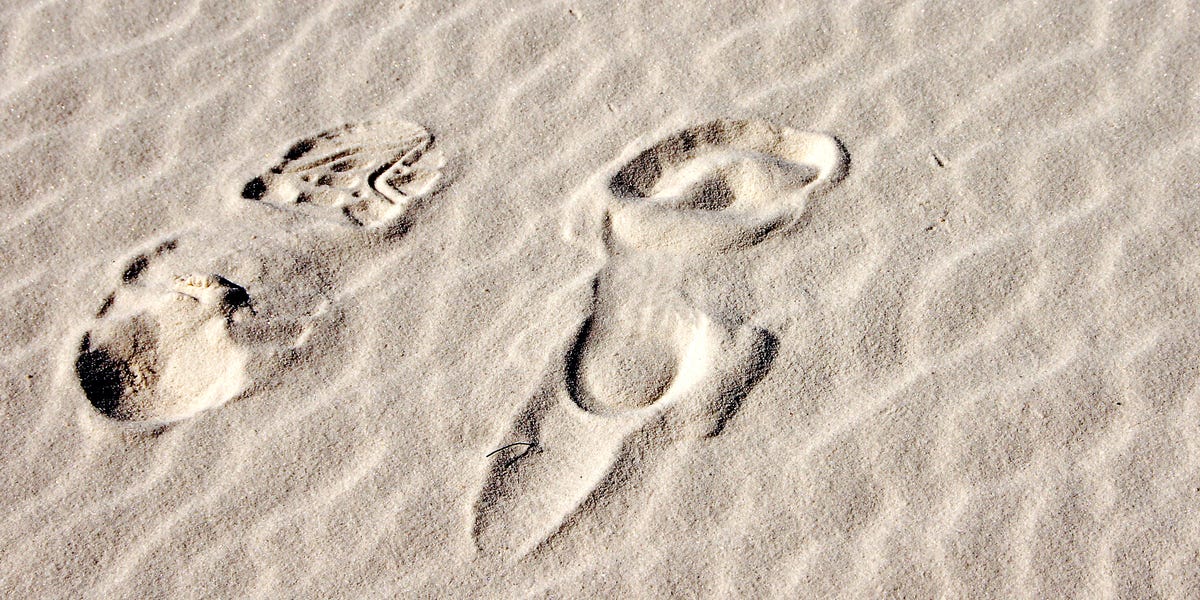
The ancient human population that traversed what is now White Sands National Park in New Mexico encountered a shockingly different environment when they were there between 23,500 and 21,700 years ago.Back in the present, the same research team that pioneered the dating of preserved footprints in the sand in 2021 took the study a step further, analyzing the sediment surrounding the prints to discover a rapidly changing environment, one the team called “an abrupt environmental change at White Sands,” in a new study published in Science Advances.By analyzing 20 stratigraphic horizons with in situ human footprints, megafaunal trackways, and linear features created by historic wheels, the team used radiocarbon dating of conifer pollen, combined with ages of aquatic seeds, to refine their dating timeline. Researchers believe the evidence indicates a “complete overturning of the environment from a perennial lake to a playa [dry lake bed]” from the height of the ice age.“This well-dated and highly resolved paleoclimate record,” the study authors wrote, “provides compelling evidence that humans in North America experienced marked environmental changes during the Last Glacial Maximum.”The researchers now believe that their data, published in both the new Science Advances study on climate and a Fossil Studies study on the footprint record, not only strengthens the dating of the footprints but provides snapshots of life around the lake through information on temperature and rainfall. “Together, these allowed us to reconstruct the landscape through which people were walking,” researchers Matthew Bennett and Sally Reynolds wrote in a post published by The Conversation.Lake Otero occupied much of the basin at the start of the timeline, with the mountains around it full of conifer forests and temperatures about 4 degrees Celsius colder than today. Then temperatures began to rise; the lake shrunk, forests declined, and oak and sagebrush crept in. “As a result of this warming, the basin became progressively drier as evaporation increased,” they wrote. “Superimposed upon this longer-term change were much sharper climate swings.”A drought impacted things heavily and “this dry period coincides with a rapid climatic change recorded thousands of miles away in Greenland ice cores.” The earliest footprints occur around the climatic transition, with footprints continuing at intervals as the lake retreated. “Our new evidence therefore shows that people visited this landscape repeatedly while experiencing substantial environmental change,” the team wrote.The researchers used agent-based computer modeling to explore what the footprints represent in human movement, revealing complex behavior patterns. “Our virtual world consisted of people moving around a fluctuating lake,” the team wrote. “When they crossed mud, they left footprints. Those footprints gradually disappeared unless changing water levels crated the right conditions for them to be buried and preserved.”In other words, sometimes human activity around the lake left virtually no fossil record, and other times, plenty of preserved footprints remained. “The footprint surfaces occur as irregular pulses that tend to cluster around periods of climatic and hydrological change—just the pattern predicted by the model,” the team wrote.That data now gives a much fuller view of ancient human history and some of the oldest in North America.Tim Newcomb is a journalist based in the Pacific Northwest. He covers stadiums, sneakers, gear, infrastructure, and more for a variety of publications, including Popular Mechanics. His favorite interviews have included sit-downs with Roger Federer in Switzerland, Kobe Bryant in Los Angeles, and Tinker Hatfield in Portland.
Scientists Studied 23,000-Year-Old Human Footprints—and Reconstructed a Lost World Around Them
Full Article
Original Source
Read the full article at Popularmechanics →KhanList aggregates and links to publicly available news content. We do not host full articles from third-party sources. Always verify important information with original sources.