
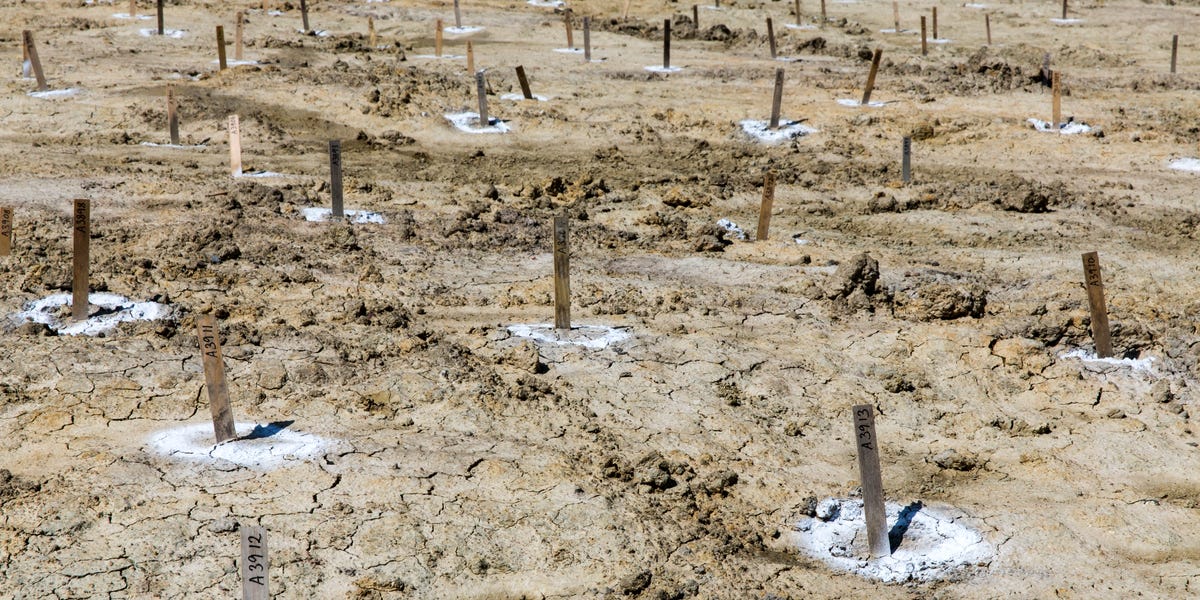
3 min readArchaeologists sifting through portions of Denmark’s western peninsula ahead of a highway expansion keep uncovering remnants of the area’s past, often in small snapshots: a grave here, an axe there, or maybe sometimes even the foundation of an ancient home. They certainly weren’t expecting to find the remains of battle lines in West Jutland, indicating a conflict they didn’t know ever transpired.“The find came as a complete surprise to us,” Michael Alrø Jensen, curator at Museum Vest, said in a translated statement. “It points to previously unknown conflicts in West Jutland dating back to the earliest part of the Iron Age.”The find showed up via a 2,500-year-old line of pits, which experts believe fighters created during the Iron Age to block hostile incursions along an ancient West Jutland thoroughfare. The discovery came as archaeologists from the museum examined fields along Route 11, between Varde and Korskro, before the Danish Road Directorate began a highway expansion.Experts dubbed the battle lines, which were found beneath a field near Schaefergården, a “post-hole alignment,” likely from around 500 B.C.E. The lines feature a long series of closely spaced holes in which one end of pointed wooden posts were buried to form a defensive palisade.“Our best theory is that there was a fear of an invading army arriving from the north via the ‘Drivvej’ route, and that attempts were therefore made to control and block the passage,” Jensen said.More evidence may still lie buried at the site. Experts note that the current Route 11 alignment between Varde and Korskro matches the ancient “Drivvej,” or Drove Road, that was the main transportation line through West Jutland for centuries. The modern road project adds an additional lane to the two-lane highway and shows how closely the ancient road—whose origin date remains unknown—matches the modern setup.Still, the find raises questions. Archaeologists and historians don’t know who developed the defensive structure—or why. The team hopes that additional work in the area may offer fresh clues about the ancient mystery.Attempts to pinpoint answers to a 2,500-year-old question got a bit muddy as the excavations revealed artifacts from a range of eras in spots that hadn’t been searched previously. Archaeologists now have evidence of human activity along the road from the first Stone Age farmers, who buried their dead in small mounds through the Bronze Age, Iron Age, and into the Viking Age (including the discovery of a 4,500-year-old battle axe buried alongside a Stone Age warrior).“What we are most excited about is that we have found traces from so many different periods within a relatively small area,” Jensen said. “We have suddenly gained a wealth of new pieces that provide much greater insight into how people lived and moved about in this region over several thousand years.”Every new discovery provides nuance to the historical record, whether the remains of a house, farm, or grave. Museum Vest hopes to learn more by excavating additional burial mounds. The various discoveries in the region together form a narrative of humans’ transformation of the land, first into farming plots and then into villages. “Once our work is complete, we hope to be able to offer the local community a more cohesive narrative about the area they live in,” Jensen said.Tim Newcomb is a journalist based in the Pacific Northwest. He covers stadiums, sneakers, gear, infrastructure, and more for a variety of publications, including Popular Mechanics. His favorite interviews have included sit-downs with Roger Federer in Switzerland, Kobe Bryant in Los Angeles, and Tinker Hatfield in Portland.
Archaeologists Found 2,500-Year-Old Battle Lines From a Conflict No One Knew Ever Happened
Full Article
Original Source
Read the full article at Popularmechanics →KhanList aggregates and links to publicly available news content. We do not host full articles from third-party sources. Always verify important information with original sources.