
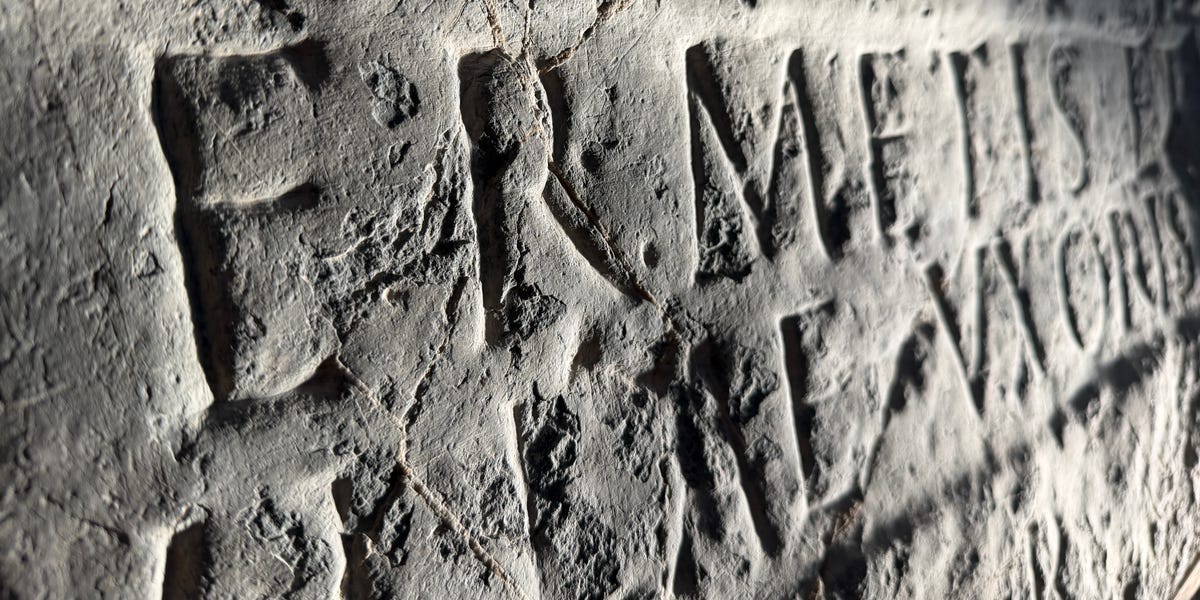
3 min readHere’s what you’ll learn when you read this story:Archaeologists exploring a Spanish cave more than 650 feet underground discovered 120 Latin inscriptions.Translations suggest some of the inscriptions are dedicated to a water goddess known as the Lady. The Roman-era inscriptions—and on-site offerings—suggest a female-led cult.Archaeologists who descended over 650 feet deep into a cave called Cova Dones in Valencia, Spain, uncovered writing with unknown meanings left behind by a Roman-era cult. Roughly 120 Latin inscriptions point to a cult worshipping a water goddess known simply as the Lady.The site was an intriguing find back in 2024, but 2026’s deeper exploration resulted in the discovery of the inscriptions, which tell a fuller story of the site. Deep in the Spanish cave system sits a chamber known as the Roman Sanctuary where a collection of shallow natural pools served as offering sites for the female-led cult to worship the Lady, likely a goddess associated with water.“Preliminary results indicate that Cova Dones was a cave sanctuary frequented by women, as several female names appear among the inscriptions documented so far,” Virginia Barciela, researcher at the University of Alicante, said in a translated statement from the university.The Lady appears in at least five inscriptions, evidence that worshippers weren’t dropping by sporadically but instead returning regularly to participate in a cult devoted to a specific deity. “The fact that the texts are concentrated in a specific, delimited area of the cave—far from the entrance—confirms that this was an organized cult,” said Sergio García-Dils, a professor at UNED-Sevilla and director of the Spanish School of Speleology.“Thanks to five votive inscriptions, we know for certain that during the Roman era, a goddess reverentially referred to as “Domina”—the Lady—was worshiped in the cave, and that women played an active role in her cult,” said Silvia Alfayé Villa, a professor of ancient history at the University of Zaragoza. “Three of the inscriptions bear the name ‘Malaci,’ a previously unrecorded epithet for a goddess who was unknown until now. This goddess held a specific title—perhaps linked to water—the definitive interpretation of which we are currently working on.”The small natural pools on the cave’s floor provided convenient basins for worshippers dropped to drop offerings into. Researchers found rings, a bracelet, chalice-shaped vessels, ceramics, and spindle whorls alongside the inscriptions. The spindle whorls were a distinct find, as the textile-weaving tools were historically associated with females and the examples found in Cova de les Dones, or Cave of the Women, further cement that the cave was so named to represent that women played a crucial role at the site.When it was originally discovered in 2024, archaeologists noted 15 Latin inscriptions and a coin portraying the Emperor Claudius left as an offering, which helped to date the human activity—and inscriptions—at the site to the first and second centuries C.E. But the rest of the inscriptions discovered in 2026 gave the archaeologists a much bigger chunk of history to decipher.“What was known as a Roman sanctuary with around 15 inscriptions has now grown to 120, making it the largest collection of Latin inscriptions known in any cave sanctuary across the entire Roman Empire,” Barciela said. “The combined study of these inscriptions and the preserved archaeological materials will allow for a more precise reconstruction of the ritual practices carried out in this space over the centuries.”Tim Newcomb is a journalist based in the Pacific Northwest. He covers stadiums, sneakers, gear, infrastructure, and more for a variety of publications, including Popular Mechanics. His favorite interviews have included sit-downs with Roger Federer in Switzerland, Kobe Bryant in Los Angeles, and Tinker Hatfield in Portland.
Archaeologists Exploring a Cave Found 120 Mysterious Messages to a Goddess Carved on the Walls
Full Article
Original Source
Read the full article at Popularmechanics →KhanList aggregates and links to publicly available news content. We do not host full articles from third-party sources. Always verify important information with original sources.