
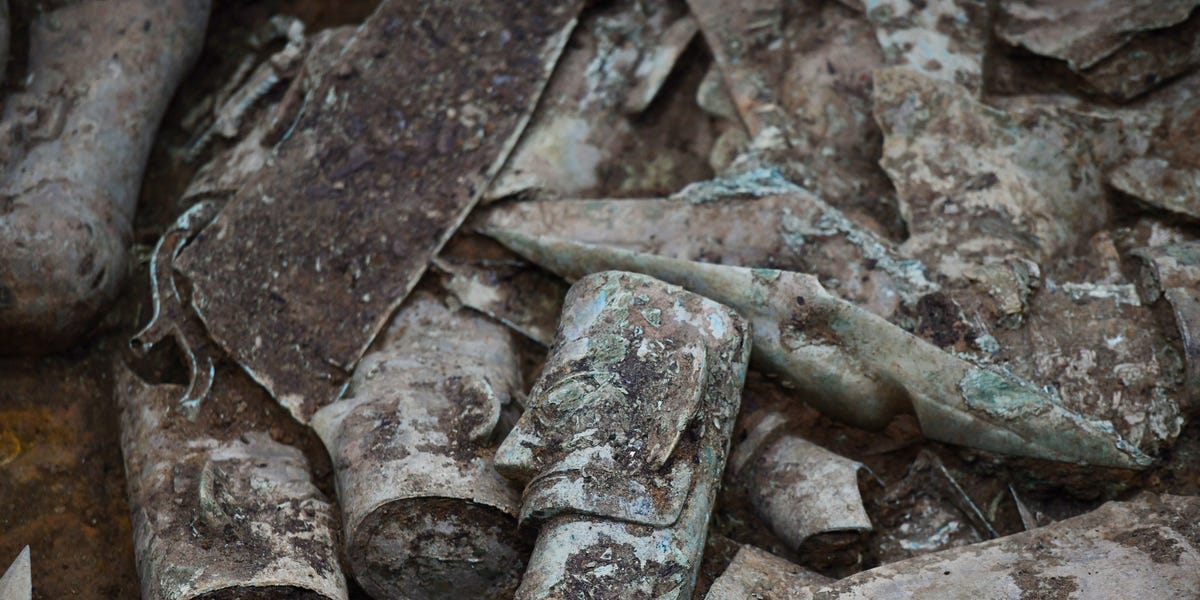
3 min readA farmer’s accidental discovery in 1920s China led to the Sanxingdui archaeological site, revealing ancient sacrificial pits that showed a sophisticated Bronze Age civilization in Sichuan province.Excavations from 2020 to 2022 uncovered over 17,000 artifacts including bronze, jade, and gold in six newly discovered sacrificial pits, providing crucial evidence about ritual practices and social organization.New research suggests Sanxingdui declined as a regional capital while the nearby Jinsha site simultaneously rose in importance, marking a significant shift in power during the Bronze Age kingdom of Shu.It has been nearly a century since the discovery of the Sanxingdui archeological site in contemporary Guanghan, Sichuan, China. It’s often repeated that the site was accidentally stumbled upon by a humble farmer (as archaeological treasures so often tend to be) in either 1927 or 1929. The farmer, whose only goal was to dig a ditch, discovered a trove of jade relics, which then made their way into the hands of collectors before the full scope of the Sanxingdui site was truly understood. Once upon a time, this spot and its sacrificial pits played a significant role in both the kingdom of Shu (1046 B.C.E. to 316 B.C.E.) and in earlier, unknown civilizations.In 2001, another accidental discovery was made about 25 miles away. This time, in lieu of the pastoral, almost providential humble farmer, it was the China Real Estate Development Group that uncovered a drain in Chengdu filled with artifacts, also from the kingdom of Shu. They named this new discovery the Jinsha site, and excavations soon began. Sanxingdui still held many mysteries, but at the dawn of the new millennium, it was Jinsha’s time to bask in the spotlight.A new study suggests this wasn’t the first time Jinsha stole Sanxingdui’s spotlight. The same shift may have played out 3,000 years ago, with Jinsha rising in importance within the kingdom of Shu at the same time that Sanxingdui was declining.The study, published in Archaeological Research in Asia, presents a preliminary analysis of six sacrificial pits first discovered in 2019 at the Sanxingdui site. As these new pits were near previously excavated spots dubbed K1 and K2, both excavated in 1986, the new pits were dubbed K3 through K8. Over two years of excavations, from 2020 to 2022, more than 17,000 objects were uncovered, including “bronze, jade, gold, ivory, elephant tusks, and silk remnants.” While all the pits appeared to be sacrificial in nature, two of them, K5 and K6 “may have been distinct from others.”The difference comes down to how their artifacts were arranged—or weren’t. The other sacrificial pits showed a “careful layering” of artifacts, which “indicates planned and orderly deposition,” suggesting there was a ritualistic meaning behind their placement.However, the artifacts in K5 were indiscriminately scattered, while K6 only featured “two wooden objects and one jade knife” all in a cluster. Along with their different size, this suggests the two pits played a different ritual role.Despite what K5 and K6 might suggest, there’s reason to believe the pits weren’t all dug and used independently of one another. In fact, the study notes that fragments of a figure carrying a ritual vessel called a “zun” on its head were found in pits K2, K3, K7, and K8. These weren’t just fragments of similar sculptures, but rather all parts of the same object, which came together to form “the top tier of a multi-tiered bronze altar.” Because this altar and other objects could be rebuilt from pieces in separate pits, the pits were likely dug and filled during the same period.The time period when these pits were made, the study suggests, was particularly pivotal for the region. “Chronologically,” the study explains, “the Neolithic and Bronze Age remains at the Sanxingdui site can be divided into 8 phases and 13 stages.” The famed sacrificial pits and their artifacts belong to one of the final phases, Phase VII sub-stage 11. Large buildings and walls emerged earlier in Sanxingdui’s history, some appearing as early as 1800 B.C.E., but after the period when the pits were created, those massive structures “were abandoned and no longer functional.” Atop their ruins, more foreboding features like ash pits and tombs were created.“Thus, at the Sanxingdui site,” the study concludes, “the sacrificial area and the sacrificial pits within it mark the turning point between its role as the Shu capital and its later status as an ordinary settlement.” The artifacts found at Jinsha tell an equal and opposite story, however. There, over the course of 3,000 or so years, we start with a small settlement, and then “features related to social stratification began to appear”—just as those features fade away at Sanxingdui. Jinsha was constructing their own large buildings just as Sanxingdui was condemning theirs to oblivion beneath their ashes.Michale Natale is a News Editor for the Hearst Enthusiast Group. As a writer and researcher, he has produced written and audio-visual content for more than fifteen years, spanning historical periods from the dawn of early man to the Golden Age of Hollywood. His stories for the Enthusiast Group have involved coordinating with organizations like the National Parks Service and the Secret Service, and travelling to notable historical sites and archaeological digs, from excavations of America’ earliest colonies to the former homes of Edgar Allan Poe.
Archaeologists Discovered Not One, Not Two, But Six Sacrificial Pits—and the Lost Relics Inside Them
Full Article
Original Source
Read the full article at Popularmechanics →KhanList aggregates and links to publicly available news content. We do not host full articles from third-party sources. Always verify important information with original sources.