
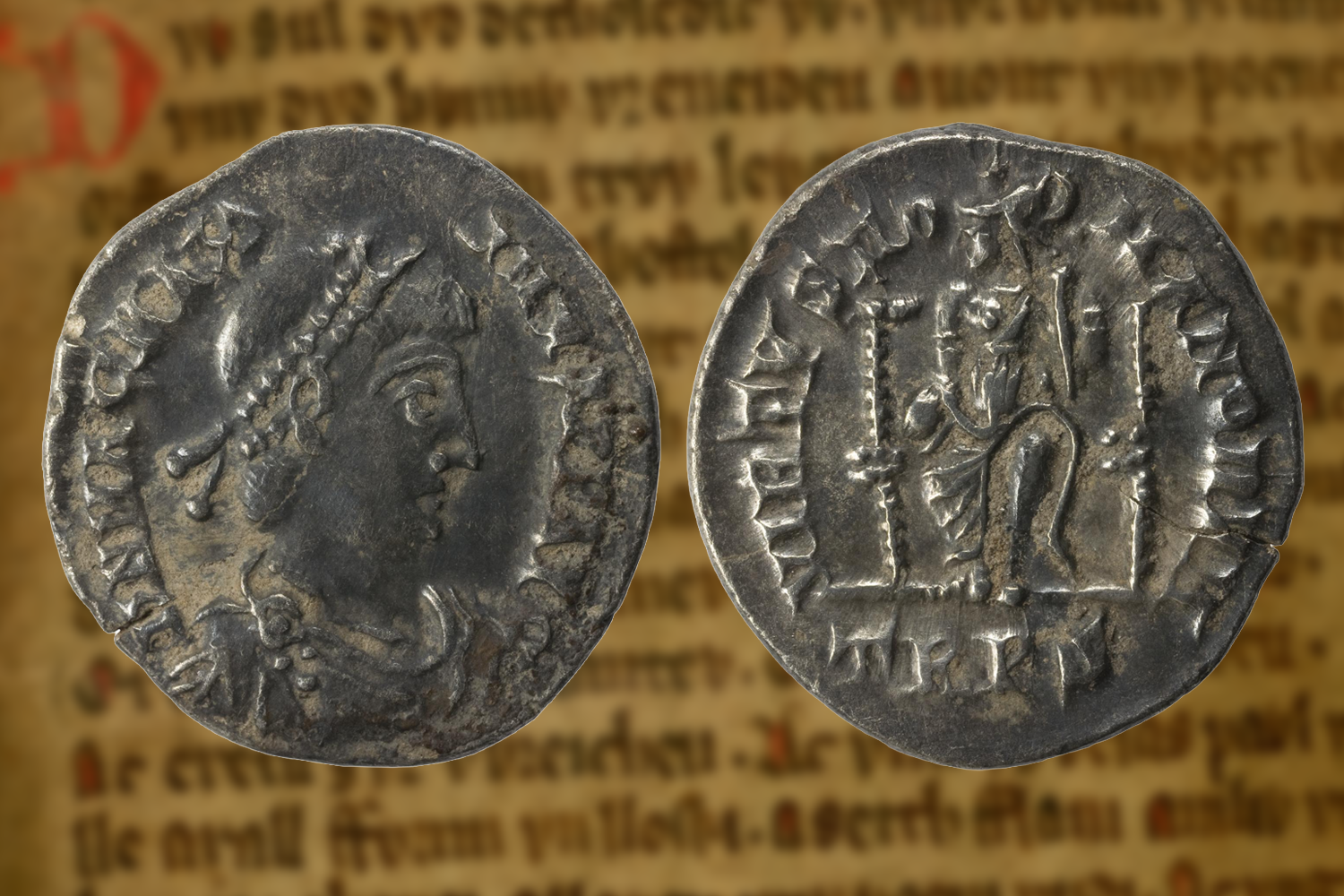
An archaeologist has uncovered an ancient fortification linked to Magnus Maximus, a fourth-century ruler who is immortalized in the medieval “Mabinogion” stories as Macsen Wledig October 16, 2026 2:51 p.m. A coin bearing the likeness of the fourth-century C.E. Western Roman emperor Magnus Maximus, overlaid atop a page from a medieval manuscript of the Mabinogion Portable Antiquities Scheme / British Museum under CC BY-SA 2.0 and Jesus College / Bodleian Library under CC BY 4.0 Welsh folklore tells of a Roman emperor named Macsen Wledig, who was tormented by visions of a beautiful stranger in a faraway land. According to a 19th-century translation of the Mabinogion, a collection of 11 medieval tales, “Except when he slept, he saw nothing of her, for he knew not where in the world she was.” Macsen’s quest to uncover this mystery woman’s identity eventually leads him to the British Isles, where his beloved lives with her family. In return for her hand in marriage, the soon-to-be empress asks Macsen to conquer “the island of Britain for her father, from the Channel to the Irish Sea, together with three adjacent islands.” Macsen eagerly complies, making his way to the top of Frenni Fawr, a peak in what is now Pembrokeshire, Wales. Per the Mabinogion, “There the emperor pitched his tent. And that encamping place is called Cadair Maxen, even to this day.” Historians have long known that this legendary figure was inspired by an actual ancient ruler: Magnus Maximus, a general whose troops proclaimed him Roman emperor in the West in the late fourth century C.E. But the events described in the Mabinogion have largely been consigned to folklore—until now. A coin minted under Magnus Maximus Public domain via Wikimedia Commons As Dalya Alberge reports for the Guardian, an ongoing excavation led by Mark Merrony, an archaeologist at the University of Oxford in England, has unearthed remnants of a Roman fort in Pembrokeshire, including fourth-century coins, an iron stylus, a game piece and fragments of ceramic tiles. The finds bolster Merrony’s argument that the Romans played a greater role in the region’s ancient past than previously believed. “If Magnus Maximus was there, there must have been an army there,” Merrony tells the Guardian. “It’s such a remote area, but the tale mentions the easternmost peak of the Preseli Hills, which is where this site is. The presence of a heavily fortified Roman auxiliary fort may help unlock the mystery of a Mabinogion legend that has endured for nearly 1,700 years.” Merrony stumbled upon the fort while riding his bike in north Pembrokeshire in 2024. “Sticking out of the ground was a triangular piece that looked like a Roman roofing slate,” he told the Pembrokeshire Herald’s Tom Sinclair at the time. “I pulled it up, and lo and behold, it’s an archetypal Roman roofing slate,” with a hexagonal shape and a long point. Early investigations indicate that the stronghold stretched over as many as three hectares, meaning it could have housed around 500 soldiers. The slopes of Frenni Fawr Alan Richards via Wikimedia Commons under CC BY-SA 2.0 In the two years since Merrony’s initial discovery, the archaeologist has conducted a geophysical survey and trial excavations at the site. He and his colleagues had a “breakthrough” in early September, when they found “bases of floor structures built of clay and packed with the remnants of thin stone blocks,” as well as traces of a Roman road, a kiln, flooring consistent with a Roman granary, and assorted artifacts such as pottery shards and a spindle whorl, Merrony writes for the Conversation. The finds support the theory that the site was once home to a timber auxiliary fort. Merrony doesn’t suggest that Maximus himself constructed the fort. Instead, he argues that Sextus Julius Frontinus, a Roman governor of Britain, established it between 74 and 78 C.E. Maximus could have used the site centuries later. “The Roman army were very regimented and always dug a trench around their camp in the shape of a playing card,” Merrony tells the BBC program “Newsround.” “If you’re spending a couple of nights somewhere, it takes an awful lot of effort and labor. But if there’s a fort a couple of miles away that’s clearly visible from the peak of the mountain—which it is and would have been—[Maximus] would have not only been able to see it but would have known about it.” As Merrony writes for the Conversation, “The discovery represents an extraordinary fusion between myth and reality and demonstrates that folklore is often underpinned by fact.” Did you know? An empire divided In the late third century C.E., the Roman emperor Diocletian established a power-sharing system known as the tetrarchy, essentially separating the empire into divisions overseen by different rulers. The East-West split became official in 395 C.E., when the two sons of Theodosius I each inherited one half of the empire. “The ideal was of two parts ruling in harmony,” Mark Humphries, a classicist at Swansea University in Wales, told Live Science’s Joe Phelan in 2022. “That said, there were moments of tension. On occasion, relations could break down.” Maximus was a Spaniard who commanded Roman soldiers in their fight against the Picts and the Scots. In 383 C.E., Maximus’ men named him Western emperor in place of Gratian, the unpopular ruler who officially held the title. Although Gratian attempted to reclaim power, he was no match for Maximus on the field of battle, and the usurper was soon able to solidify his claim to the throne. Maximus set his sights even higher, however, challenging Gratian’s co-emperor, Valentinian II. That’s when Theodosius I, the duo’s counterpart in the east, decided to intervene. Theodosius defeated Maximus, who was captured and executed in 388 C.E. So, how did Maximus become Macsen? The 12th-century English chronicler Geoffrey of Monmouth fictionalized Maximus’ life in his History of the Kings of Britain, which depicts the emperor becoming the Christian king of Britain after marrying a Welsh princess traditionally identified as Elen Luyddog. Maximus’ status as a “Christian Roman Celt” made him “a bridge between the old order in Wales and the new,” the Welsh politician and author Gwynfor Evans wrote in a 1983 essay. “The quite romantic story of Magnus Maximus was transformed by professional Welsh raconteurs, giving Macsen Wledig, emperor of Rome, a place in our legend second only to Arthur.” A page from the White Book of Rhydderch showing the beginning of "The Dream of Macsen Wledig," a tale featured in the Mabinogion Public domain via Wikimedia Commons You Might Also Like Get the latest stories in your inbox every weekday. More about: Ancient Civilizations Ancient Rome Archaeology British History Christianity Cool Finds England folklore Kings Legend Medieval Ages Monarchs Myth New Research Roman Empire Wales
Legend Has It That This Roman Emperor Established a Camp in Wales. A Newly Discovered Fort May Offer Proof That It Really Existed
Full Article
Original Source
Read the full article at Smithsonianmag →KhanList aggregates and links to publicly available news content. We do not host full articles from third-party sources. Always verify important information with original sources.