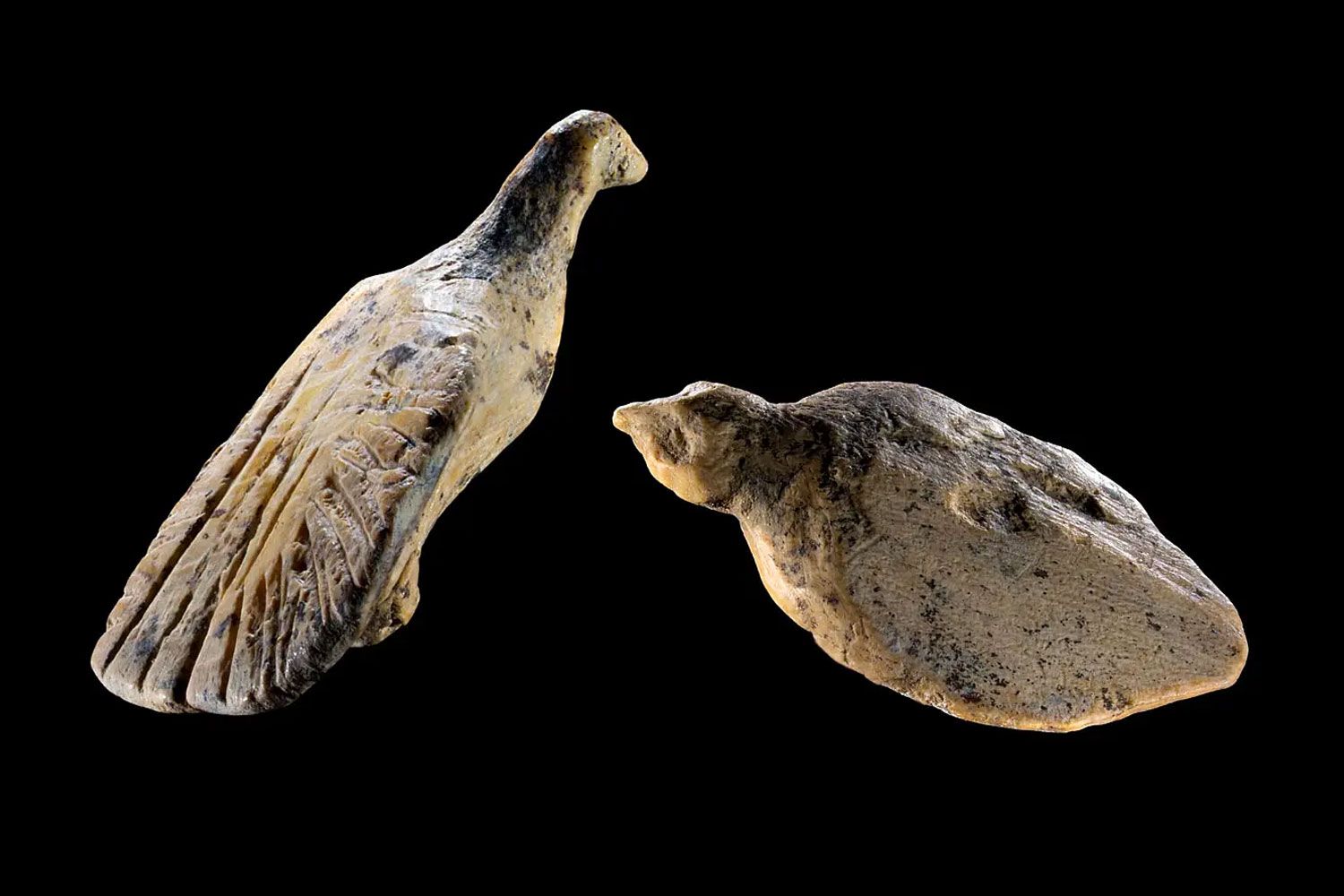
Measuring less than an inch long, the figurines were buried beneath Germany’s Hohle Fels Cave, where some of the world’s oldest known figurative artworks have been found Each bird figurine measures less than an inch long. Ralf Ehmann / University of Tübingen / URMU Approximately 40,000 years ago, not long after Homo sapiens arrived in Europe, a group of early humans settled in a cave in present-day Germany. Among these residents were artists who used mammoth ivory to carve two tiny bird sculptures. The delicate figurines spent the millennia that followed buried in a layer of prehistoric sediment. Now, archaeologists have recovered the artworks, becoming the first to set eyes on them in tens of thousands of years. Weighing just a fraction of an ounce each, the figurines measure less than an inch long—about the size of a thumbnail. One depicts a bird with its wings spread, though fragments of its body have been lost. The other, which was found intact, appears to be lying down, perhaps tending to its eggs. Ice Age artists carved this bird with its wings spread out. University of Tübingen / Ralf Ehmann “The carvings are not highly stylized but instead include many specific and unique features,” Nicholas Conard, an archaeologist at the University of Tübingen in Germany, says in a statement. “Here, the artist has recorded detailed observations that allow us to consider which kind of bird is represented and what the bird could be doing.” The artworks feature carefully crafted details, such as distinctive eyes and markings representing feathers. Experts think that one of them may be a ptarmigan, a bird in the grouse family. They’re less certain of the other’s identity, though it may be another ptarmigan or a bird of prey. The two objects were made around the same time, and researchers say they could have been carved by the same artist. During excavations in 2025, they were found about five feet from each other at the Hohle Fels Cave in southwestern Germany. Excavations at Hohle Fels in southwestern Germany in 2025 Mohsen Zeidi / University of Tübingen Hohle Fels is one of six caves in the Swabian Jura region that are protected as part of a UNESCO World Heritage site. Beginning in the 1860s, excavations in the area revealed artifacts dating to between 43,000 and 33,000 years ago, including animal figurines and early musical instruments. According to UNESCO, these items are “some of the oldest figurative art worldwide.” The two bird figurines were found in layers from the Aurignacian period, which is associated with some of the earliest known modern human cultures in Europe. This cave has revealed many other artifacts, including early bone flutes and the Venus of Hohle Fels, one of the oldest surviving examples of figurative art depicting a human. About 25 years ago, researchers uncovered another bird figurine. Quick facts: Hohle Fels’ first bird artifact This figurine’s body was found in 2001, while the head and neck were identified in 2002. Researchers think the nearly two-inch-long sculpture represents some sort of water bird, such as a cormorant or duck. Shortly after the discoveries, Conard wrote in the journal Nature that this artifact was the “oldest known representation of a bird.” Conard tells Nature’s Ewen Callaway that artifacts of this kind may suggest a level of cognitive acuity that helped early humans thrive in Europe during the Ice Age, when other groups, such as Neanderthals, disappeared. In the future, the researcher would like to investigate these ideas by analyzing ancient DNA from the cave sediments. The figurine with its wings spread is the smallest Ice Age artwork found in the region, according to Schwäbische Zeitung’s Christoph Schneider. Other artworks dating to this period typically measure between one and four inches long. Both bird artifacts are now on display at the Museum of Prehistory Blaubeuren. When the researchers presented their discovery there earlier this week, Conard noted that three bird sculptures have now been found at Hohle Fels, while nearby sites have only revealed figurines depicting other animals, per Schwäbische Zeitung. This discrepancy suggests that communities at different sites created artworks that focused on specific subjects. For reasons unknown, the residents of Hohle Fels may have had a penchant for birds. This bird is depicted lying down, maybe tending to its eggs. University of Tübingen / Ralf Ehmann The purpose that the figurines served is also a mystery. According to the statement, the researchers wonder whether they were “personal talismans” or symbols associated with their owner’s identity. Daniel Adler, a paleolithic archaeologist at the University of Connecticut who wasn’t involved in the research, theorizes that they may have been linked to group affiliation. As he tells Nature, “These objects were created with a purpose other than simple enjoyment.” Conard’s team has been investigating Hohle Fels for nearly 30 years. The researchers conduct excavations by carefully removing sediment before sifting through it with a fine mesh. Elisa Luzi, a paleontologist at the University of Tübingen, identified one of the bird figurines during this process. “You see this figurine, and you feel the humanity of it all,” she tells Nature. “No one has seen these things for 40,000 years, and we are the first ones to do it. It’s a privilege.” “Feather Light, Research Heavy: Discover the Miniature Birds in Ice Age Art” is on view at the Museum of Prehistory Blaubeuren through April 4, 2027. You Might Also Like Get the latest stories in your inbox every weekday. More about: Archaeology Artifacts Birds Cool Finds Germany History Human Origins
Archaeologists Discover Two Thumbnail-Size Bird Sculptures Carved From Mammoth Ivory 40,000 Years Ago
Full Article
Original Source
Read the full article at Smithsonianmag →KhanList aggregates and links to publicly available news content. We do not host full articles from third-party sources. Always verify important information with original sources.