
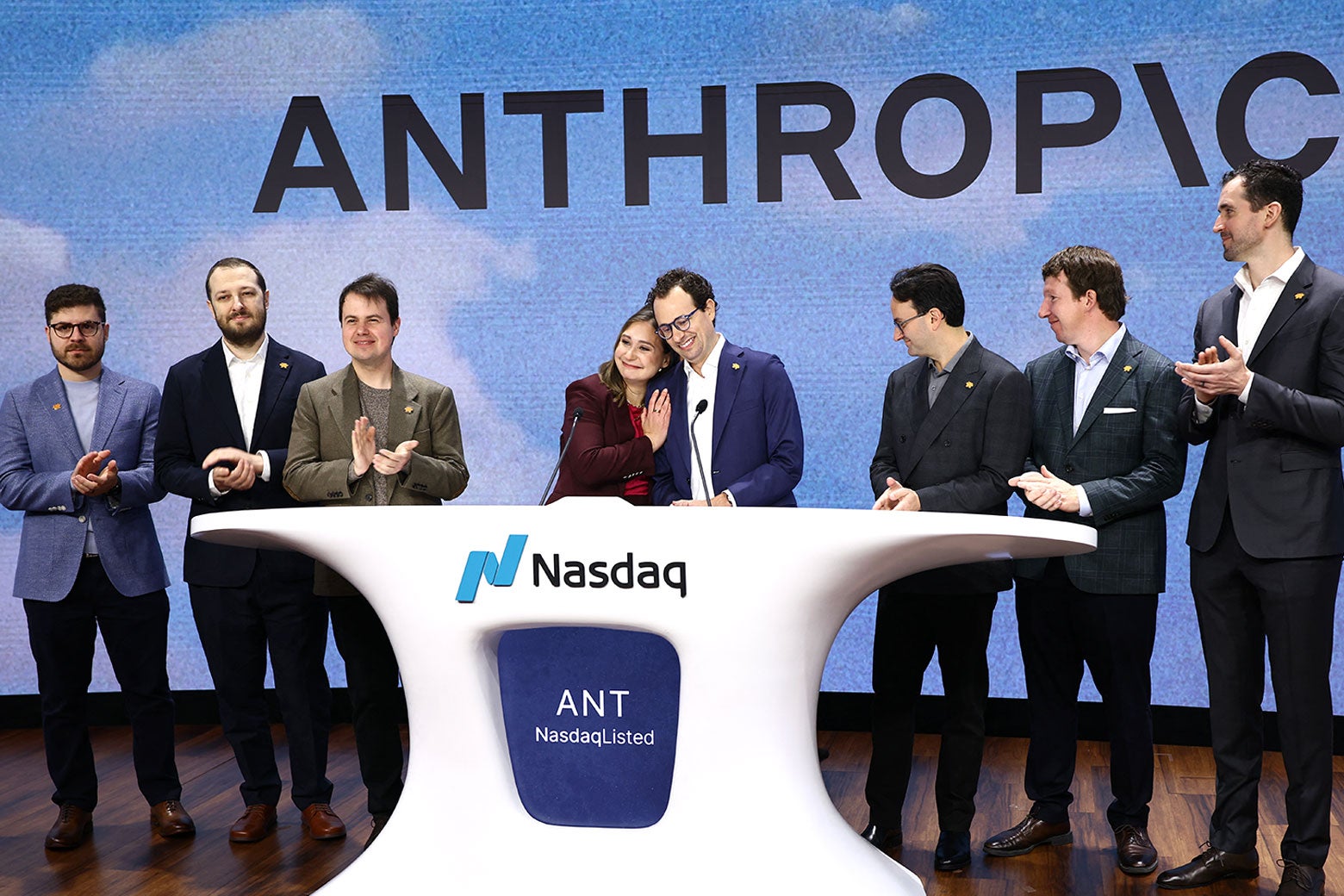
Moneybox Even the biggest public offering in history couldn’t lift the broader market. By Enter your email to receive alerts for this author. Sign in or create an account to better manage your email preferences. Unsubscribe from email alerts Are you sure you want to unsubscribe from email alerts for Nitish Pahwa? Nov 20, 202611:23 AM Charly Triballeau/AFP via Getty Images Sign up for the Slatest to get the most insightful analysis, criticism, and advice out there, delivered to your inbox daily. It was another beautiful day for Wall Street—and a nerve-racking one for anyone already nervous about how much the United States’ economy is intertwined with the A.I. bubble. On Thursday morning, siblings and Anthropic co-founders Dario and Daniela Amodei rang the bell at the Nasdaq to launch the initial public offering for their monumentally valued tech firm, with shares originally priced at a whopping $83 each. Even before $ANT opened up to the public, early investors in the company helped bring in an unprecedented $81 billion haul. Once the stock did go on wider sale, however, it hit a peak of $111.50 a share for a $2 trillion valuation, before falling a touch as the day went on, still trading high yet settling below the $100 threshold. Meanwhile, by the markets’ close, overall Nasdaq values fell slightly, by 2 percent. Anthropic has already smashed the historic records SpaceX set when it hit the indexes earlier this year—and thus is counterintuitively putting itself up for more scrutiny and already-visible panic. Much like Elon Musk’s rockets-and-A.I. firm, Anthropic is selling a vision of an extremely speculative future and almost zero executive accountability, while carrying alarming losses on its balance sheets and wiggling its way into the stock indexes with more than a little help from regulation exemptions as well as your retirement accounts. The maker of Claude Code is also springing forward with this IPO in a moment when the A.I. boom has never felt more fragile. Thursday is no doubt a historic triumph for Anthropic, but it’s one with little promise that the good times will continue. Let’s look at some numbers. Anthropic’s revenue has grown this year, but at a slower pace than before, and its monetary gains don’t even clear $1 billion. At the same time, its losses and steepest obligations have ballooned: The company has nearly $1 trillion worth of chips and computing deals with corporations like Amazon, Google, and Nvidia up through 2030—and $70 billion of that comes due within the next 10 months. Yes, the public investment bonanza will help, but Anthropic’s paths to growth and ability to pad its profit margins are already facing a limit. Bloomberg’s chief U.S. economist, Anna Wong, pointed out that the firm is no longer able to price its tokens at as premium a level as it was able to do in the past, squeezing one area of further growth. (So much for “tokenmaxxing.”) And where Anthropic’s business stands to go from here puts a lot of people beyond Big Tech on the hook. With 401(k)s and pension funds indubitably exposed to the Nasdaq, it should concern everyone that an index already battered by A.I. bearishness couldn’t lift itself up even via the largest IPO in history. (And other indexes fared even worse yesterday.) In the wake of the stock market bearishness fueled by the ouster of Nvidia CEO Jensen Huang—a fall in the chipmaker’s fortunes that has not bounced back in spite of Nvidia’s impressive numbers this past quarter—the people with the most to lose from a broader market rout are rightfully fearful. On Thursday morning, a few dozen protesters gathered outside the Nasdaq, some of whom were arrested in the process; one of the leading organizers told Mother Jones that the IPO frenzy reminded him of the ultraconcentration that fueled 2008’s market bust and the Great Recession. (Last month, New York City’s comptroller wrote to Anthropic asking it to pause the IPO until major risks around A.I. capabilities and finances were addressed, to no avail.) AFL-CIO President Liz Shuler wrote in a statement that “worker pension plans and 401(k) accounts will absorb Anthropic shares whether they choose to invest in the company or not,” exposing its members to “increasing risks to our financial markets and workers’ retirement security.” Shuler also made a grim 2008 analogy, insisting that “we cannot make the same mistake with unregulated AI” that the financial sector did with unregulated debt swaps. One only need look at Anthropic rival SpaceX as a sign of what may come: The IPO that initially hit a peak of $200 is now down by nearly 10 percent of its asking price. It’s still riding high, to be sure, but at nowhere near as robust a level as once promised. (Musk, who just expressed his regret at wasting hundreds of millions of dollars backing MAGA midterms candidates, hasn’t even been a trillionaire for a few months now. Sad!) As for the other tech stocks that once catapulted off A.I. hype? They are also crashing, whether they are A.I. “neoclouds” or Big Tech giants who look to A.I. as just one part—if still a major part—of their business. The Amodei siblings may have been smiling on Wall Street this week, but people at all class levels are not feeling so much exuberance right now. Anthropic, overall, has been enjoying the ride and will probably do so for a little while yet. But at some point, the lofty promises will need to be cashed. And some of the buyers who expressed their confidence will likely cash out themselves before Anthropic sees earth again. Artificial Intelligence Silicon Valley Stock Market
Anthropic’s Blockbuster IPO Had One Very Bad Sign
Full Article
Original Source
Read the full article at Slate →KhanList aggregates and links to publicly available news content. We do not host full articles from third-party sources. Always verify important information with original sources.