
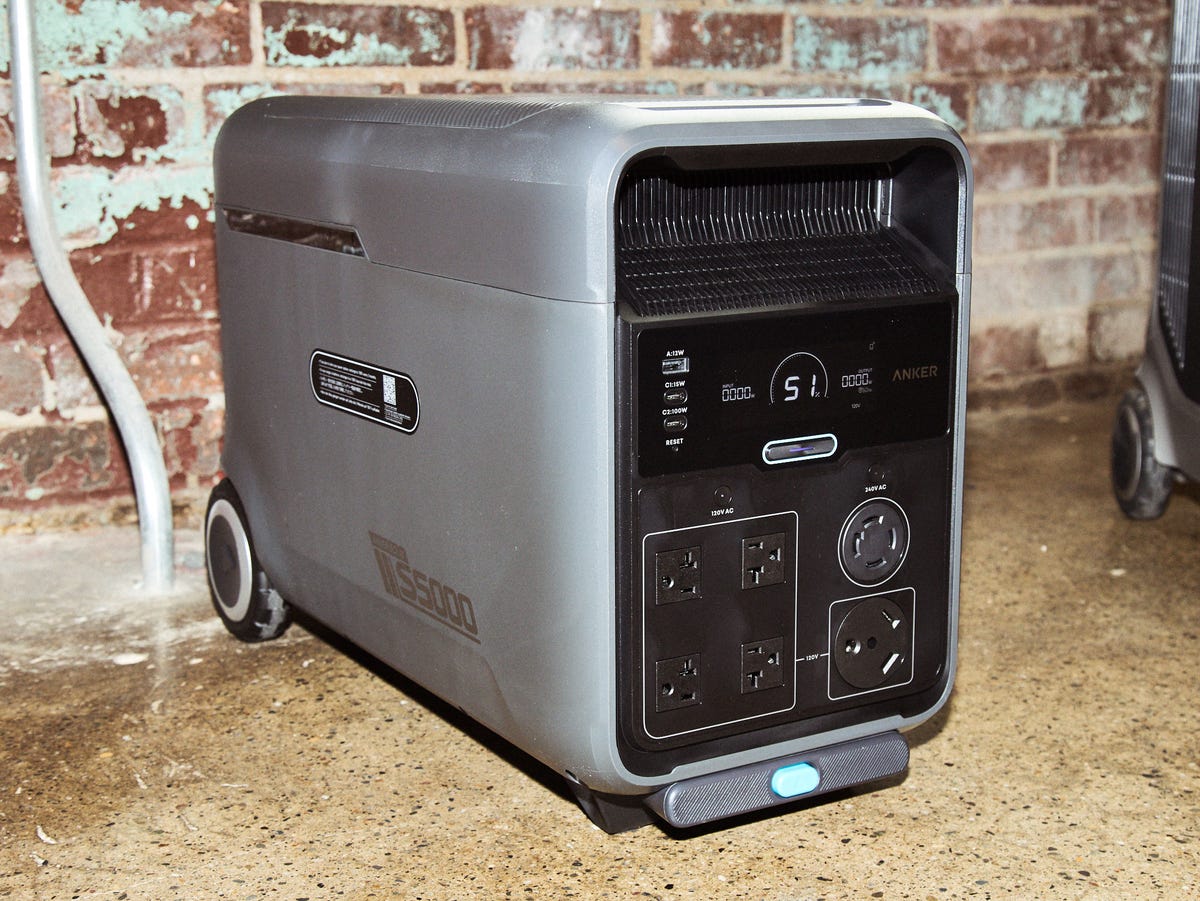
How long a power station lasts has the most impact on your experience when using one, whether you’re experiencing a blackout or enjoying a weekend off the grid. This year, Anker has upped its game with the S-series stations. Advanced algorithms have improved how its inverters deliver power and extend battery life. Not long ago, I reviewed this technology in the small but powerful S2000 and was impressed. Now, I’ve put the newer and larger S5000 power station through its paces, and it didn’t disappoint.For context, I also compared the S5000 to Anker's other large power station, the F3800 Plus (now only available as a bundle with other home power accessories), which has been on our list of the best portable power stations. Each model offers both 120- and 240-volt output, but the S5000 has a much larger battery capacity of 5,024 watt-hours (compared with 3,840 watt-hours with the F3800 Plus), and the S5000 is much smaller in size. While it offers less total power output (4,500 watts versus 6,000 watts for the F3800 Plus), I think the S5000 represents an overall improvement for those looking to buy a home backup station that’s more powerful than a typical portable power station.ProsExcellent efficiency (able to run at nearly 97 percent of true-to-battery capacity)Very compact design that’s easy to move aroundBoth 120- and 240-volt outputConsThough built for 240-volt home backup, don’t expect it to power a central heating system or HVAC system that runs over 30 ampsHow I Tested for Efficiency This is what I cared about the most because better inverter efficiency is the primary feature Anker touts with the S5000. To evaluate its efficiency, I ran two tests. The first was to turn on the AC output and let it run overnight with nothing plugged into it, making sure to deactivate any auto-off features. I did this because, even when idling, most power station batteries lose some stored energy. But after 18 hours, the S5000’s battery capacity was still at 100 percent—that’s impressive. To make a comparison for context, I ran the F3800 alongside it for the same amount of time, and its battery capacity dipped to 81 percent.Winston ZhouOne of my efficiency tests ran a 1,500-watt space heater, which pulled around 4,900 watt-hours of power, very close to the rated 5,024 watt-hours the S5000 offers.For the second test, I plugged a watt meter into the station and plugged a space heater into the meter. I then ran the heater at full power, drawing around 1,500 watts, until it drained the battery fully. Using a resistive load like this (a device that turns energy to heat) can drain a battery pretty quickly, but this also gives you a good read on a power station's performance. It lasted just over three hours, and my meter measured just under 4,900 watt-hours. Compared with its official spec of 5,024 watt-hours of capacity, I determined that this station is around 97 percent efficient. Many stations hover around 89 percent on average, so this was a big win for the S5000.Winston ZhouThe 4,500-watt S5000 isn’t as powerful as Anker’s 6,000-watt F3800, but it packs 5,024 watt-hours of capacity (versus the F3800’s 3,840 watt-hours) and features a far more efficient inverter.The technology behind this ability enables the inverter to throttle itself up and down to meet the demands of the devices plugged into it. This is especially significant for lower-powered devices and cyclical appliances with fluctuating power needs, like refrigerators, because the inverter maintains its efficiency, regardless of what’s plugged into it. That means longer run times across the board. This station could easily power my full-size refrigerator for more than 48 hours.Portable but PowerfulThe size of this station in relation to the battery capacity is its second most striking feature. It’s two-thirds smaller than the F3800 but offers 1,184 more watt-hours. At 99 pounds, I wouldn’t call it light, but with two wheels and a telescoping handle, it’s easy enough to roll around, and it’s not too hard to lift in and out of a vehicle. It would be easy to transport this to and from a second home or a job site.Winston ZhouThough the station is 99 pounds, the telescoping handle and wheels makes it easy to move around. Plus, its compact design fits easily in a car’s trunk.There are a few other enhancements, as well. The 30-amp, 240-volt connection (great for powering an electric dryer or other 240-volt appliance) has its own on/off button, so it won’t create any unwanted drain when all you need is 120-volt AC power. It also accepts both low- and high-powered DC input, which means you get up to 3,000 watts of solar power if you have enough panels to achieve that.Winston ZhouUsing the Anker 5500 tri-fuel smart generator, you can recharge the S5000 at up to 4,500 watts using a direct DC connection, which is at least three times faster than a standard AC plug.There’s also a port connection for adding up to five expansion batteries, potentially increasing the total battery capacity to as much as 30,000 watt-hours. That same port can be used to connect to Anker’s Solix 5000 Smart Tri-Fuel Generator for direct DC recharging, which is three times faster than standard AC charging. I had this very generator on hand and was able to test this out. I observed around 4,000 watts of input while the generator was running on gasoline. In an emergency where the power has gone out for several days, you could use this method to fully recharge the S5000 in less than two hours.The only downside is the maximum total output of 4,500 watts. While that’s perfectly fine for very basic home backup and RV use, it’s not going to power a heating/ventilation/air-conditioning system, let alone a full bank of circuits on a manual transfer switch, no matter how many expansion batteries are attached (they only add capacity, not output). True whole-home backup would require a larger station.Is the Anker S5000 Worth It?Sometimes, newer power station models are just more of the same, with only minor tweaks to power output, capacity, or outlet configuration. But the Anker S5000’s inverter efficiency technology is a notable upgrade that delivers on its promise of longer runtime than comparable models with the same capacity.It’s not a contender for true whole-home backup (Anker’s E-10 system is a better option for that) and doesn’t have as much output power as the F3800, but it can bring substantial power during an emergency to several appliances or a couple of critical circuits, and it’s much more portable. And if you’re an RV owner looking for a compact yet powerful station, this should definitely be on your list for consideration.Shop the Anker Solix S5000 Power StationOther Editor-Recommended Power StationsDavid is a Reviews Editor for Hearst’s Enthusiast Group, contributing to Popular Mechanics, Runner’s World, Bicycling, Best Products, and Biography. He has over 25 years of experience writing about and reviewing consumer electronics, kitchen appliances, DIY products, outdoor gear, and more. He also spent years covering the ever-changing world of online retail. To relax, he loves experimenting with new recipes, tweaking his smart home setup, and spending time outdoors on his bike or camping.
Anker’s New Power Station Is the Most Efficient I’ve Tested, Capable of Running My Fridge for 2 Days
Full Article
Original Source
Read the full article at Popularmechanics →KhanList aggregates and links to publicly available news content. We do not host full articles from third-party sources. Always verify important information with original sources.