
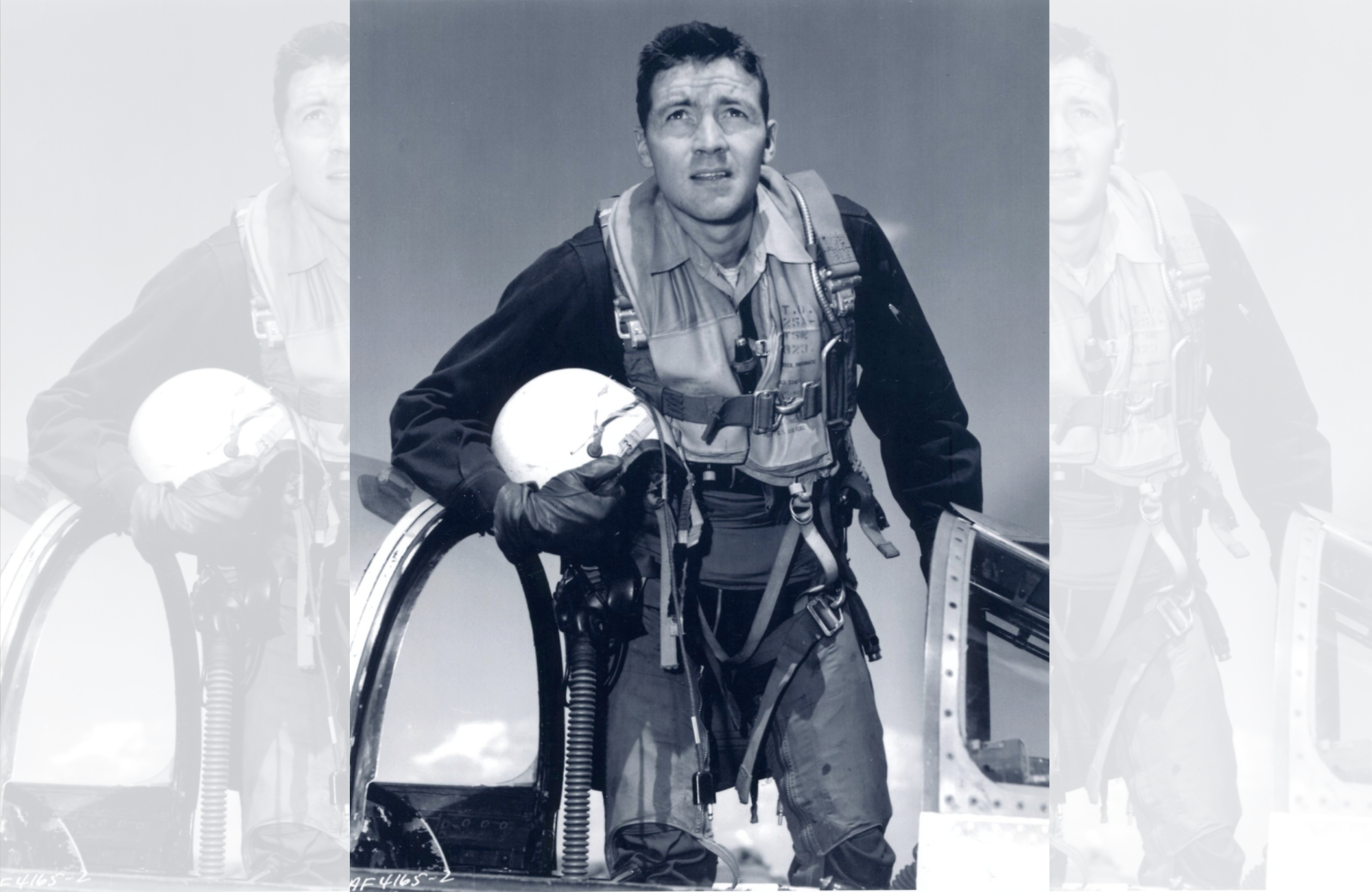
During World War I, fighter pilots became “knights of the air,” — romanticized as noble, masculine heroes who guarded the ground from violence above. That mythology lasted, creating a heritage that still tinges new fighter pilots with pride. “Military culture is different from civilian culture, military aviation culture is distinct from both, but fighter pilot culture is a world unto itself,” writes Michael W. Hankins in Flying Camelot: The F-15, the F-16, and the Weaponization of Fighter Pilot Nostalgia. However, things were different for Vietnam War pilots. Century Series fighters had struggled in the conflict’s air combat and the Air Force’s front-line fighter was the two-seater F-4 Phantom. The mythos of the fearless, individualistic fighter and the desire for turn-and-burn dogfights seemingly evaporated. Col. John Richard Boyd and his “Fighter Mafia” strove to change that. Born in Erie, Pennsylvania, in 1927, Boyd entered the U.S. Army Air Forces at the tail end of World War II, spending 12 uneventful months in Japan before his discharge in 1947. At the outbreak of the Korean War, Boyd reenlisted and was assigned to Nellis Air Force Base in Arizona, where he trained in a North American F-86 Sabre before logging a slew of combat hours in Korea — and, in the final few weeks of the war, was credited with damaging a MiG-15. Ordered back to Nellis, Boyd began training to become a flight instructor, and he soon earned a reputation for being unafraid of criticizing superior officers. His detractors would later call him profane, crude — perhaps even treasonous. Boyd’s proponents praised him as a genius, comparable to Sun Tzu. Loved or despised, however, no discussion of the F-15 and F-16 design process, or the influence of energy maneuverability theory — a formula he co-produced to determine the specific energy rate of any aircraft — would be complete without discussing Boyd. He and his disciples, a mixture of pilots and engineers, “were selling a powerful idea: Defense technology could be both cheaper and more effective, and that we used to have it right but had lost our way. In the late 1970s, coming out of the difficult Vietnam War experience, the desire for more efficient, less complicated technology found a lot of traction, and it’s still with us,” writes Hankins. Essentially, Boyd and the members of his self-dubbed “Fighter Mafia” — which included the likes of pilot Everest Riccioni, civilian mathematician Thomas Christie and aeronautical engineer Harry Hillaker — argued that the defense industry of the 1960 and 70s was in a crisis due to its overreliance on complex, expensive weapons and championed the superiority of man over machine. “No amount of electronic or optical equipment can substitute for a pilot’s ability to turn his head and see his antagonist,” Riccioni wrote in his thesis on air superiority. “From Boyd’s acolytes’ point of view,” writes Gerald A. Schiller, “the Pentagon’s sole function was hardly defense; it was merely a bureaucracy created to get Congress to fund expensive weapons systems — systems that often performed poorly when tested, and whose price tags kept escalating at alarming rates.” Their argument, according to Hankins, was, at its core, “steeped in specific cultures, with specific beliefs, assumptions, behaviors, and values. The F-15 Eagle and F-16 Fighting Falcon, originally designed to focus on air-to-air combat, are the strongest examples of the influence of culture on technology within the US Air Force.” An F-16C Fighting Falcon shoots an AIM-120 Advanced Medium-Range Air-to-Air Missile over testing ranges near Eglin Air Force Base, Florida, 2019. (Senior Airman Joshua Hoskins/Air Force) Boyd, alongside Christie, had already conclusively proven, through their energy maneuverability theory, that the Soviet MiG-21 was superior to the General Dynamics F-111 in combat. The swelling ranks of the Fighter Mafia sought to produce a pure air-to-air combat aircraft to counter the Russian threat. “Department of Defense 1960’s era aircraft, such as the F-105, F-4, and F-111, while adequate in air-to-ground roles, were significantly disadvantaged in air-to-air maneuvering,” writes the Air Force in 2025. Boyd and Christie’s physical theory would, according to author Robert Corum in Boyd: The Fighter Pilot Who Changed the Art of War, forever change how fighter planes were designed. Boyd and his “Fighter Mafia” became almost biblical in their efforts to create — behind the scenes — their generation’s greatest fighter and put the pilot firmly back in control. The members even spoke in code when discussing their work to develop a pure fighter, calling it “the Lord’s work,” writes Hankins. To that end, over several years, Boyd and his followers secretly worked the “hallways, back doors and alleys of the Pentagon and the aircraft industry,” according to one of Boyd’s closest friends, Col. James Burton. “In essence, the Fighter Mafia had spent several years in secret, illegal meetings with two contractors (General Dynamics and Northrop) to design an aircraft; then the Fighter Mafia co-wrote the RFP for that plane; then they participated in a source selection committee that also contained many of their devotees who shared their values; and finally, amid numerous possible outcomes and other potential factors affecting the selection process, the winners were the two companies the Fighter Mafia had been secretly meeting with all along,” writes Hankins. Ultimately, and perhaps unsurprisingly, General Dynamics, led by engineer Robert H. Widmer, secured Department of Defense funding to develop the YF-16. The first test flight occurred on Feb. 2, 1974, and it entered service four years later. While the Air Force has since modified the F-16 into an effective, low-cost multi-role aircraft, it remains one of the strongest examples of how fighter culture swayed Air Force technology — with Boyd firmly at its center. He was, writes Corum, “The fighter pilot who changed the art of war.”
The Air Force maverick ‘who changed the art of war’
Full Article
Original Source
Read the full article at Militarytimes →KhanList aggregates and links to publicly available news content. We do not host full articles from third-party sources. Always verify important information with original sources.