
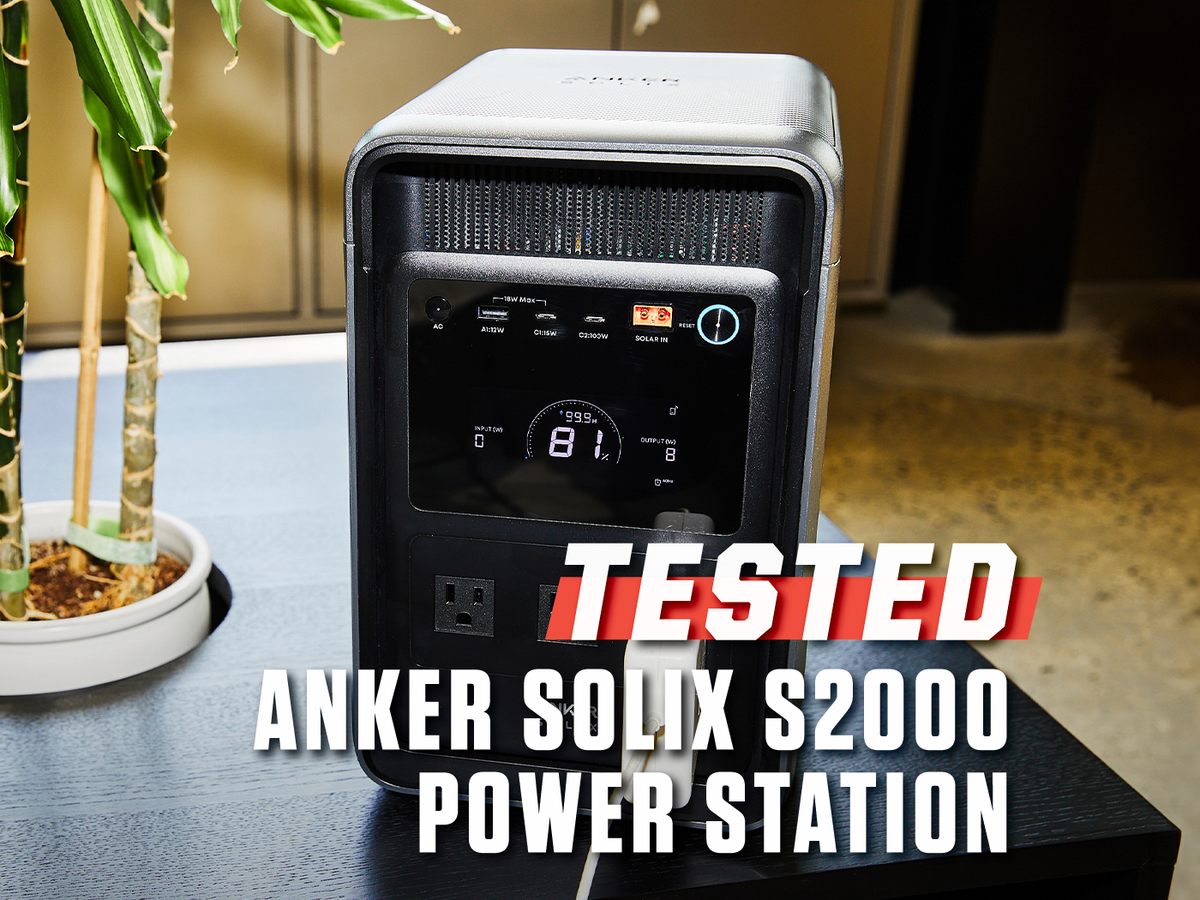
4 min readThere’s a harsh truth about power stations: Like any battery-based device, their efficiency isn’t perfect, so some stored energy gets lost along the way as it powers your devices and appliances. One of Anker’s newer models, the S2000 Power Station, is built to address this issue.Beyond the efficiency technology, it’s also a well-designed, small power station. It’s very compact, weighs just over 35 pounds, and has plenty of outlets. It also functions as a uninterruptible power supply (UPS) for 10-millisecond automated backup.The caveat here is that you’ll pay for that extra runtime and the relatively small footprint. It’s pricey compared to other stations in its class, plus it isn’t meant to run several high-power appliances at the same time. Yet what it does, it does well. It’s better suited to run a refrigerator and a few low-powered devices. In fact, the Solix S2000 was so efficient, it lasted 24 hours in my real-world fridge test.How I Tested To see how well this efficiency-improving technology worked, I compared the S2000’s capacity of 2,010 watt-hours to two other power stations: the Anker C2000 and the Bluetti Elite 300, which respectively offer 2,048 and 3,014 watt-hours of capacity. I used each one to power the same refrigerator in my kitchen with roughly the same internal and ambient temperature conditions.Keep in mind, the stations I compared the S2000 with have higher power output ratings, so they are better suited to supporting high-power appliances; any of my comparisons for this review are to illustrate how well the efficiency technology in the S2000 works.ProsDelivered noticeably longer runtime in testingVery compact design for the amount of capacity it offersFunctions as a 10-millisecond UPSCons1,500 watts won’t run all high-powered small appliances (e.g., a four-slice toaster)Only one high-powered USB-C portKey SpecsOutput1,500 W (3,000 W surge)Capacity2,010 WhOutlets5 x 120 V AC; 1 x 100 W USB-C; 1 x 15 W USB-C; 1 x 15 W USB-AWeight35.7 lbHow It Achieves Better EfficiencyAt best, most power stations run at 65 to 85 percent efficiency because of a variety of factors that cause energy loss. That can include how high or low the total load is; whether the appliance draws constant power, like a wireless router, or variable, like a fridge; the quality of the inverter; and even the temperature of the room.The S2000 is designed to recognize the type of device that needs to be powered and adjust the inverter's frequency to match the type of demand. This, in theory, helps reduce the amount of wasted power.For example, a wireless router tends to draw a consistent load of around 10 watts or so. The S2000 detects that and throttles the inverter down so that it doesn’t waste energy on such a low-powered device. A refrigerator may draw 300 watts for just 15 minutes every hour while idling the rest of the time. The S2000 is designed to rest the system when power isn’t needed. These adjustments may seem small but can potentially reduce the amount of wasted power and keep the battery running longer, sometimes by several hours.trevor raabYou can keep track of how well the S2000 is performing using the mobile.The Results Are ImpressiveThe S2000 ran my fridge for just over 24 hours, the C2000 ran it for 18 hours, and the Bluetti lasted 29 hours. That’s impressive performance for the S2000, beating out a station with roughly the same capacity and nipping at the heels of one that offers a third more.That 24 hours was not quite the “up to 35 hours” Anker boasts, but every refrigerator is different. While mine is fairly efficient, it’s not perfect (and more than 10 years old). A newer and more efficient refrigerator might help the station come closer to that claim. Regardless, the simple fact that the S2000 performed better than the C2000, which technically has a bit more capacity, is some proof that the improved technology works.I did some other tests as well, including running higher-powered appliances, like a space heater, to see how well it handled those. It can surge to 3,000 watts, which worked well to accommodate the startup power the heater needed, but I couldn’t run it at full power, as that exceeded the 1,500 running watts maximum. Meanwhile, it handled my electric kettle with no problems, and rode the edge of that limit, drawing around 1,450 watts without overloading (some stations will shut down if you get that close).Trevor RaabThere are five AC outlets on this power station, two of which are on the back, which helps keep cables out of sight.The Final VerdictThe S2000 makes good on its promise of improved efficiency, though it’s not a large station and may not be the right choice if you’re looking to run a lot of high-power appliances. That said, I could easily see this being used as a reliable backup for a refrigerator during an emergency, a high-capacity UPS to instantaneously back up a computer or medical equipment, or a grab-and-go power station you bring on a road trip to help recharge devices. Any extra runtime it can give you is icing on the cake.Shop the Anker S2000 Portable Power StationOther Editor-Recommended Power StationsJackery Explorer 1000 V2 Portable PowerNow 11% OffEcoFlow River 3 Plus Portable Power StationNow 13% OffGoal Zero Yeti 1500 Portable Power StationDavid is a Reviews Editor for Hearst’s Enthusiast Group, contributing to Popular Mechanics, Runner’s World, Bicycling, Best Products, and Biography. He has over 25 years of experience writing about and reviewing consumer electronics, kitchen appliances, DIY products, outdoor gear, and more. He also spent years covering the ever-changing world of online retail. To relax, he loves experimenting with new recipes, tweaking his smart home setup, and spending time outdoors on his bike or camping.
Anker’s Latest Power Station Is So Efficient It Lasted 24 Hours in My Real-World Fridge Test
Full Article
Original Source
Read the full article at Popularmechanics →KhanList aggregates and links to publicly available news content. We do not host full articles from third-party sources. Always verify important information with original sources.