
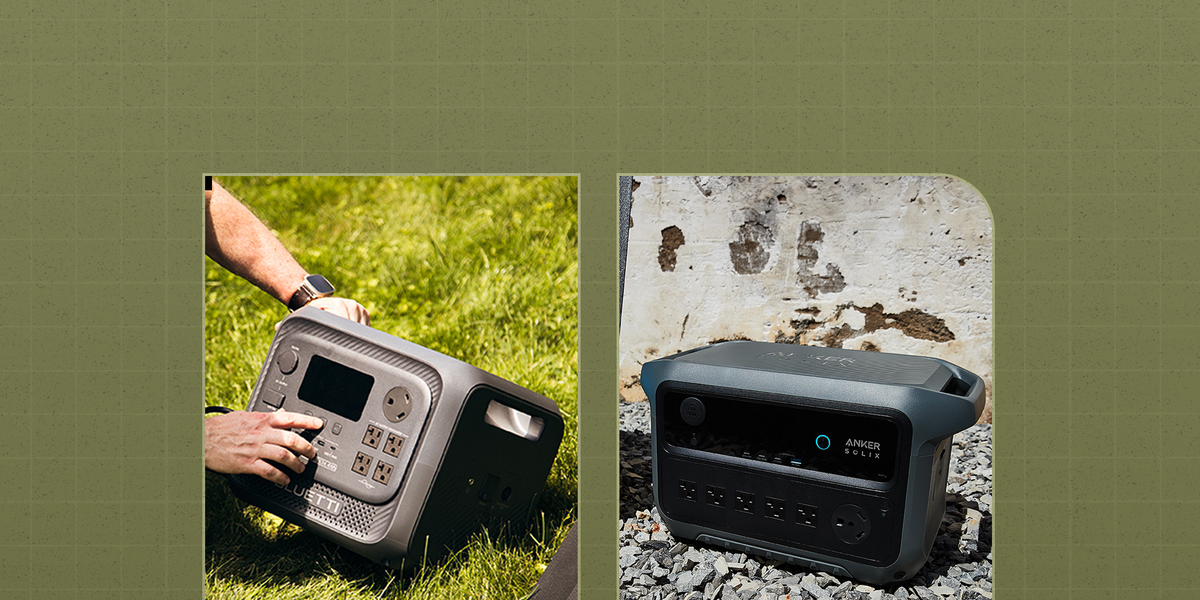
6 min readTwo brands that almost always make our lists of the best portable power stations and solar generators are Anker and Bluetti. Both offer a wide range of battery-based power, from small, portable models for taking on a camping trip to expandable home backup systems that, when installed, provide backup power during an emergency. But how do similar models, like the Anker Solix C2000 and the Bluetti Elite 300, stack up?I chose these two not only because I conducted hands-on testing of both, but also because they occupy the same tier in output, approximate capacity, and price. While they are not the smallest power stations on the market, they are still very portable and powerful enough to run several appliances for several hours during a power outage. It’s a good matchup.ProsFive 20-amp standard outlets and one 30-amp 120-volt outletCapacity can be doubled with the addition of an expansion batteryTwo 140-watt USB-C portsConsOnly a max of 800 watts of solar input, which is lower on average than comparable stationsKey SpecsOutput2,400 W (4,000 W surge)Capacity2,048 WhMax Solar Input800 WOutlets5 x 120 V AC; 3 x USB-C; 1 x USB-A, 1 x 12 V DC; 1 x 120 V, 30 A (TT-30R)Weight41.7 lbPros3,000 watt-hours of capacity in a smaller package compared to similar stations30-amp, 120-volt connection makes it good for hook-up to a small RVExcellent app with lots of advanced featuresConsNo way to expand it with extra batteriesJust two USB-C portsKey SpecsOutput2,400 W (4,800 W surge)Capacity3,014 WhMax Solar Input1,200 W Outlets4 x AC outlets; 1 x 30-amp (120-V); 1 x 12-volt; 1 x 12-volt (car port); 2 x USB-A; 2 x USB-C (TT-30R)Weight59 poundsKey Differences: Anker Solix C2000 vs. Bluetti Elite 300Battery CapacityWhile these two power stations are very similar, the biggest difference is in battery capacity, which determines the number of watt-hours a power station offers and, ultimately, the amount of runtime you have. The higher the capacity, the more runtime is available to you. Both power stations use Lithium Iron Phosphate (LiFePO4) batteries, which are superior to Lithium-ion, but in this case, the Bluetti Elite 300 is the capacity winner, offering 3,014 watt-hours compared to the Anker C2000’s 2,048 watt-hours.What does that translate to? In a practical test, I powered my refrigerator—under similar conditions—with the Anker station for 18 hours, while the Bluetti was able to keep it running for 29.5 hours. That might make a difference for some people, though 18 hours of runtime is still pretty good. Plus, the extra capacity of the Bluetti means more battery cells, which equals more weight. In fact, it adds nearly 20 pounds, making it much heavier to lug around. Both have built-in handles, but the Anker was much easier to lift.Even so, sometimes more capacity is the better end of the bargain. I’ve taken the Elite 300 on several camping trips now, and I’ve been able to power lights, an electric grill, and even a portable tent air conditioner. On my last trip, I used it over the course of three days without having to recharge it once. I could not have done that with the C2000.Winston ZhouThe Bluetti Elite 300 can accept up to 1,200 watts of solar input. We paired it with a 350-watt portable panel during our testing. Anker’s C2000 can only accept up to 800 Watts.Solar PowerYou can pair either of these stations with a portable solar panel, but their maximum input levels differ greatly. The Anker station only accepts up to 800 watts, while the Bluetti station accepts up to 1,200 watts. To be fair, most single portable panel arrays don’t exceed 500 watts (and no panel ever runs at 100 percent efficiency), so I’m not sure this is really a huge issue, but if you’re the type of user who would run panels in parallel to get as much solar power as you can, this may be an important point to consider.Capacity ExpansionExpansion capability can be important if you realize late in the game that you desire more runntime that your station is able to deliver. In this case, Anker wins. The Solix C2000’s battery capacity can be increased to 4,096 watt-hours by adding a BP2000 expansion battery, or you can save a little bit of money by buying them as a pair.The Bluetti Elite 300 cannot be expanded with an extra battery, which I thought was odd because some other Bluetti products are expandable. I won’t call it a deal breaker by any stretch—especially since the Elite 300’s base capacity is already greater—but it’s an oversight I hope they correct in future versions of this model.Other Notable ComparisonsNumber of OutputsWhen the number and variety of outlets, the Solix C2000 has a slight edge. There are five standard 120-volt AC outlets on the front (compared to Bluetti’s four), powered by an inverter that delivers the full 2,400 watts to this bank—not all power stations do that. As long as you don’t exceed a 2,400-watt draw of power, you can confidently use all five outlets at the same time. Both offer a 30-amp, 120-volt outlet, which is mostly useful for powering RVs or some niche applications.Trevor RaabThe Anker C2000 has five 120-volt AC outlets that can power the full range of output, up to 2,400 watts.For DC power, this station also offers two high-powered, 140-watt USB-C ports, which are great for charging laptops or fast-charging mobile phones. There’s also a low-powered, 15-watt USB-C port and a USB-A port for legacy devices. Bluetti only offers two USB-C ports (100 and 140 watts) and two 15-watt USB-A ports.One outlet the Elite 300 offers that is rare in power stations is a 12-volt 30-amp XT90 DC outlet. This isn’t a port the general user might care about, but for overlanders and RV owners, it’s a game changer. This port gives you another way to run high-powered 12-volt appliances or devices like water pumps and air compressors.Vehicle RechargingMost power stations can be recharged using the 12-volt car port of a vehicle (i.e., cigarette lighter), but that can take a very long time (sometimes as much as 12 hours), and may not be practical as the car has to be running to do it. But both companies make alternator chargers that connect directly to your car’s electrical system, enabling faster DC-to-DC charging that can fully charge a station in much less time, around 1-3 hours.Trevor RaabThis expansion port on the Anker C2000 allows for the addition of an extra battery or a connection to a car alternator charger. The Bluetti Elite 300 cannot be expanded with an additional battery.Bluetti offers a vehicle-based fast charger that connects to the Elite 300’s DC input, while Anker offers an alt charger that connects to the C2000 using the same port on the power station that’s typically used for adding an expansion battery. This will allow you to fast-charge the C2000 in as little as an hour. The car still needs to be turned on to use this method, but because it takes less time, it’s a more reasonable solution. Both charge at a rate of 800 watts, so there’s no clear winner here, except that Anker’s solution is less expensive.One last cool thing I discovered with this power station is that when it comes to recharging, the C2000 recharges itself at the full rate while providing full output from the inverters. For example, I ran a space heater that needed 1,400 watts of power while still charging at the full 1,800-watt fast-charging rate (I confirmed this using a wattmeter). Other power stations often throttle the amount of power coming into the station while powering devices. This model treats input and output independently, which is impressive and uncommon.Winston ZhouThe Bluetti Elite 300 has 3,012 watt-hours of capacity despite its smaller size. That gives it a longer overall runtime compared to the Anker C2000.Portability and DurabilityWhile both are similar in size, I think the Bluetti—despite being heavier—is superior when it comes to overall portability and durability. The Elite 300 is smartly designed in the shape of a cube with inset handles that don’t stick out. So, even though it’s heavier than the Solix C2000, it was easier to pack up in a car full of gear. The Solix is wider, and the handles stick out and take up extra space. Meanwhile, the hard plastic they use to construct the Elite 300 is stronger and more durable compared to the Solix C2000.The Mobile AppMy other favorite thing about the Elite 300 (and other stations made by Bluetti) is the mobile app. In my experience, Bluetti makes one of the best apps out there, with more customizable options than most other brands (though EcoFlow’s app is also very good). The app allows you to vary your recharge rates (reducing them can help battery longevity), set AC and DC eco modes to prevent unwanted battery drain, and configure settings when you use the station as a universal power supply (UPS), to name a few.Anker’s app offers some of the same advanced settings, so it won’t leave you high and dry by any stretch, but nowhere near as many as Bluetti. If you like to nerd out with kind of stuff, Bluetti’s is the app for you.Which Power Station is Better For You?At the end of the day, these are both very capable power stations, so picking the best one for you will likely boil down to feature sets. In terms of capacity, overall portability, and advanced features, you can’t beat the Bluetti Elite 300 (it’s my personal favorite of these two stations). But if all you need are the basics, the Anker is a very reliable option with lots of outlets and the ability to expand battery capacity later, if you need to. Plus, it tends to go on sale with a bigger discount, too, and that’s never a bad thing.Other Editor-Recommended Power StationsJackery Explorer 1000 v2 Portable Power StationNow 11% OffEcoFlow River 3 Portable Power StationNow 13% OffGoal Zero Yeti 1500 Portable Power StationDavid is a Reviews Editor for Hearst’s Enthusiast Group, contributing to Popular Mechanics, Runner’s World, Bicycling, Best Products, and Biography. He has over 25 years of experience writing about and reviewing consumer electronics, kitchen appliances, DIY products, outdoor gear, and more. He also spent years covering the ever-changing world of online retail. To relax, he loves experimenting with new recipes, tweaking his smart home setup, and spending time outdoors on his bike or camping. Rachel is the Deputy Editor of Reviews for Hearst's Enthusiast and Wellness Group where she supports Popular Mechanics, Runner's World, and Best Products. Her background is in service journalism and earlier in her career she worked as a daily newspaper reporter and book editor. She spent more than a decade as a staff editor and writer at TripAdvisor and Penguin Random House and her byline has appeared in Time Out New York, the New York Daily News, and New York Magazine. Outside of work, Rachel can be found planning her next trip, visiting museums and galleries, and walking her wirehaired dachshund in Central Park.
Anker Solix C2000 vs. Bluetti Elite 300: One Model Wins on Capacity, Portability, and Advanced Features
Full Article
Original Source
Read the full article at Popularmechanics →KhanList aggregates and links to publicly available news content. We do not host full articles from third-party sources. Always verify important information with original sources.