
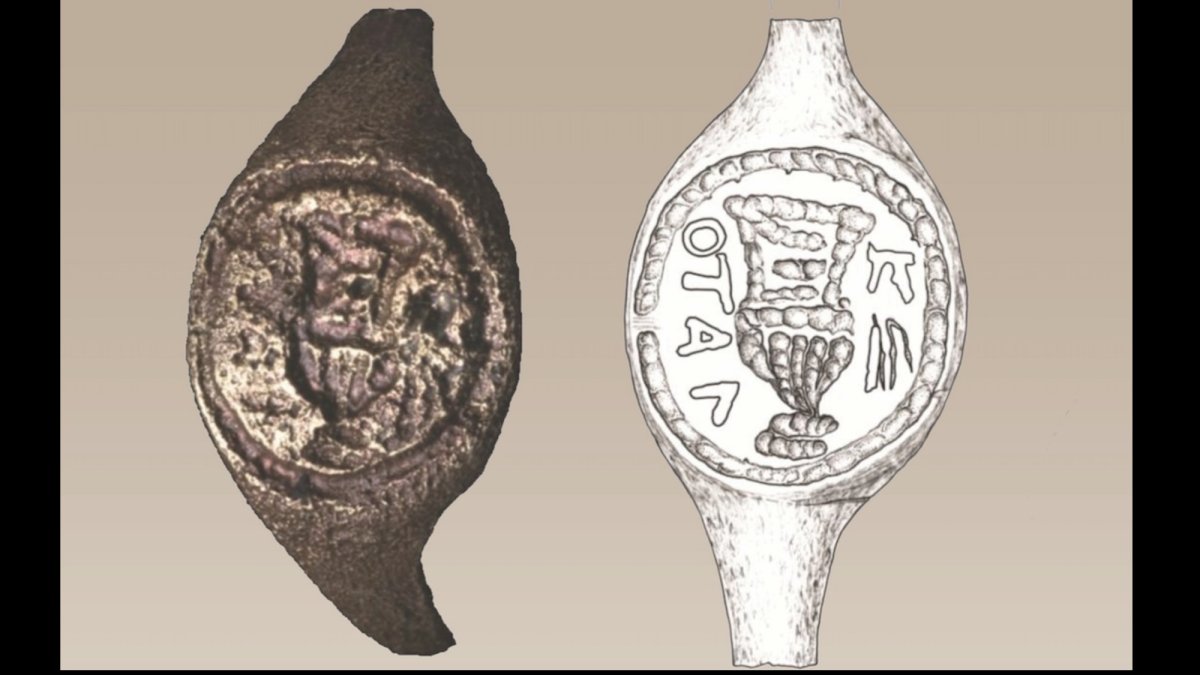
Photo (left) and drawing of the 2,000-year-old copper alloy ring excavated in the 1960s. Research by UCLA’s Catherine Bonesho’s suggests it may have belong to an enslaved or formerly enslaved person who participated in the administrative work of Roman Judea under Pontius Pilate. Credit: C. Amit/IAA Photographic Department (photo) / J. Rodman (drawing) / both courtesy of Roi Porat Get the Popular Science daily newsletter💡 Breakthroughs, discoveries, and DIY tips sent six days a week. By signing up, you confirm you are 16+, will receive newsletters and promotional content and agree to our Terms of Use and acknowledge the data practices in our Privacy Policy. You may unsubscribe at any time. The story of a 2,000-year-old ring potentially tied to one of the Christian Bible’s most impactful figures has yet another hypothesis. In a study recently published in the journal Palestine Exploration Quarterly, historian Catherine Bonesho argues that the letters on a ring often associated with the Roman governor Pontius Pilate refer to somebody named Pilate, and not necessarily the official who sentenced Jesus to death. The reason behind the mix-up? A common Roman translation error. The backstory behind Pilate’s ring The ring was first excavated during the 1960s at a mountaintop fortress called Herodium about 7.5 miles south of Jerusalem. However, researchers ostensibly forgot about the jewelry after placing it in storage, where it remained until its rediscovery in 2018. That same year, archaeologists publicly revealed the artifact uncovered in the Judean desert with supposedly dramatic historical connections. Based on their analysis, researchers initially argued a copper alloy ring’s engraved Greek lettering (ΠΙΛΑΤO) and image of a vase tied the accessory either to Pontius Pilate, or someone who worked in the New Testament figure’s administration. The theory made international headlines while also receiving a heavy dose of criticism. Another group of scholars eventually refuted the claims in 2023, contending the ring had no connection to anyone named Pilate. In their view, the image separating the letters Π and Ι from Λ, Α, Τ and Ο denoted two separate words. Archeologists suggested the ring was supposed to feature the name ΠΙΛΑΤΟY—the Greek translation of PILATI, or “belonging to Pilate.”But for whatever reason, the engraver left off the “Y.” It was around then that Bonesho first learned about the ring’s existence—and this theory—through a social media post. “After talking with a friend of mine about it, I commented on the post that maybe it was Latin written in Greek letters,” Bonesho, a historian of ancient Judaism at the University of California, Los Angeles (UCLA) recalled in a recent profile. It’s all Greek to me A separate scholarly article cited her suggestion, which eventually spurred Bonesho’s own investigation. After analyzing digital images and renderings of the ring, Bonesho now believes whoever engraved it wasn’t trying to fit two separate words on the face. Nor were they discarding a “Y” to save space. Instead, they were attempting to fit ΠΙΛΑΤO around the vessel relief, which was possibly engraved on the ring by an earlier artisan. The second engraver may have also accidentally created a tiny defect that required them to break up Pilate’s name.As for the letters themselves, Bonesho thinks the ring’s maker mistakenly swapped the Latin long “o” vowel with the similar looking Greek omicron. Basically, she thinks it’s a 2,000-year-old typo. “The mixing up of omicron and omega for long and short ‘O’ vowels in transliterating Latin into Greek is common among early Latin language learners,” Bonesho contended. “They might have thought, ‘It looks like an O, and I have an O in front of me—why not just use the O?’” Under these parameters, the ring technically should say “ΠΙΛΑΤΩ,” which means “to” or “for” Pilate. If true, then the wearer wasn’t a man named Pilate, but a subordinate or enslaved person under his oversight who used the ring as a wax or clay seal for various materials and documents. The theory is further bolstered by the jewelry’s material,Copper alloy was considered a cheaper metal at the time, and usually only worn by lower status individuals. Bonesho said this latest interpretation doesn’t lessen the artifact’s historical importance. If anything, it imbues it with more nuance and context. “Complexity often gets lost in popular narratives of how things worked at that time,” she said. “But understanding the ring gives us more insight into what the Roman administration of early Roman Judea looked like.” 2026 Popular Science Home of the Future Awards 39 products that will improve your everyday life.
Ancient ring supposedly tied to Pontius Pilate may include a typo
Full Article
Original Source
Read the full article at Popsci →KhanList aggregates and links to publicly available news content. We do not host full articles from third-party sources. Always verify important information with original sources.