
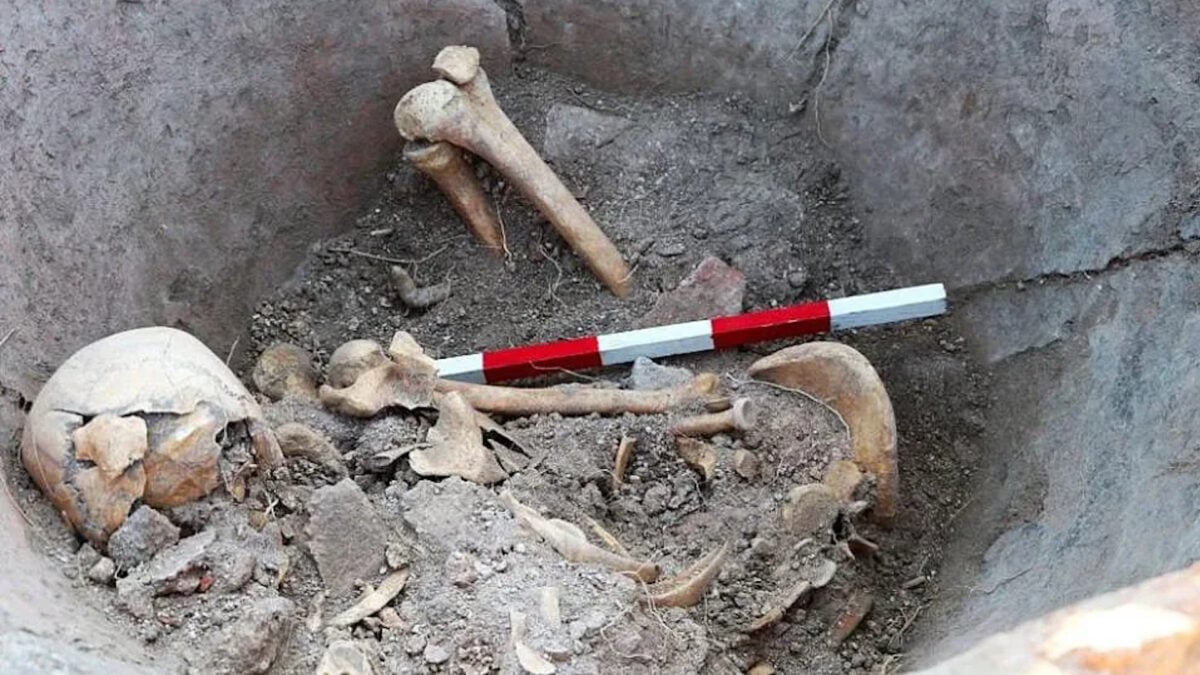
Picture this: It’s the 5th century CE. You’re in the much besieged Roman city of Deultum, a colonial outpost along the empire’s eastern Balkan territory in what is now Bulgaria. A few decades ago, the army of Roman centurions ostensibly protecting your fair city were handily smote by a raiding party of Germanic Goths. Your city was sacked, then rebuilt, albeit modestly. Now, this guy Attila the Hun is taking his turn pillaging the place. Also, somehow you’ve been lit on fire. That appears to have been the fate for some unlucky young man whose skeletal remains were discovered this August, inside a large ceramic jar where the long-deceased individual had once apparently attempted to hide. Archaeologist Lyudmil Vagalinski, whose team has been excavating Deultum this summer, told the Bulgarian news site Standart (Стандарт) that while the precise date of this resident’s demise has yet to be determined, his own preliminary estimate of the episode is somewhere around 400 CE. And—judging from the ashes identified at the bottom of this Roman earthenware, technically known as a dolium—the deceased had likely been set ablaze sometime before seeking refuge in what would become his final resting place. “He made no attempt to get out, he probably suffocated in the fire,” Vagalinski told Standart, translated via Google. “For now, we can say that the skeleton is that of a young person, but we will know more after the anthropological analysis.” A knives out mystery According to Vagalinski, the project’s lead excavator and a professor at the Bulgarian Academy of Sciences, the skeleton was found clutching an iron knife in its right hand as it sat in what was likely once a defensive crouch inside the dolium, its knees pressed up to its chin. A second knife was found hanging from a ring on his belt, but Vagalinski suspects that the man was more a bystander than a trained combatant. Traces of fire damage extend beyond the confines of the dolium too, Vagalinkski noted, adding to the likelihood that the death occurred during one of the many attacks that plagued Deultum between the 4th and 6th centuries. But the researchers won’t know more until the dolium’s contents have been further examined by their physical anthropologist colleague in Sofia, Bulgaria’s capital, where the skeletal remains have now been shipped. A wider view of the skeletal remains inside the ceramic Roman jar, or dolium, where it was found clutching an iron knife while seated in what was likely once a defensive crouch. Credit: Archaeologia Bulgarica Wake up, dead man Vagalinski, who has published his team’s Deultum finds with the journal he founded, Archaeologia Bulgarica, opined to the site Live Science that the young man may have ultimately been done in by his own fellow citizens. “After the attack, the inhabitants of the city leveled the ruins of the tower and covered them with a new, higher floor,” the archaeologist told the publication. Vagalinski and his colleagues plan to return to the excavation site next summer to focus their attention on the colonial city’s western Late Roman gate, which they believe was erected sometime around 300 CE. But they also hope to find out more clues about the fate of this dead young man and his knives, as they plan to continue investigating the gate’s northern turret, where the dolium had been buried.
1,600-Year-Old Skeleton Found Hiding Inside Jar With 2 Knives Raises More Questions Than Answers
Full Article
Original Source
Read the full article at Gizmodo →KhanList aggregates and links to publicly available news content. We do not host full articles from third-party sources. Always verify important information with original sources.