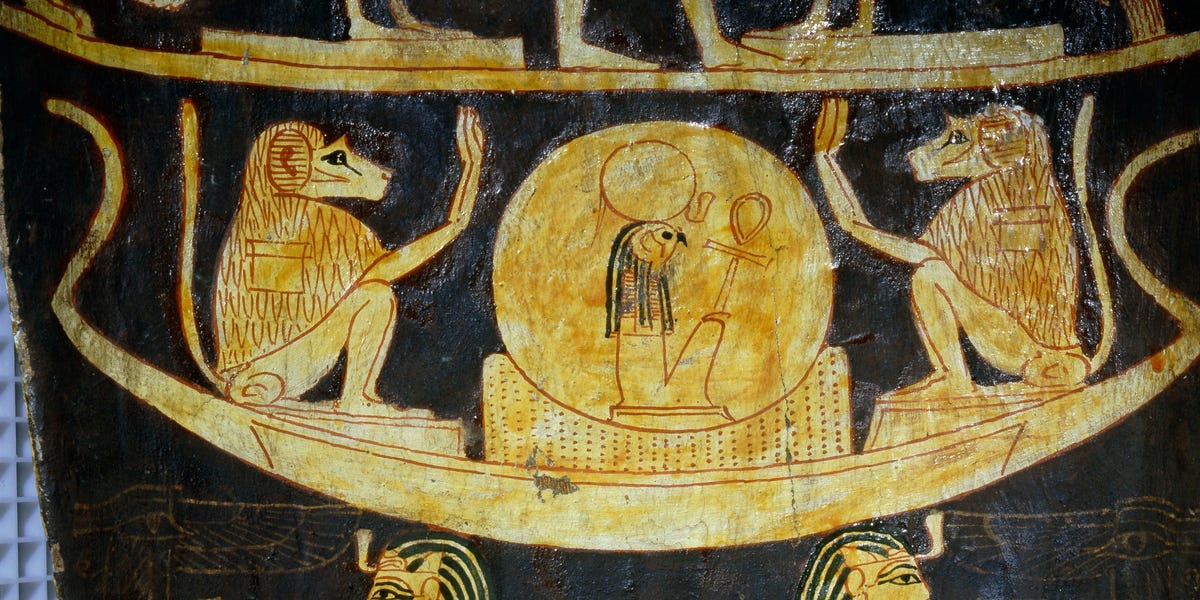
4 min readHere’s what you’ll learn when you read this story:While the Egyptian god Thoth was often depicted as having a human body with the head of an ibis, there has been much speculation around why he is also portrayed with the head of a baboon.The ancient world noticed links between the Moon and baboon behavior, but present-day researchers wanted to find out if there was a link between the luminosity of baboon fur and that of the Moon.Baboon fur turned out to have an extremely similar reflectance spectrum to that of moonlight, almost glowing, which explains the lunar association.Thoth, the Egyptian god of magic, wisdom, writing, and the Moon, is closely associated with the sacred ibis. This may have been because the bird’s beak is shaped like a crescent moon. Its feathers are also the same otherworldly shade of white as moonlight, which may be why one of Thoth’s names, “Dhwty,” translates as “white/bright-thing.” But if the ibis mirrors the moon, which Thoth was associated with, why was the god also frequently depicted as a baboon?Sacred ibises (Threskiornis aethiopicus) were once endemic to Egypt, but they became locally extinct after the gradual disappearance of the marshes and swamps along the banks of the Nile. Besides having a beak shaped like a crescent moon, the striking black and white plumage of the ibis resembles lunar phases, especially when the bird stands with its wings tucked in. Ibises were thought to be the earthly embodiment of Thoth, so revered that millions of the birds were mummified as offerings to the deity. Baboons, on the other hand, were never endemic to Egypt. They probably arrived in Egypt through trade, after which they also became sacred animals in the image of Thoth and sometimes Hapi, bred and kept captive in temple enclosures and mummified for the afterlife.There are six species of baboon, but only the Hamadryas baboon (Papio hamadryas), which is native to the Horn of Africa and the southwestern Arabian Peninsula, was considered the living image of Thoth. Hamadryas baboons are strikingly dimorphic, with adult males draped in a mantle of silver fur and whitish cheek ruffs as opposed to the sandy brown fur of females and juveniles. Egyptians thought the way these baboons bowed as the moon disappeared at sunrise was thought to be grieving its loss. But do the primates actually have some connection to the moon?Researchers Nathaniel Dominy of Dartmouth College and Catherine Hobaiter of the University of St. Andrews wanted to find out. “The reasons for this zoomorphism are uncertain,” the researchers said in a study recently published in Time and Mind: The Journal of Archaeology, Consciousness and Culture. “Speculation has focused on physical traits of the sacred ibis, especially its curved, crescent-moon shaped beak and its black-and-white pied coloration. The baboonification of Thoth is far more puzzling.”Dominy and Hobaiter studied 12 baboon specimens from the American Museum of Natural History. They compared the reflectance spectrum of the hair of hamadryas baboons and olive baboons (Papio anubis) to that of the Moon. Visible moonlight is almost entirely reflected sunlight, with a small contribution from earthshine, and the full Moon appears roughly 400,000 times fainter than the Sun. Its irradiance spectrum spans ultraviolet, visible and infrared wavelengths, but it’s strongest in the infrared. Meanwhile, the spectrum of olive baboon hair is seen as greenish-brown through human vision because of where in the spectrum it peaks and how it deflects downward at longer wavelengths. Not only is the spectrum of hamadryas baboons 65% brighter than that, but its profile turned out to be almost supernaturally close to that of moonlight: mostly flat but peaking at about the same place in the visible range. Our eyes interpret this as gray and silver. The magnificent shoulder mantle and cheek ruffs of hamadryas baboons are especially bright, so reflective that they even surpass the exceptionally luminous golden lion tamarins of Brazil.In sum, the fur of hamadryas baboons is the color of moonlight.The luminosity of hamadryas baboons potentially explains why Thoth was often depicted as one of these sacred animals. Whether in ibis or baboon form, Thoth was often seen with a full moon above his head. Living baboons kept by ancient Egyptians were almost treated as deities themselves. Ancient Egyptians treated the living baboons they kept almost as deities in their own right. Their keepers interpreted the animals’ behavior as a response to celestial events: they read one set of vocalizations as mourning, uttered when the solar barge of Ra displaced the Moon, and they interpreted shifts in behavior during solar eclipses as reactions to the Moon obscuring the Sun. The Egyptians also believed that anyone who learned the language of baboons would thereby decode the tongue of the gods.Some of the animals even had obituaries written for them, such as Mestatatoumis, the “hearing ear” of Thoth, whose mummy was entombed in the Baboon Catacomb of North Saqqara, at the edge of the vast human necropolis there. The sobriquet “hearing ear” implies that the baboon was an intercessor for Thoth on Earth, intervening for the god when prayers were sent to him or requests from him were heard. It was through Thoth that Egyptians believed they had received the gifts of writing and language.“Some zoomorphic forms of the gods can be associated with evident attributes of the species that embody them…[while] most zoomorphic associations are inscrutable,” the researchers said. “In the case of Thoth, the dual use of T. aethiopicus and P. hamadryas ‘defies explanation.’ Indeed, the baboon is an enigma as the only non-native zoomorphism.”Elizabeth Rayne is a creature who writes. Her work has appeared in Popular Mechanics, Ars Technica, SYFY WIRE, Space.com, Live Science, Den of Geek, Forbidden Futures and Collective Tales. She lurks right outside New York City with her parrot, Lestat. When not writing, she can be found drawing, playing the piano or shapeshifting.
Ancient Egyptians Believed Baboons Were Connected to the Moon. Scientists Say They Were Right.
Full Article
Original Source
Read the full article at Popularmechanics →KhanList aggregates and links to publicly available news content. We do not host full articles from third-party sources. Always verify important information with original sources.