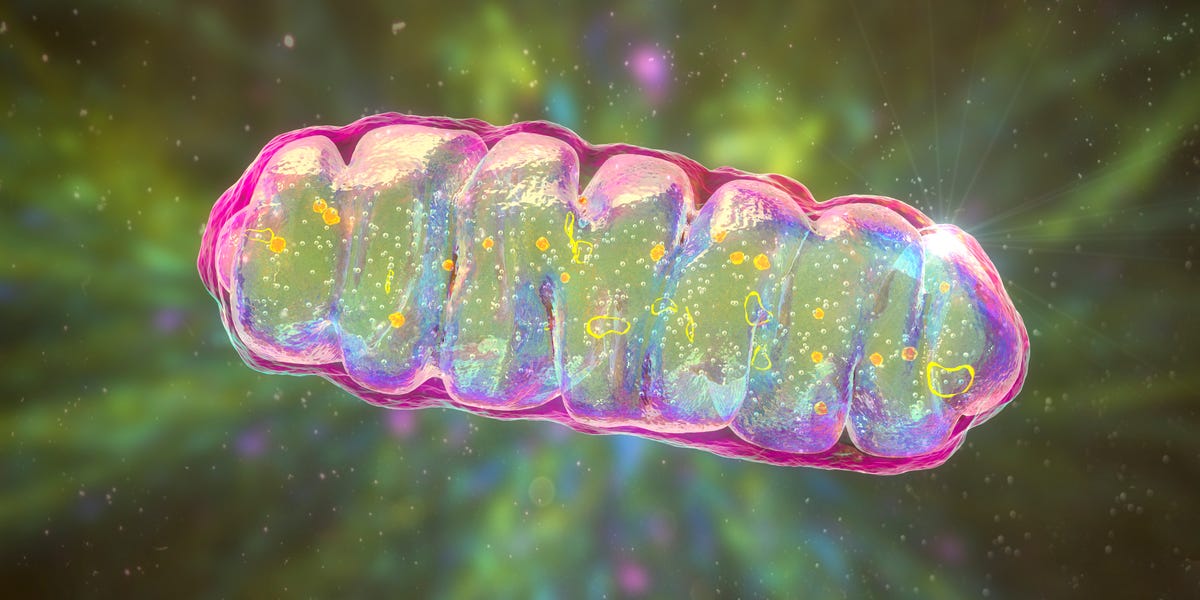
3 min readHere’s what you’ll learn when you read this story:Mitochondria play a vital role in most human cells by transforming food and oxygen into chemical energy.A new study finds that a lack of phosphatidylcholine, a membrane lipid, can reduce mitochondrial function, thereby accelerating aging.In a new study, scientists discerned that mitochondrial aging can potentially be reversed by feeding an organism choline or phosphatidylcholine.On average, the human body is made of 37 trillion cells, and many of those cells contain mitochondria, a membrane-bound organelle whose primary job is to transform food and oxygen into chemical energy. Because of this nifty, life-sustaining feat, mitochondria are commonly referred to as the “powerhouse of the cell.”Of course, one of the main effects of aging is a distinct lack of energy from our more youthful days, and in a new paper, a team of scientists led by researchers at the Leibniz Institute on Aging in Germany explored whether the performance of cellular mitochondria may be responsible. Scientists have long known that cellular aging and dysfunction—along with genomic instability—is a key driver of aging, but past studies haven’t extensively researched the mechanisms that cause mitochondria to play such an outsized role in the aging process. The new study, published in the journal Nature Communications, offers evidence that a membrane lipid known as phosphatidylcholine might hold the answer.In healthy cells, phosphatidylcholine increases mitochondrial flexibility, allowing them to form dynamic networks that can respond to changing energy needs. “You can imagine the whole system as a finely branched power grid that becomes increasingly damaged with age: connections break down and currents stall,” Leibniz Institute on Aging’s Maria Ermolaeva, the study’s lead author, said in a press statement. “Although energy production continues, it becomes less efficient and sustainable, and energy can no longer be distributed flexibly.”As phosphatidylcholine levels decline with age, mitochondria lose that much-needed flexibility, leading to cellular decline. Discovering this connection required Ermolaeva and her team to compare experiments with humans cells and clinical datasets with detailed mitochondrial analysis of Caenorhabditis elegans, a roundworm with a fully mapped cell lineage that’s perfect for studying aging because it only lives for two to three weeks. The researchers successfully connected patterns in laboratory models with human ones, and direct observation of the roundworms revealed molecular changes in real time.The study demonstrates that this method of cellular aging occurs in stages, an insight supported by human-based data as well. First, the cell experiences stress resistance, which leads to metabolic and eventually epigenetic changes. The team also noted sex-specific differences, and found that human phosphatidylcholine levels dropped rapidly around the age of menopause, a period often associated with increased fatigue.While that all reads like a mountain of bad news, there is a glimmer of hope. The study also notes that this decline is potentially reversible. By directly feeding worms choline or phosphatidylcholine, younger-acting mitochondria resulted in just a few days.“Our work shows that both mitochondrial aging and broader systemic aging are, at least in part, modifiable,” Ermolaeva said in a press statement. “If we understand the underlying processes, we may be able to take targeted countermeasures."Researching those underlying processes will be the target of future studies, but the hope is that future therapies could target at least this one piece in the entropic puzzle that is human aging.Darren lives in Portland, has a cat, and writes/edits about sci-fi and how our world works. You can find his previous stuff at Gizmodo and Paste if you look hard enough.
Scientists Uncovered a Hidden Switch Inside Our Cells That Could Slow—or Even Reverse—Aging
Full Article
Original Source
Read the full article at Popularmechanics →KhanList aggregates and links to publicly available news content. We do not host full articles from third-party sources. Always verify important information with original sources.