
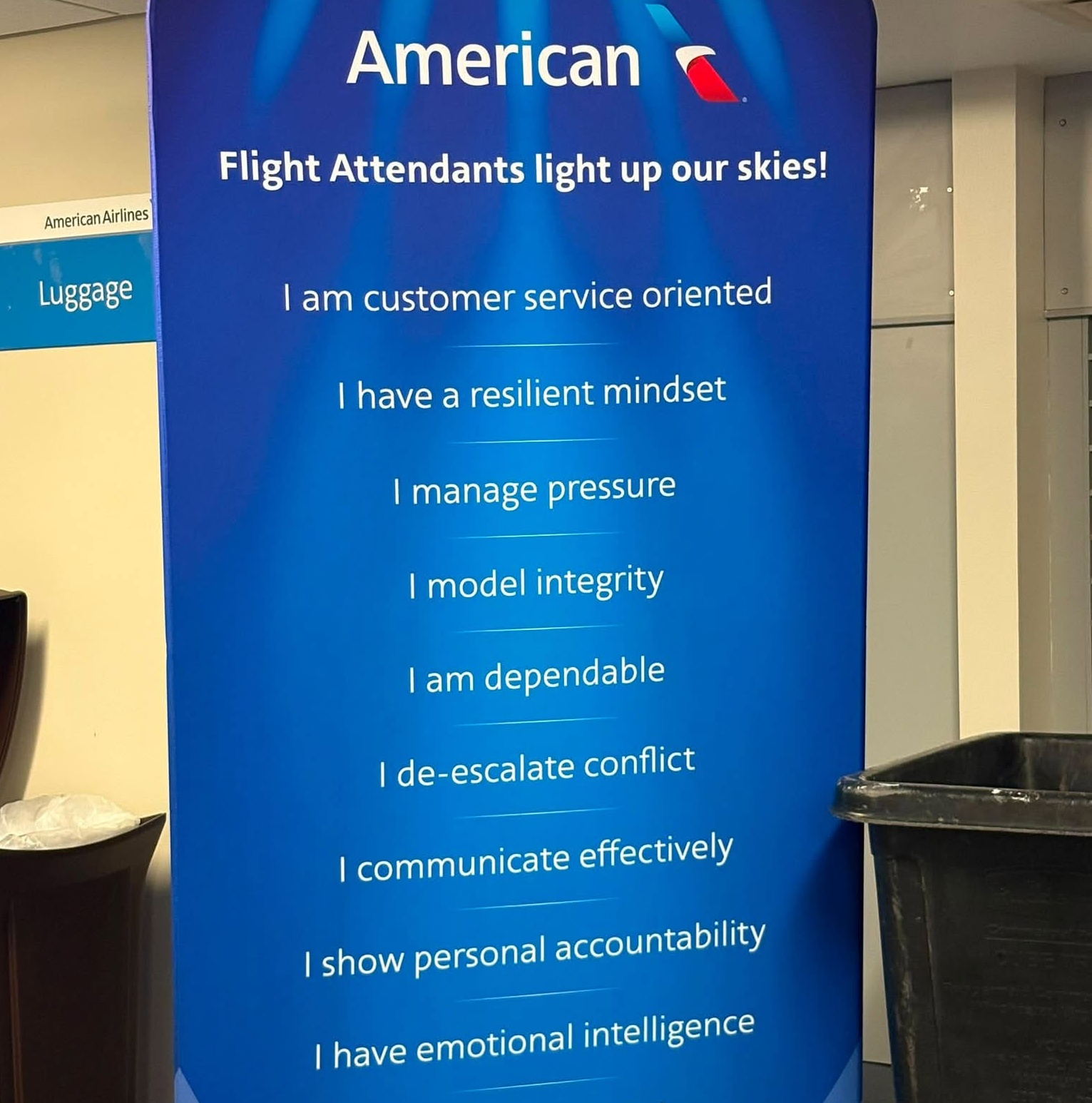
American Airlines has a banner telling flight attendants who they are supposed to be. They “light up our skies!” and each crewmember is asked to see themselves this way: I am customer service oriented I have a resilient mindset I manage pressure I model integrity I am dependable I de-escalate conflict I communicate effectively I show personal accountability I have emotional intelligence I am professional As an applicant profile, the list is o.k. but certainly not ordered how I’d choose. Service orientation, resilience and de-escalation are real requirements, and hiring is the right time to select for them even as there are key personality traits conspicuously absent from this list. Even the best airline faces weather, mechanical failures, medical events and intoxicated passengers. The banner has only “I” statements and never mentions what the airline commits to! As a method for motivating flight attendants, this is peak human resources. No one becomes more emotionally intelligent because a vinyl sign tells them to have emotional intelligence. Flight attendants wind up dealing with conflict that originates elsewhere from operational delays, broken seats and tray tables, and missing meals. American should train people to calm those situations even as it creates fewer of them. Their operational challenges have been real for years even when they prioritized fixing this over everything else. American Is Right To Measure Flight Attendant Performance This spring Me@Work began giving individual flight attendants scores using a year of customer and operational data. The Association of Professional Flight Attendants answered with Them@Work, grading inflight management instead. Me@Work’s central problem is attribution. It combines attendance, required reports and predeparture work with passenger scores and operational results produced by the whole airline. A customer rating also reflects delays, broken wi-fi, dirty planes and bad catering. Individual accountability should focus on what the employee controls. Me@Work doesn’t currently affect pay or assignments, and a strong score brings no meaningful reward. Flight attendants see it alongside a broader management system heavy on meetings and potential discipline. Minimum defensible compliance becomes rational. Employees follow the script, protect the door-close metric and don’t go out of their way for passengers. American shouldn’t stop measuring. They should do more of it! And bring on ghost riders to evaluate whether service standards are being followed. They should use them to reward the best and coach people who need help, eventually moving out those who remain unsuited to the job. American Has Tried To Make Culture The Product Before At American’s September 2017 Media and Investor Day, then-CEO Doug Parker said the company would make culture a competitive advantage. Competitors could match product investments while employees and service would differentiate American. Parker’s theory which he attributed to Southwest Airlines co-founder Herb Kelleher was that American would take care of employees, they would take care of customers, and customers would take care of shareholders by coming back. That can work. Southwest even still does a good job selecting for people who wind up liking their jobs, liking interacting with customers, and who have fun day to day. It’s not an excuse for the failure to invest in product, as it was in 2017. Parker said airlines don’t win with product because everyone else would just match those investments. Employees can’t deliver premium service on top of a cheap, broken product. And you don’t get to ’employees taking care of customers’ with slogans on a poster. At the event where Parker laid out this theory the airline also displayed their new coach seats for the first time, that would have less legroom, no screens, and get paired with smaller lavatories. Meanwhile, Elise Eberwein’s employee care pitch was about helping employees use their benefits and a company-sponsored weight-loss program. American also invested in two-day Elevate the Everyday Experience training. By spring 2017, 35,000 employees had participated. Elevate supplied words: acknowledge the customer, be present, show you care, communicate proactively and give options. Managers received separate coaching training. The vendor claimed a 15% increase in passenger satisfaction without supplying its methodology. Yet service never became American’s advantage. APFA complained even then that “Elevating the experience must begin with an investment in the tools necessary to do our jobs,” and that a cohesive workforce was built “from the top down.” In 2014 Parker had also famously argued that profit sharing was “not the right way to pay 100,000 employees that don’t have that much impact on the daily profits.” He clarified that outside forces drive profits. He broke the link he later needed employees to see between their work, customer loyalty and American’s results. The Product Is Finally Catching Up American is finally making the product investments its competitors made earlier. Its newest Boeing 787-9 business class is competitive. Starlink will start to roll out on more than 500 Airbus narrowbodies next year. Lounges and catering are improving. Premium and extra-legroom seating will rise from about 25% to 40% of seats on narrowbody departures over several years, and seatback screens are coming back. American has made better product decisions in the past 18 months than it did over the previous decade. The urgency is still missing. Screen-equipped deliveries and retrofits begin in 2028, while A321neo work stretches into the early 2030s. United said this spring that 70% of its United Next narrowbody retrofit was already complete. American is following the right map years late. And a better cabin still requires flight attendants to deliver consistent service. Management Needs To Create The Product And The Culture Robert Isom has to sell a premium global vision constantly in stations and crew rooms, not only in quarterly meetings after earnings calls. I was encouraged to see Isom working alongside employees at a gate. Management supplies service-ready aircraft, correct catering, accurate information, realistic staffing and authority to recover failures. Flight attendants report ready, remain visible, communicate, deliver the defined service and solve the problems they can. American evaluates individual, controllable behavior with credible evidence and gives employees a real opportunity to challenge errors. Repeated, attributable evidence of excellent performance earns meaningful recognition and money. Repeated failure after coaching has consequences. (The company missed a huge opportunity with its new flight attendant contract, that came with big raises, to get some accountability as well as I pointed out while it was still being negotiated.) American needs standards and trained evaluators. Human resources can implement the strategy through coaching, rewards and accountability. But Human Resources cannot provide the strategy or leadership. A better banner would begin with what American promises its flight attendants: a reliable operation, working equipment, clear service standards, discretion to solve customer problems, management support and a reward for delivering. Flight attendants do need resilience. American management should be working to require less of it. Topics on this page
American Airlines Tells Flight Attendants: Be Resilient And De-Escalate, This Banner Explains Why Service Still Lags
Full Article
Original Source
Read the full article at Viewfromthewing →KhanList aggregates and links to publicly available news content. We do not host full articles from third-party sources. Always verify important information with original sources.