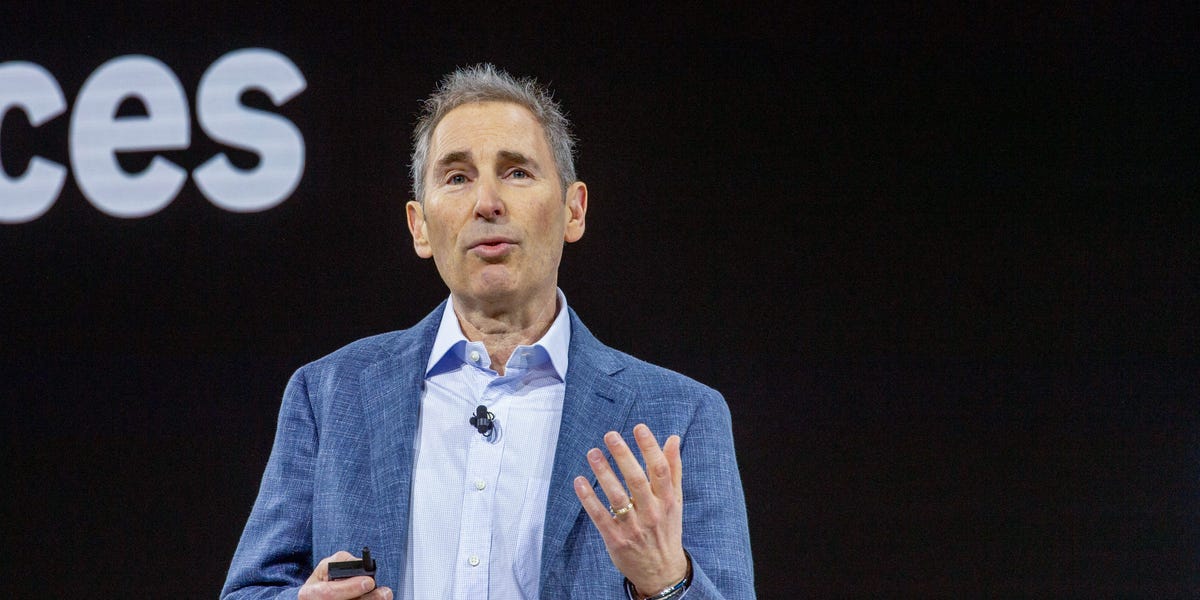
Amazon is proving you don't need the best model to win the AI race Amazon CEO Andy Jassy. Andrej Sokolow/picture alliance via Getty Images Amazon's earnings on Thursday highlighted a surprising idea gaining traction across Silicon Valley: You don't need the best models to win in AI.The company reported blockbuster results, including a 37% jump in revenue from Amazon Web Services. Those gains came from the cloud giant running many different AI models from leading providers such as Anthropic and OpenAI. In contrast, Amazon's efforts to build its own models are in somewhat of a mess, as Business Insider reported earlier this week.On Thursday, Amazon CEO Andy Jassy suggested this isn't a problem. During a call with analysts he said there won't be a single AI model that dominates the industry.Instead, Jassy explained, customers increasingly want to use multiple leading models, a trend that's helped fuel the rapid growth of Amazon Bedrock, the company's platform for accessing foundation models."AWS and Amazon can have a wildly successful business without its own frontier model," Jassy said. "There is not going to be one model to rule the world."This is a big change from what's been guiding much of the AI market since it exploded in 2022 on the back of ChatGPT. Companies have raced to develop the most powerful models, spending huge sums of money on training and other expensive development techniques. Now, though, the race has evolved to be less about raw performance and more about building and running efficient models, so-called intelligence per dollar. This potentially suits Amazon more than some other AI rivals.Amazon has never prioritized its own models. It did develop in-house offerings via the Nova range of models, but they struggled to come close to frontier.More recently, the company has been overhauling its AI strategy, winding down most of the existing Nova line while shifting resources toward a new frontier-model initiative, Business Insider reported earlier this week.Jassy's remarks suggest the company's long-term strategy is not to rely exclusively on its own models, but to make AWS the platform where customers can access the industry's leading AI systems — whether to not those come from Amazon.Rather than trying to win solely on model performance, Amazon has focused on making Bedrock the centerpiece of it AI strategy. Last year, Jassy said AWS was "building Bedrock to be the biggest inference engine in the world" and predicted the service could eventually rival EC2, AWS's flagship cloud computing business.During Thursday's call, Jassy said companies building AI applications want access to a wide range of models because different systems will surpass one another over time and excel at different tasks. That dynamic, he said, gives Bedrock a competitive advantage."If you're a company that's building important AI applications, you want to make sure that you have the ability to use all the available models," Jassy said. "They're going to each leapfrog each other at different times."At the same time, Jassy made clear Amazon remains committed to developing its own AI models.He said having a leading model would give the company greater control over costs for both its own consumer applications and AWS customers, while allowing Amazon to prioritize features important to customers and move faster without relying on outside providers.Alexa, for example, has been reducing its reliance on Anthropic's costly models in favor of Amazon's own AI models to lower costs, Business Insider previously reported.Jassy predicted that within the next few years there will be "at least a half dozen models that are comparably good to each other.""They'll all be on Bedrock," he said, "and one of them will be ours."Have a tip? Contact this reporter via email at ekim@businessinsider.com or Signal, Telegram, or WhatsApp at 650-942-3061. Use a personal email address, a nonwork WiFi network, and a nonwork device; here's our guide to sharing information securely. Read next Eugene is Business Insider’s Chief Tech Correspondent, where he leads coverage of Amazon. His reporting spans the company’s retail operations, AWS, Alexa, and its secretive internal work culture.Previously, he worked at CNBC, Fortune Magazine Korea, and Japan's Yomiuri Shimbun. He holds degrees from NYU and Columbia University’s Graduate School of Journalism.In 2022, Eugene broke a story uncovering Amazon’s practice of deceptively enrolling customers in Prime and deliberately making cancellation difficult. A year later, the Federal Trade Commission sued the company, citing his reporting. That case culminated in a record $2.5 billion settlement in 2025.His reporting has earned multiple honors, including the SF Press Club’s Bay Area Journalism Award and SPJ NorCal’s Excellence in Journalism Award.Eugene lives in the Bay Area. Contact him via email at ekim@businessinsider.com, or Signal, Telegram, or WhatsApp at 650-942-3061. Use a personal email address, a nonwork WiFi network, and a nonwork device; here's our guide to sharing information securely. ExpertiseAmazon, Jeff Bezos, Andy Jassy, e-commerce, and cloud computing.Popular ArticlesAmazon:Internal Amazon emails give an exclusive look at how CEO Andy Jassy has started to run the company, with obsessive attention to the retail business and what some employees feel is micromanagingAndy Jassy will be the next CEO of Amazon. Insiders dish on what it's like to work for Jeff Bezos' successor, who built AWS into a $40 billion business.Internal documents show Amazon has for years knowingly tricked people into signing up for Prime subscriptions. 'We have been deliberately confusing,' former employee says.Inside Amazon's flailing brick-and-mortar ambitions: missed projections, pressure to cut costs, and a war with Whole FoodsInside Amazon's complex employee-review system, where workers feel left in the dark and managers expect to give 5% of reports bad reviewsAfter 28 years, 'Day 2' finally arrives at AmazonAWS, Alexa, healthcare:Inside Amazon's struggle to break into the lucrative market for SaaS business applications, including an internal pitch to buy $38 billion HubSpotInside Amazon's struggle to crack Nvidia's AI-chip dominanceAmazon's AI data center dream runs into the reality of 'zombie' facilities, higher costs, and labor shortagesAmazon is gutting its voice assistant, Alexa. Employees describe a division in crisis and huge losses on 'a wasted opportunity.'Amazon is working on a new 'Remarkable Alexa,' but internal politics and technical issues plague the projectAmazon projected huge losses from its healthcare business in 2024, but strong sales growth, internal document reveals Amazon Artificial Intelligence
Amazon is proving you don't need the best model to win the AI race
Full Article
Original Source
Read the full article at Businessinsider →KhanList aggregates and links to publicly available news content. We do not host full articles from third-party sources. Always verify important information with original sources.