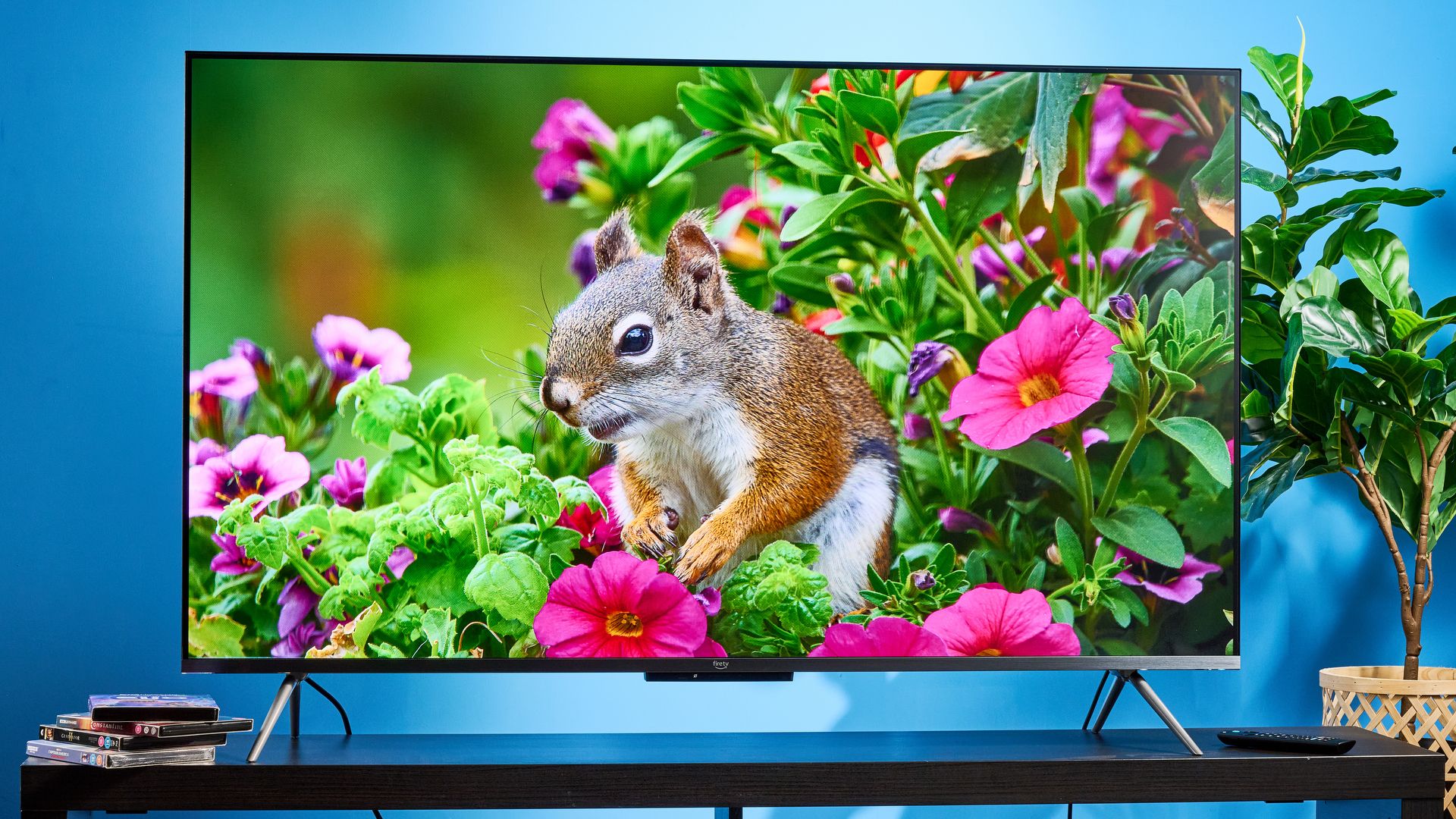
Tom's Guide Verdict The Amazon Ember QLED Series is a fine FireTV for folks who want to welcome Alexa+ into their homes, but it’s let down by some oversaturation and some motion smoothing issues. You can find cheaper alternatives that perform better with 4K/HDR content — so keep that in mind. Pros +Decent color and picture quality +Fire TV is responsive +Alexa+ built-in Cons -Warm colors appear oversaturated -Black levels could be darker -Not as bright as other TVs Why you can trust Tom's Guide Our writers and editors spend hours analyzing and reviewing products, services, and apps to help find what's best for you. Find out more about how we test, analyze, and rate. Jump To: Specs Price & availability Design and ports How we test TVs Performance Test results Audio Interface & apps Remote Verdict The Amazon Ember QLED is Amazon’s budget take on QLED TVs. With new-and-improved Amazon Alexa+ and the classic easy-to-use Fire TV interface, does it have what it takes to be one of the best TVs under $500? Not quite.The Ember QLED performs admirably with 4K UHD Blu-rays and is more than good enough for series binge-watchers, but I wish the blacks were darker and the colors a touch brighter. It’s not as affordable as other QLED options from Hisense and TCL, and many folks will be quickly tire of being assaulted by ads.While it might not be the best TV in the world, if you value convenience over serious cinematic quality, the Ember QLED could be right for you. To find out why, keep reading this Amazon Ember QLED Series review.Latest Videos FromTom's GuideAmazon Ember QLED Series review: Specs Swipe to scroll horizontally Price $479 (50”) - $1,199 (75”) Screen size 50, 55, 65, 75 (U.S. only) Model Amazon Ember Omni QLED Resolution 3840 x 2160 4K Ultra High Definition HDR HDR10, HLG, Dolby Vision, HDR10+ Adaptive Refresh rate 60hz Ports 3 HDMI 2.0 + 1 HDMI eARC 2.1 Audio 2.0 channel Smart TV software Amazon Fire TV with Alexa+ Size (without stand) 50: 43.7 x 25.5 x 3.2inches55: 48.3 x 28.2 x 2.8 inches65: 56.9 x 33 x 2.8 inches Weight (without stand) 50: 18.3 pounds55: 26.2 pounds65: 38.4 pounds Amazon Ember QLED Series review: Price & availability (Image credit: Tom's Guide)The Amazon Ember QLED Series was released in November 2025 and is the current version of Amazon’s QLED. (Amazon updated its naming conventions for TVs: No longer do they follow ‘Amazon Fire TV’ nomenclature; new models are called ‘Ember’.)I tested the 55” version for this review, but all sizes except the 50-inch have full-array local dimming, which ensures blacks are blacker and large highlights pop. Other than that, all models have the same features, including a physical mic-off switch on the bottom of the TV.In terms of price, the 50-inch model starts at $479 from Amazon. In the U.K., it’s £649 for the 50-inch, which is quite a bit more expensive. The 55-inch model I tested is $589. It’s also worth noting that the larger 75-inch model is not sold in the U.K., unfortunately.While the 50-inch model is somewhat affordable, the 65-inch Amazon Ember QLED comes in at $849 … which is quite a bit higher than the competition. For example, the Hisense QD7 is $439 for the 65-inch, which works out almost $400 cheaper than the Amazon Ember QLED — it’s probably the best TV under $500, so I highly recommend checking it out.Tom's Guide: Direct to Your InboxGet instant access to breaking news, the hottest reviews, great deals and helpful tips.Amazon Ember QLED Series review: Design and ports (Image credit: Tom's Guide)In terms of appearance, the Ember QLED looks great. It has a thin silver bezel that wraps around the exterior and measures in at only 2 inches thick.The TV has dual two-pronged legs on either side — but the legs are quite far apart, so bear that in mind if you have a small TV stand.The Ember QLED has four HDMIs (one eARC), an optical port, an Ethernet port, a USB-A port, and a headphone jack. There’s only one HDMI 2.1 port (and it’s the eARC), and three HDMI 2.0s, which is a little disappointing to see on a new TV.There’s also an optical port, which isn’t used as often these days, but is a good option if you have an older soundbar, AVR, or DVD player and don’t want Dolby Atmos audio.Amazon Ember QLED Series review: How we test TVs (Image credit: Tom's Guide)We follow a standard testing protocol for every TV we review at Tom’s Guide. Our benchmarks include a series of technical and subjective tests designed to rate the set’s performance.For our technical tests, we set the TV to Filmmaker mode (usually the most accurate out of the box) and take measurements using a Jeti SpectraVal 1501-HiRes spectroradiometer, a Klein K10-A colorimeter, a Murideo 8K-SIX-G Metal pattern generator, and Portrait Displays’ Calman TV-calibration software. We also use a Leo Bodnar 4K Video Signal Lag Tester for determining the TV’s gaming prowess.Subjective tests vary based on the reviewer but usually include anecdotes from a diverse selection of movies, TV shows, and other content. For a more detailed look, check out our “How we test TVs” page.Amazon Ember QLED Series review: Performance (Image credit: Tom's Guide)In all sizes other than 50”, the Ember QLED has full-array local dimming. In layman’s terms, this improves the contrast on an image — it makes the blacks blacker, and ensures big highlights pop (while dimming smaller white objects).To see just how good the contrast could look, I tested this with a scene from “The Revenant” and struggled to pinpoint elements in the darkest shots. The blacks blended into one mass of black, while firelight seemed a little too saturated.I also watched “Top Gun” on 4K Blu-ray. In the famous beach football scene, the oranges were almost bursting with brightness, but this negatively affected the rest of the scene. Every actor blended together. Motion artifacting during action scenes towards the end physically made me ill. This is definitely an area for Amazon to improve on in future TVs.When watching TV shows on Netflix, contrast was noticeably worse. Some blacks appeared more gray, and some whites were dull. However, the warm colors — that appeared a little oversaturated in “Top Gun: Maverick” — were bright.The good news is that the Amazon Ember QLED supports basic HDR10 and the more advanced Dolby Vision, which is great if you have a large 4K UHD Blu-ray collection, Netflix Premium, Disney+ and/or Apple TV+.In short, I wouldn’t recommend this TV if you’re a movie buff. I’d go for the Hisense QD7 in a heartbeat, or the Amazon Ember 4-Series if you want to save more money on a 4K TV.Amazon Ember QLED Series review: Test results Swipe to scroll horizontally Header Cell - Column 0 Amazon Ember QLED Amazon Ember 4-Series Roku Select Series Hisense QD7 Vizio VQM65-C SDR Brightness (10%, in nits) 439 304 335 402 789 Delta-E (lower is better) 4.62 7.1 2.45 1.75 4.99 Rec. 709 Gamut Coverage 99.8% 99.3% 93.85% 99.56% 97.87% HDR Brightness (10%, in nits) 251 287 335 659 779 UHDA-P3 Gamut Coverage 96.19% 94.10% 91.59% 94.33% 92.89% Rec. 2020 Gamut Coverage 72.31% 70.13% 72.36% 74.73% 71.34% Input latency (in milliseconds) 13 13 9.6 9.4 9.9 As far as our lab tests are concerned, the Ember QLED lands right in the middle of the competition. It’s brighter than the cheaper 4-Series and Roku Select Series, but it can’t keep pace with the class-leading Hisense QD7 and surprisingly solid Vizio VQM65-C.The Ember QLED Series has great Rec. 709 color coverage, meaning the TV screen can portray 99.8% of standard broadcast colors. However, it’s less accurate than its rivals, as evidenced by its Delta-E score of 4.62, meaning its overall color accuracy is relatively poor. That was backed up by the oversaturated oranges and undersaturated skin tones I observed during testing.For overall color volume, the race is a lot closer, with all five TVs in the mid-nineties for their respective UHDA-P3 Gamut Coverage. None of the TVs are prepared for the upcoming Rec2020 Color Gamut, but all of them are well-equipped for current HD/SDR content.What about 4K/HDR? The Ember QLED performed pretty poorly in our HDR brightness tests — topping out at a measly 251 nits, well below the industry-recommended 1,000 — so I wouldn’t really recommend this TV if you’re a movie aficionado or a gamer.Amazon Ember QLED Series review: Audio (Image credit: Tom's Guide)Like most TVs, the Ember has just two small 10W speakers, so bass can be lackluster. Dialogue sounded clear enough in most scenes but Amazon also included a ‘Dialogue boost’ control — just don’t count on it to radically improve vocal clarity.There’s a 5-band EQ customizer that does help a little. I’d rather this be a series of presets like ‘Bass boost’ or ‘treble boost,’ but I appreciate that there’s a built-in customizer.If you have a little more space in your budget, I recommend buying one of the best cheap soundbars — you can get the fantastic Sony HT-S100F for under $100 on sale these days. Any of those models will be an improvement on the Ember’s built-in speaker system.Amazon Ember QLED Series review: Interface & apps (Image credit: Tom's Guide)It’s a polarizing smart platform, but I found the Amazon Fire TV interface to be easy to use. I was able to navigate through the apps like Netflix, Disney+ and Prime Video quickly.One of the biggest upgrades from the 2023 model is the updated Amazon Alexa+ integration. Simple voice commands such as “Find me a film I can watch with my family” brought up movies like “Minions,” “The Gruffalo,” and “The Mandalorian and Grogu.”When I asked Alexa+ to “Find me a film a really picky person would like,” it brought up new releases like “Remarkably Bright Creatures” and “Euphoria.” When I asked for a “High school TV show that’s funny but also thrilling,” Alexa unfortunately replied, “I don’t know how to help you with that.”A simpler request — ”High school movie” — suggested “Incoming,” “Onward,” and “Untitled.” Only one of these movies is actually a high school movie, which was disappointing.The price for this enhanced usability is a slew of mostly Amazon-related advertisements. Unfortunately, this has become par for the course with smart TVs and isn’t exclusive to the Fire TV platform.Amazon Ember QLED Series review: Remote (Image credit: Tom's Guide)As with every other Amazon TV, you get the classic ‘Fire TV’ remote. It’s long and slender, easy to grip in one hand, and includes all the buttons you’d need. Perhaps an improvement could be to include one blank, customizable button for direct access to a regularly used app not in the included four, such as YouTube.The remote uses two AAA batteries, which is pretty standard, but I wish more companies were taking inspiration from Samsung’s new solar-powered remotes. Never having to replace the batteries is not only good for users, but it’s good for the planet as well.Amazon Ember QLED Series review: Verdict (Image credit: Tom's Guide)Unless you’re shopping during a major sale period like Amazon Prime Day or Black Friday, you’ll be spending around $600 on the 55-inch Amazon Ember QLED — and at that price, there are simply better options out there.Don’t get me wrong, for your standard SDR content it’s good enough, and its Fire TV operating system is easy to use, with an accessible interface and great Alexa+ integration. As with all Amazon TVs, the remote is also easy to use — ideal for those who get overwhelmed with complex operating systems or remotes.Just don’t expect it to perform miracles with 4K/HDR content. If you want something a bit more accomplished, take a look at the Hisense QD7. Not only is it cheaper ($299 for the 55-inch model), but it’s going to deliver a more impressive picture quality without many of the performance issues I listed above.If you’re dead-set on an Amazon model, I’d recommend saving your $300 and getting the lower-quality Amazon Ember 4-Series. It’s not a QLED, but at least you’ve saved money. Erin Bashford is a senior writer at Tom's Guide, focusing on reviews. She has a Masters in Broadcast and Digital Journalism from the University of East Anglia. As an ex-barista, she knows her way around a coffee machine, and as a music lover, she's constantly chipping away at her dream of having a multi-room home sound system. In her spare time you can find her reading, practising yoga, writing, or stressing over today’s NYT Games. You must confirm your public display name before commenting Please logout and then login again, you will then be prompted to enter your display name.
Amazon Ember QLED TV review
Full Article
Original Source
Read the full article at Tomsguide →KhanList aggregates and links to publicly available news content. We do not host full articles from third-party sources. Always verify important information with original sources.