
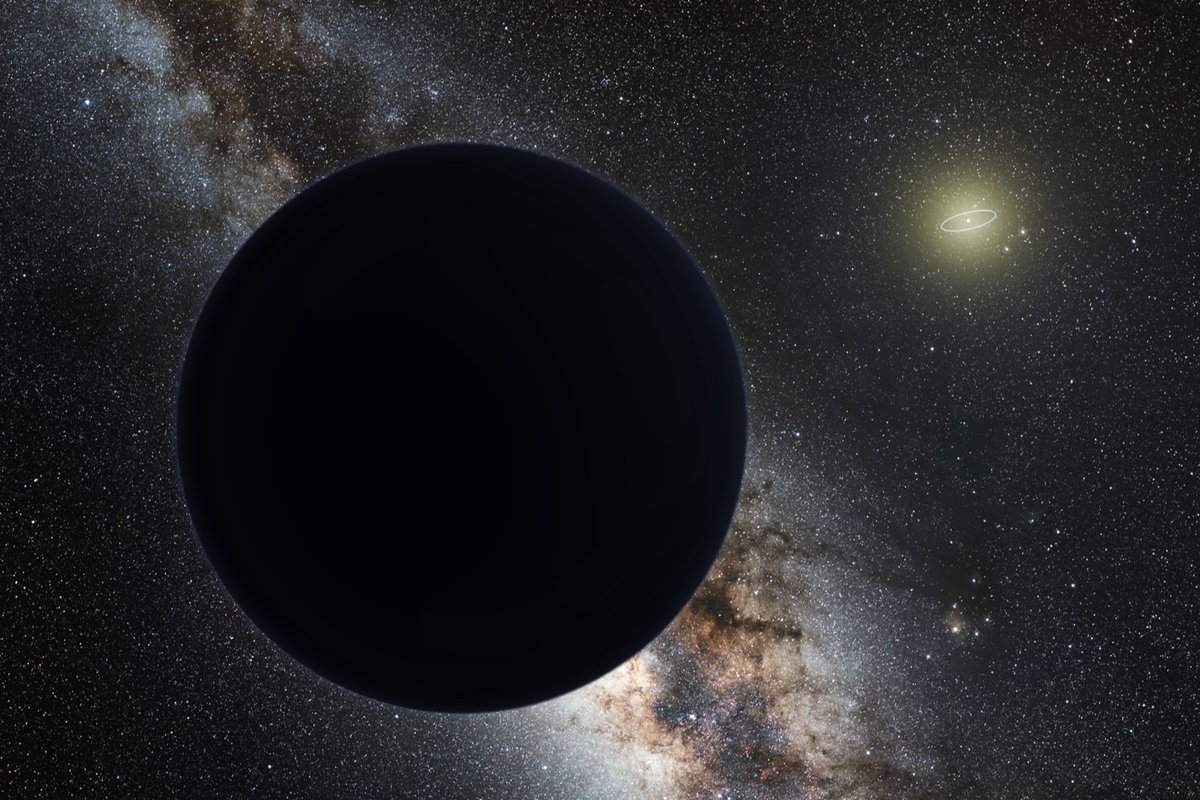
November 29, 20263 min read Add Us On GoogleAdd SciAmA software engineer and his colleagues used large language models to find what could be a hidden worldThis artist’s concept shows a shadowy dwarf planet adrift in the outer reaches of the solar system. Neptune’s orbit is represented as an ellipse around the distant Sun. nagualdesign/Tom Ruen/background from ESO/CC BY-SA 4.0Amateur astronomers using Anthropic’s Claude say they’ve found a potential dwarf planet in public archives of telescope images, signaling what may become a new wave of such discoveries in the outer solar system. Software engineers Joshua Wolk and Luke Farritor, working with artificial intelligence researcher Will DePue, discovered the candidate in early data from the Vera C. Rubin Observatory in Chile, specifically in views of the southern sky the observatory captured in April and May 2025, during its commissioning phase.The Rubin data are online, and the team used the commercial AI models to write code to search it for slow-moving objects in a crowded region of sky near the galactic plane. They’d already used AI to plot 400 of the thousands of known trans-Neptunian objects (TNOs), a catch-all category of objects beyond Neptune’s orbit. The team noticed that other observatories had mostly ignored the region because it was too densely cluttered with background stars for TNOs to be easily discerned. The researchers’ AI-assisted code first detected signs of the candidate dwarf planet in the Rubin data, which they confirmed by matching roughly 50 billion potential orbits to objects in archived image data from earlier telescope surveys.The discovery “shows that there’s people out there who can find things that we miss, and that’s phenomenal,” says Mario Jurić, an astronomer at the University of Washington who leads the Rubin Observatory’s Solar System Operations Team. Jurić inspected the images and ran the team’s data through Rubin’s verification systems to confirm that their first newfound TNO is probably real.On supporting science journalismIf you're enjoying this article, consider supporting our award-winning journalism by subscribing. By purchasing a subscription you are helping to ensure the future of impactful stories about the discoveries and ideas shaping our world today.Judging from its brightness, the object is about 365 miles (590 kilometers) across, which could be large enough for gravity to have pulled it into a spherical shape—an essential requirement for a dwarf planet. Its eccentric orbit varies between 32 and 79 astronomical units (roughly between three billion and 7.3 billion miles) from the sun, and it is now near its greatest distance.The new candidate dwarf planet—it has yet to be formally recognized by the International Astronomical Union—comes only weeks after a professional team led by Harvard University astronomer Matthew Holman announced a different dwarf planet candidate in Rubin data from the same star-spangled patch of sky—but it was found with a traditional search using computer algorithms, not AI. Holman welcomes the new approach but cautions it’s not clear how the AI-assisted search was achieved. In fact, Holman says, it’s likely Claude used open-source software tools that Holman himself built to find the dwarf planet candidates. “That’s where Claude is particularly strong,” he says: combining established methods with an extensive knowledge of the relevant scientific literature.Jurić says that half a dozen amateur researchers contacted him last week about potential discoveries pulled from the Rubin data by AI. “Before, you needed to be a master coder to implement some of this stuff,” he says. “But now, if you have an idea and if you know what to look for, you’ve got a software engineering team at your fingertips.”Wolk thinks (and Holman agrees) that there are many more TNOs yet to be found in the same neglected patch of the sky: “There’s a few that I’m trying to recover right now.” His interest in the outer solar system coincides with a scientific boom in research about this mysterious region, which is home to hundreds of thousands of orbiting ice and rock objects—and dwarf planets like Pluto—in what’s known as the Kuiper Belt. Professional astronomers say the objects are “cosmic fossils” that preserve clues about the solar system’s evolution: the outer planets Jupiter, Saturn, Neptune and Uranus formed somewhat closer to the sun and only later moved into their more distant orbits, Jurić says. “Something happened that pushed them out, and these objects in the outer solar system can tell us what that was.”Subscribe to Support Independent JournalismGreat science journalism requires human expertise, time, effort and creativity. And it costs money. That’s why I and the journalists here at Scientific American hope you’ll join our community.When you subscribe, you are supporting staff and freelance journalists who are passionate about telling science stories that are true, important and compelling. Our editors and reporters are often experts in their fields, which means they understand the nuances of big discoveries and can untangle the breakthroughs from the hype. With a subscription, you are also supporting rigorous fact-checking to ensure the words we publish are precise and accurate. And you’re supporting original illustrations, graphics and photos that bring you closer to an advanced laboratory, an ice sheet in Antarctica or a space mission in orbit. You’re helping us craft other types of high-quality journalism as well: Our newsletters are carefully written, edited and curated by staffers you have or will come to know and love. Our Science Quickly podcast is based on original reporting, collaboration with editors and scientists and exacting production.Subscriptions keep this engine running so we can continue to deliver thoughtful, rigorous and independent science journalism to you. In an era of viral misinformation, this work is crucial. If you value what we do, I hope you’ll consider joining us as a subscriber
Amateur astronomers and AI spot a potential dwarf planet
Full Article
Original Source
Read the full article at Scientificamerican →KhanList aggregates and links to publicly available news content. We do not host full articles from third-party sources. Always verify important information with original sources.