
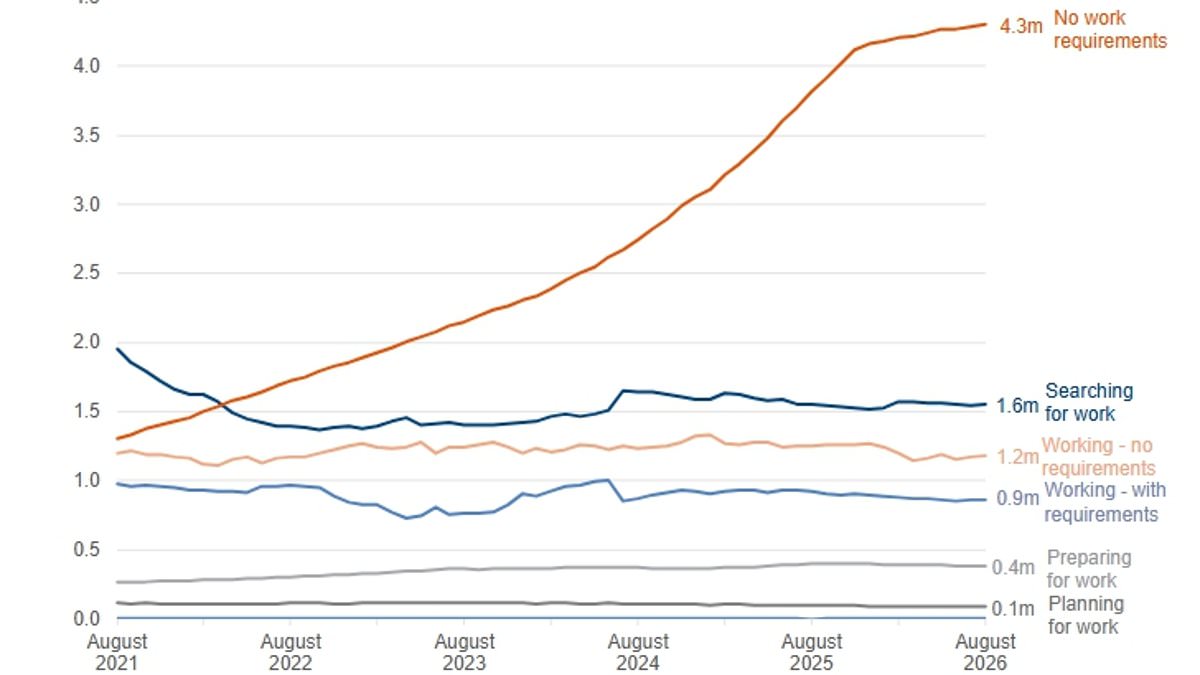
Published: 13:24 EST, 17 November 2026 | Updated: 14:38 EST, 17 November 2026 Almost half a million Britons were signed on to unemployment benefits without any requirements to look for work in the last year, damning figures show.More than four million were claiming Universal Credit (UC) with ‘no work requirements’ conditions in August - an increase of 486,000 in a year, the latest data shows.The number of those receiving the main out-of-work benefit with no obligation to work or even to look for a job has spiralled under Labour, reaching a record 4.3million people in August.Those claiming jobless benefits with no work requirements now make up an astonishing 51.4 per cent of the total 8.4 million people on UC, Department for Work and Pensions (DWP) data shows.Jamie Jenkins, the former head of health and employment data at the Office for National Statistics, said: ‘Many are genuinely ill or caring for someone. But when more than half of people on the main benefit aren't expected to work, what is the system now for?’UC is a payment to help with living costs and is available to people who are out of work or cannot work, as well as to working people who are on low incomes.People in the ‘no work requirements’ bracket can include those in full-time education, over the state pension age, someone with a child aged under one, and those considered to have no prospect of work.Some UC claimants are required to carry out certain ‘work-related activities’, such as attending interviews or actively searching for a job. But the majority can now draw the benefit without doing anything work-related. The number of people getting the main out-of-work benefit with no obligation to work or even to look for a job has spiralled under Labour, reaching a record 4.3 million people in August The DWP points out that a significant proportion of the growth in UC claims in recent years is due to people being moved on to UC from the legacy benefits system.But the figures show that while an extra 124,000 people were handed UC with no work requirements between January and August 2026, just 1,700 of these had been moved across from the old system.A DWP spokesman said: ‘The number of people on Universal Credit has now stabilised after a significant increase since 2022 driven by the move from legacy benefits, and this also applies to the number with no work requirements which has increased just 0.4 per cent on the last quarter. 'We are already changing the system through narrowing the gap between Universal Credit standard and health rates, restoring face-to-face assessments, and investing a record £3.5billion in employment support for disabled people and those with long-term conditions. 'Today's Milburn report, and the Timms report due later this month, will lay the foundation for sustainable welfare reform.'Separate figures released on Tuesday show that the child element of UC was handed out for an additional 1.6million children in May 2026 following Labour’s decision to scrap the two-child benefit cap.The two-child UC limit was introduced by former Tory chancellor George Osborne and had been in place since 2017. Under the previous rules, families could only receive the child element of UC for their first two children.But the decision to scrap the two-child benefit cap was announced by former chancellor Rachel Reeves at the budget in November 2025 and came into effect in April 2026.Responding to the figures, Secretary of State for Work and Pensions Pat McFadden said: ‘This is about changing the story of children’s lives.‘Children who grow up in poverty are more likely to have mental health difficulties, to be Neet and to earn less as adults.‘We want to give every child a genuine shot at life – to do well at school, stay healthy, succeed at work – ultimately contributing to their community as adults.‘Removing the two-child limit is the most cost-effective way to drive down child poverty rates and is an investment worth making – for those children, for their families, and for the whole country.’
Almost half a million people signed on to unemployment benefits without any obligation to look for work in the last year
Full Article
Original Source
Read the full article at Dailymail →KhanList aggregates and links to publicly available news content. We do not host full articles from third-party sources. Always verify important information with original sources.