
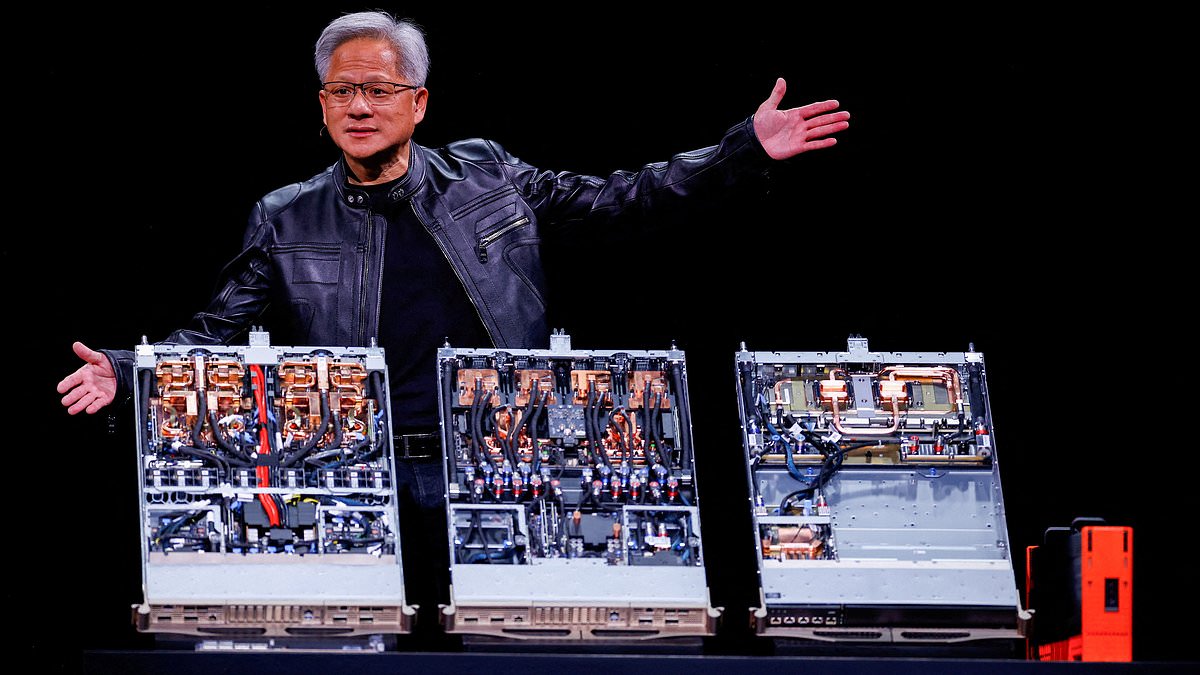
AI debt nightmare is being exposed as investors wake up to the emperor having no clothes: ALEX BRUMMER Updated: 03:45 EST, 13 November 2026 The departure of Jensen Huang from Nvidia, after days of epic scrutiny of his personal life, could prove to be the defining event of the whole AI revolution.It has brought the chip designer down with a bump, wiping almost a trillion dollars off the value of the company since reports of his affair with a Chinese intelligence asset became public knowledge on October 29.Subsequent reports of an alleged extra-marital affair with a senior colleague at Nvidia, Kimberly Powell, were the final straw, which required a weak board to act.The appointment of a veteran board member, Harvey C Jones, as chairman and finance boss Colette Kress as interim chief executive are emergency choices intended to bring stability to chaos.The implications of Huang’s exit are much wider. Claude AI champion Anthropic has already seen hundreds of billions of dollars wiped off the value of its intended initial public offering.Nvidia shares may bounce and Anthropic come to market, but Huang’s sordid departure should bring some proper scrutiny to an AI revolution where far too little attention has been paid to governance or to extraordinary debt levels. The departure of Jensen Huang from Nvidia has brought the chip designer down with a bumpFinancial markets have a rhythm of their own. Crowd behaviour can cause optimism to be divorced from reality.It is remarkable that warnings from almost every financial enforcer on earth, including the Bank of England and the International Monetary Fund, about inflated AI values, divorced from reality, were ignored.Each time stocks in the sector have lurched downwards they rapidly recovered. Such volatility is almost always a prelude to market collapses.In the last 48 hours I have faced criticism, from several British corporate executives, for excessive negativity. Hopefully, they are right and the Huang scandal will prove an eddy on the passage to the sunny uplands.Much the same was said on the eve of the Great Financial Crisis (GFC) when the run on Northern Rock and the implosion at investment bankers Bear Stearns were largely seen as one-offs.It was during this period that I visited the offices of CQS, one of London’s leading hedge funds. I was introduced to a credit analyst.He pulled up on screen a table of credit exposures, which showed that all Britain’s second-line consumer banks, such as Halifax Bank of Scotland (HBOS), were effectively bust. Several of our major clearing banks were in trouble too.Not long after, then Prime Minister Gordon Brown, Chancellor Alistair Darling and Bank of England Governor Mervyn King were required to launch a near-£1trillion lifeboat (including monetary system support) to hold up the whole edifice.A crisis that began in the little-understood sub-prime mortgage market in the US drilled a black hole in public finances from which we have never recovered.Only yesterday I bumped into an analyst whose firm provides services to hedge funds and other investors across the globe. He noted the AI investment boom had spread far and wide. The big beasts among tech giants, and their smaller cousins, could no longer finance investment from cash flow and had run up $3trillion of debt in a rapid-fire time.As was the case during the GFC, there is precious little transparency as to where risk lies.Students of 2008 would recognise the number of ‘special purpose vehicles’ (SPVs) – a feature of 2008 – that had been established to move the risk off published balance sheets. This offered the opportunity to spread the leverage through the financial system.The fall in tech values may not simply be a nervy reaction to Jensen Huang and strategic fall-out in Beijing. Finally, some investors are waking up to the reality that the emperor has no clothes.Silver liningIf there is any comfort for the UK to be drawn, it is that Britain, with its great science and tech roots, may be enjoying a halo effect from the AI revolution.The surprising strength of growth in the third quarter, which zipped to 0.7 per cent, may partly be down to research and development, AI adoption and investment in infrastructure such as data centres.We live in hope.DIY INVESTING PLATFORMSAJ BellAJ BellEasy investing and ready-made portfoliosHargreaves LansdownHargreaves LansdownFree fund dealing and investment ideasinteractive investorinteractive investorFlat-fee investing from £4.99 per monthFreetradeFreetradeInvesting Isa now free on basic planTrading 212Trading 212Free share dealing and no account feeAffiliate links: If you take out a product This is Money may earn a commission. These deals are chosen by our editorial team, as we think they are worth highlighting. This does not affect our editorial independence.Compare the best investing account for you
Alex Brummer: The AI debt binge sparks disturbing echoes of the financial crisis
Full Article
Original Source
Read the full article at Dailymail →KhanList aggregates and links to publicly available news content. We do not host full articles from third-party sources. Always verify important information with original sources.