
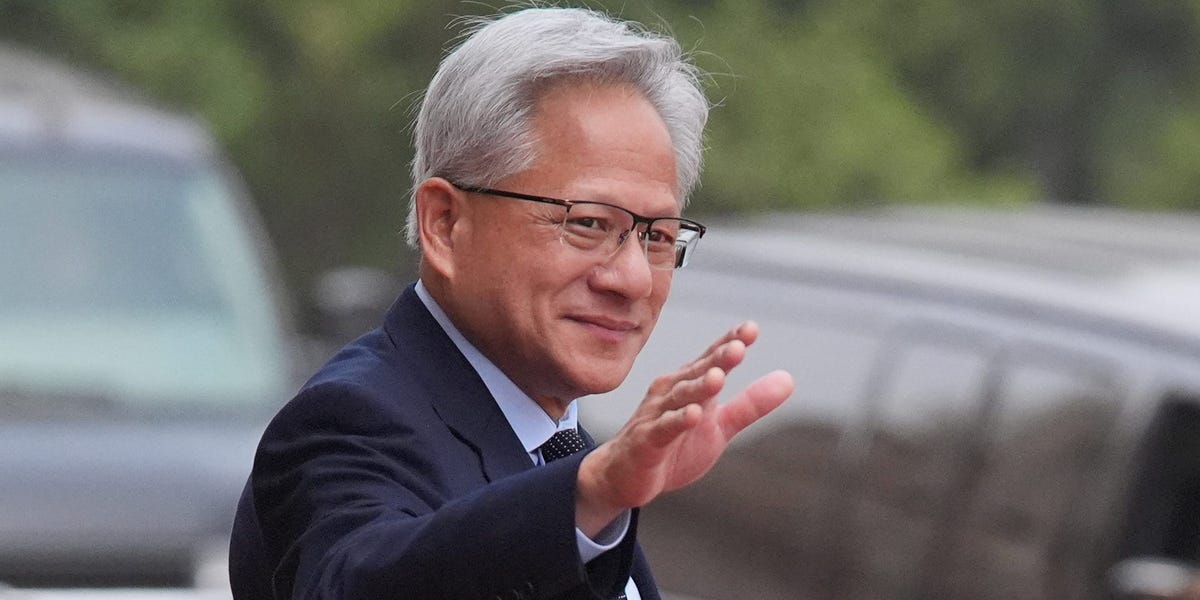
Jensen Huang shows the risk of becoming an indispensable leader When he ran Nvidia, Jensen Huang said a flat structure at the top kept information flowing and decision-making nimble. Mark Schiefelbein/Associated Press For years, Jensen Huang embraced a flat leadership model as he molded Nvidia into one of the world's most powerful companies.His sudden exit Wednesday amid scandal puts that arrangement to the test like never before.After cofounding the chip giant at a Denny's restaurant in the early 1990s, Huang went on to lead Nvidia with as many as 60 direct reports. That deliberately flat structure at the top was something he credited with helping the company keep information "fluid" and employees empowered.Yet the halo surrounding a successful tech founder, combined with an org chart light on top layers, can leave a company with a thin succession bench, C-suite observers told Business Insider."It's hard to imagine any of those direct reports are able to get the scale, scope, and experience to even be qualified to be the CEO," said David Astorino, a senior partner at leadership consulting firm RHR International.Nvidia hadn't publicly disclosed a succession plan. The company's appointment of an internal interim CEO to replace Huang while launching a search for a permanent replacement, including internal and external candidates, suggests it also didn't have an obvious candidate in mind behind the scenes, said Astorino.Nvidia didn't respond to a request for comment from Business Insider.'Key-person risk'Astorino said Huang's outsize status created "key-person risk," in which too much control rests with a single executive. He said the problem is particularly acute for Nvidia because of its central position in the AI ecosystem.Dan Kaplan, managing partner and head of the HR practice at the consulting firm ZRG, said founders can be conditioned to brush off doubts after years of being told their ideas would fail, making it especially hard to persuade them to plan for a future without them. "They're not great at hearing no," he said. "They develop the thickest skin possible" after years of hearing from skeptics while building their companies."When you have a flat organization like this, it's great for speed. It's not great for developing leaders," Kaplan said.Nvidia's succession crunch reflects a broader corporate dilemma: Boards too often begin planning only after the window to prepare has narrowed. In a 2025 Nasdaq survey of about 700 board members, CEOs, executives, and governance professionals, 21% said their boards had no CEO succession plan, while another 16% said they had only an emergency plan.Identity tie-upHuang resigned as CEO, president, and board member amid reports of multiple extramarital affairs and a board investigation into concerns that he may have been the subject of a foreign intelligence effort.Nvidia named Colette Kress, its CFO, interim CEO while it searches for a permanent replacement.The abrupt transition underscores a common vulnerability for founder-led companies, said Bradley Akubuiro, a partner at Bully Pulpit International and former Fortune 50 chief spokesperson. The reason, he said, is that founders' identities often become tied to an organization's success or failure.Boards in general can mitigate that risk by adding an independent director, lead director, or chair who can bring more governance to a founder-led company and keep succession planning on the agenda, Akubuiro said. They should ensure that someone can provide continuity if a CEO leaves unexpectedly."It isn't always going to be misconduct," he said. "Any number of things could happen."A viable succession plan requires more than putting a name on an org chart, Akubuiro added. Potential successors need substantial operational experience, exposure to the board, and sufficient visibility with investors, customers, and other stakeholders to inspire confidence that they have what it takes to step in, he said.Avoiding a lame duckEven when companies do that planning work, however, they often keep it quiet, said Umesh Ramakrishnan, cofounder and chief strategy officer at the executive search firm Kingsley Gate. That's because publicly naming a successor can turn the sitting CEO into a lame duck, prompt passed-over contenders to resign, and invite internal jockeying for influence around the heir apparent, he said."The organization starts gravitating toward the successor because they know that's where the power center is going to be," Ramakrishnan said.Still, he said that boards should begin succession planning well before a crisis, cultivating two or three serious internal candidates, giving them substantial operating responsibility, and creating incentives for them to stay through the transition.Lior Prosor, cofounder and managing partner at the venture fund Deep33, said Nvidia has been a "super sticky organization" for years, in part because employees could take part in the company's extraordinary stock run-up. With the company's shares taking a hit, the leadership upheaval could give rivals a fresh opening to recruit some of its most valuable talent."For the first time ever," employees may be asking, "How much will my equity be worth? How quickly does it come back?" Prosor said.Nvidia's troubles could serve as a learning opportunity for companies that have flattened management structures, said Alexander Kirss, a director analyst in Gartner's HR practice."No employee is irreplaceable," he said. "That includes the CEO." Read next Business Insider tells the innovative stories you want to know Business Insider tells the innovative stories you want to know Business Insider tells the innovative stories you want to know Business Insider tells the innovative stories you want to know Sarah E. Needleman covers leadership and the workplace for Business Insider.Previously, she was a reporter for The Wall Street Journal for more than two decades, covering technology companies, entrepreneurship, and recruiting.In 2022, Sarah received an honorable mention with WSJ colleagues for their coverage of workplace misconduct at Activision Blizzard from the Society for Advancing Business Editing and Writing.Sarah graduated from Rutgers University in 1997 with a bachelor's degree in journalism. She lives with her husband, daughter, and fur child (an Australian labradoodle) in northern New Jersey. Tim reports on the workplace and the forces reshaping how people make a living, including AI, remote work, and corporate cost-cutting. His reporting examines how those shifts are changing careers, management, hiring, performance expectations, and workers’ day-to-day lives, particularly in fast-changing fields such as tech.He previously reported on Wall Street and the stock market for the Associated Press. Leadership Technology
Jensen Huang shows the risk of becoming an indispensable leader
Full Article
Original Source
Read the full article at Businessinsider →KhanList aggregates and links to publicly available news content. We do not host full articles from third-party sources. Always verify important information with original sources.