
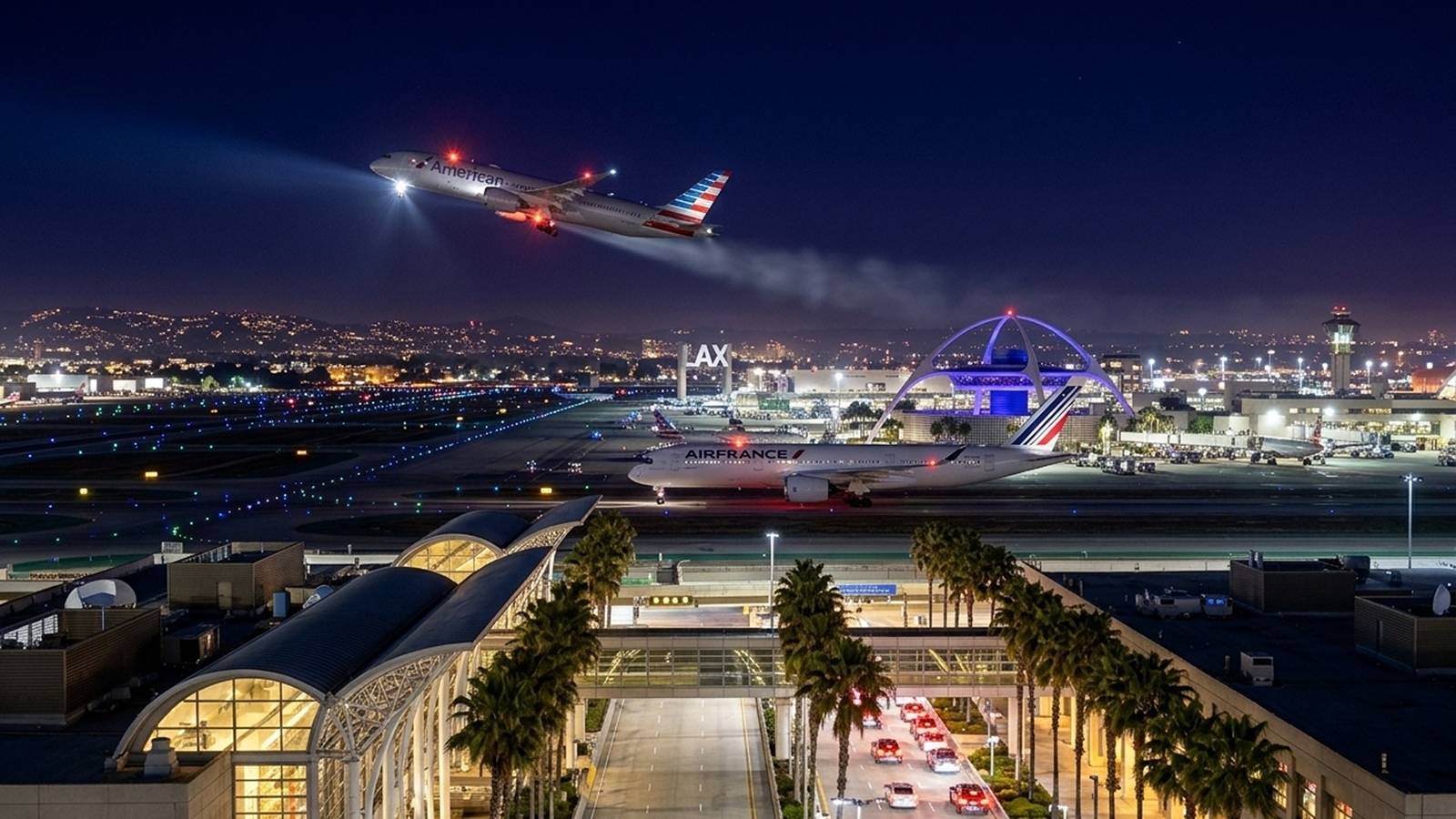
Published Nov 8, 2026, 2:35 AM EST Journalist – Aaron is an aviation and travel journalist with 14 years of experience in the travel and tourism industry. His background spans airport operations, aviation infrastructure, and travel consulting, having worked with global organizations across New Zealand, Europe, and North America. Combining industry expertise with firsthand travel experience across more than 52 countries and five continents, Aaron covers airlines, airports, aviation policy, and the wider travel sector. He is based in Canterbury, New Zealand. His work has been published in Simple Flying and featured by MSN, SAM CHUI Aviation & Travel, EIN News, Pakistan Defence, and Climate Depot. Two aircraft belonging to American Airlines and Air France came within 400 feet (121 meters) of each other as both jets attempted to depart from Los Angeles International Airport (LAX). Quick actions by air traffic control and the pilots onboard averted a close call that could have had catastrophic consequences. The two planes were departing from California's busiest airport early on Saturday morning, when Air France flight 28 was destined for Papeete (PPT), and American was flying to Dallas/Fort Worth International Airport (DFW) and came scarily close to each other as they departed from Los Angeles. Air France operates to the overseas collectivity of France located in the south-central Pacific Ocean, French Polynesia, with one-stop flights from Paris Charles De Gaulle Airport (CDG) to Papeete, via Los Angeles. Air France And American Airlines Escape A Mid-Air Disaster In Los Angeles Credit: Fabian Joy | Shutterstock The Air France Airbus A350-900, operating as AF28, had been cleared to take off from Los Angeles via the SUMMR2 procedure, and during its climb it identified the American Airlines jet and the two planes came within close separation. SUMM2, according to the Federal Aviation Administration (FAA), is to fly from Runways 24L/R and 25L/R and requires standard takeoff minimums with a minimum climb rate of 500 feet per nautical mile (ft/NM) up to 640 feet. At the same time, the American jet, destined for Texas, was told by air traffic control to stay at 2,000 feet, to allow the Air France widebody to turn and then head to FL270. Incorrect actions, including an unauthorized turn by Air France, led the two planes into conflicting flight paths. Simple Flying reached out to Air France for comment on the incident on Sunday; however, an airline spokesperson could not immediately be reached. Error Identified Shortly After Takeoff Credit: Karolis Kavolelis | Shutterstock According to TurbineTraveler on X, the Air France plane made an unauthorized turn left instead of its agreed plans from air traffic control to continue straight. This placed the Air France jet directly in the trajectory of the departing American jet. This led the two planes to come within a short distance of each other. Promptly picked up by air traffic control, actions were immediately issued to both aircraft for crews to turn away from each other. This led to the controller then querying the Air France crew to understand the miscommunication of departure instructions and the deviation from the instructed flight path. Both aircraft involved are detailed in the table below, with flight data captured from the Simple Flying Flight Tracker: Flight AF28 AA1660 Destination Papeete (PPT) Dallas/Fort Worth (DFW) Departure Time 12:15 AM (November 7) 12:16 AM (November 7) Date Saturday November 7 Saturday November 7 Aircraft Registration F-HUVK N191UW Type Airbus A350-900 Airbus A321-200 Both the American and Air France flight then were able to continue safely onto their intended destinations with no reported injuries or harm to anyone on board. A similar incident occurred in Los Angeles in 2025, when an American and ITA Airways jet almost collided mid-air after a pilot deviation from the busy airport. Deviation From SUMMR2 Chart At Los Angeles International Airport Credit: Robin Guess | Shutterstock As one of the busiest airports in the US and globally, flight operations at Los Angeles International are strictly controlled. At the airport, the airport follows the Summ2 aviation navigation procedure for aircraft departing westward from the airport, directing planes out and over the Pacific Ocean. SUMMR flights transition to long-haul or coastal routes, including to destinations in Hawaii, Asia, and the north, like San Francisco. This required the Air France flight to depart straight from Runway 24L at 251 degrees and rise to 640 feet, allowing the jet to head straight over the water to separate it from other aircraft. Instead of following this procedure, the pilot on board the Air France jet made a sharp left turn shortly after departure, which intersected the departure path of the American jet that had departed from Runway 25R and could have led to the two aircraft colliding. As the two planes departed, the departure controller identified the conflict, and their swift actions resulted in the two planes being able to quickly change course and avoid a mid-air collision.
Air France A350 Nearly Collides Midair With American A321 After Wrong Turn At LAX
Full Article
Original Source
Read the full article at Simpleflying →KhanList aggregates and links to publicly available news content. We do not host full articles from third-party sources. Always verify important information with original sources.