
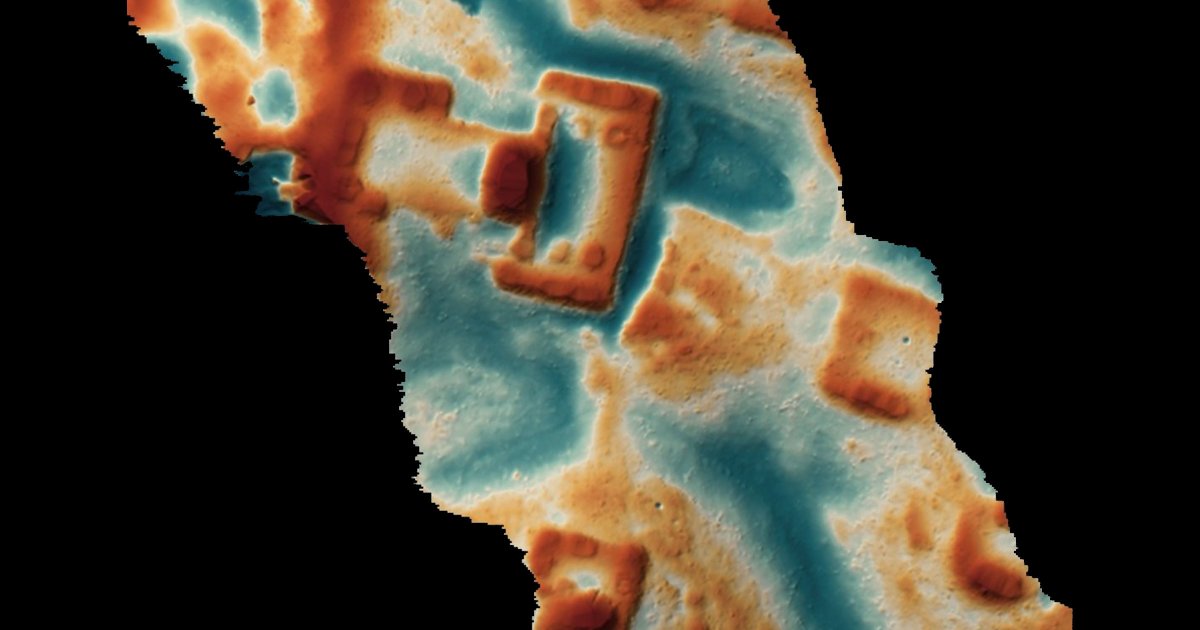
Google AI researcher Pietro Miotti let his AI agents loose on some NASA lidar data — where, according to him, they made a staggering discovery: an ancient Maya site lurking deep under the thick canopy of the jungles of Mexico. “By analyzing NASA lidar data, my AI agents discovered a Maya site in Mexico that, as far as anyone can tell, no one had reported before,” Miotti wrote in a breathless blog post. “It took less than 72 hours to go from a random thought while traveling to an official reply from the Mexican government.” “This is by far the best time ever to be alive,” the researcher, who admitted that he’s “not an archeologist,” gushed. “I think we’re on the brink of a revolution across every science, not just coding, physics and math,” he tweeted. The discovery blew up on social media, with users lauding him for “finding ancient mayan sites from your desk chair” and arguing that the discovery justified AI data centers. (Naturally, they also shared AI slop images of what the site could look like once unearthed.) The news even caught the attention of media outlets, including The Verge and TechRadar. But it didn’t take long for the scientific community to call foul. “This story is going wild on X and elsewhere,” archeologist and award-winning author Sarah Parcak wrote in a post on Bluesky. “The site was already published by Dr. Francisco Estrada-Belli of Tulane University ages ago.” In a 2025 paper, a team of researchers directed by Estrada-Belli examined lidar data colleceted by NASA’s Goddard Space Flight Center, covering 95,000 square kilometers of central America, finding that the ancient Maya population may have been significantly larger than previously estimated, possibly upwards of 16 million people at its peak. “This is why we have peer review,” Parcak added. “Mexican gov didn’t have it in their database, but that doesn’t mean it is unknown/unmapped.” Estrada-Belli shared images of the site with Parcak, adding credence to the revelation. To his credit, Miotti admitted defeat, conceding in an update that “it turns out the site had already been mapped.” “The agents missed it while going through the literature, so they rediscovered it rather than discovered it,” Miotti claimed. “Still work to do then!” Nonetheless, the incident highlights a trend of AI researchers being accused of taking credit for pre-existing scientific research. Perhaps the most notable is OpenAI, which released a flood of “proofs” for well-known, unsolved mathematical problems. But many of these solutions appear to be ripping off the work of mathematicians, who were actively working on the puzzles. The incident escalated into a crisis earlier this year as mathematicians accused OpenAI of providing unverified proofs and relying on plagiarism. It underscored how the entire AI industry has built its foundations by effectively ripping off rights-protected content on the web and using it to train their models. While Miotti thankfully admitted that his AI agents had discovered a site that we already knew about for years, that doesn’t mean other researchers will make similar claims that may go by undisputed and taken for granted. Besides, ironically, machine learning and computer vision have long been a “core part of remote sensing for as long as it’s been around,” geoscience consultant Alex Janevski wrote in a post on Bluesky. “I hate how this sort of hyperbolic misinformation both takes credit away from the actual experts and distorts how those experts are of course already using advanced digital tools of various kinds and have been for decades,” Roman historian Anise Strong wrote. “Don’t reinvent the wheel, Random Internet Guy!” More on AI and science: Explosive Document Claims That AI Is Not What We Think
AI-Pilled Tech Bro Claims His Agents Found an Ancient Maya Site in the Jungle. It Turns Out That Researchers Actually Discovered It.
Full Article
Original Source
Read the full article at Futurism →KhanList aggregates and links to publicly available news content. We do not host full articles from third-party sources. Always verify important information with original sources.