
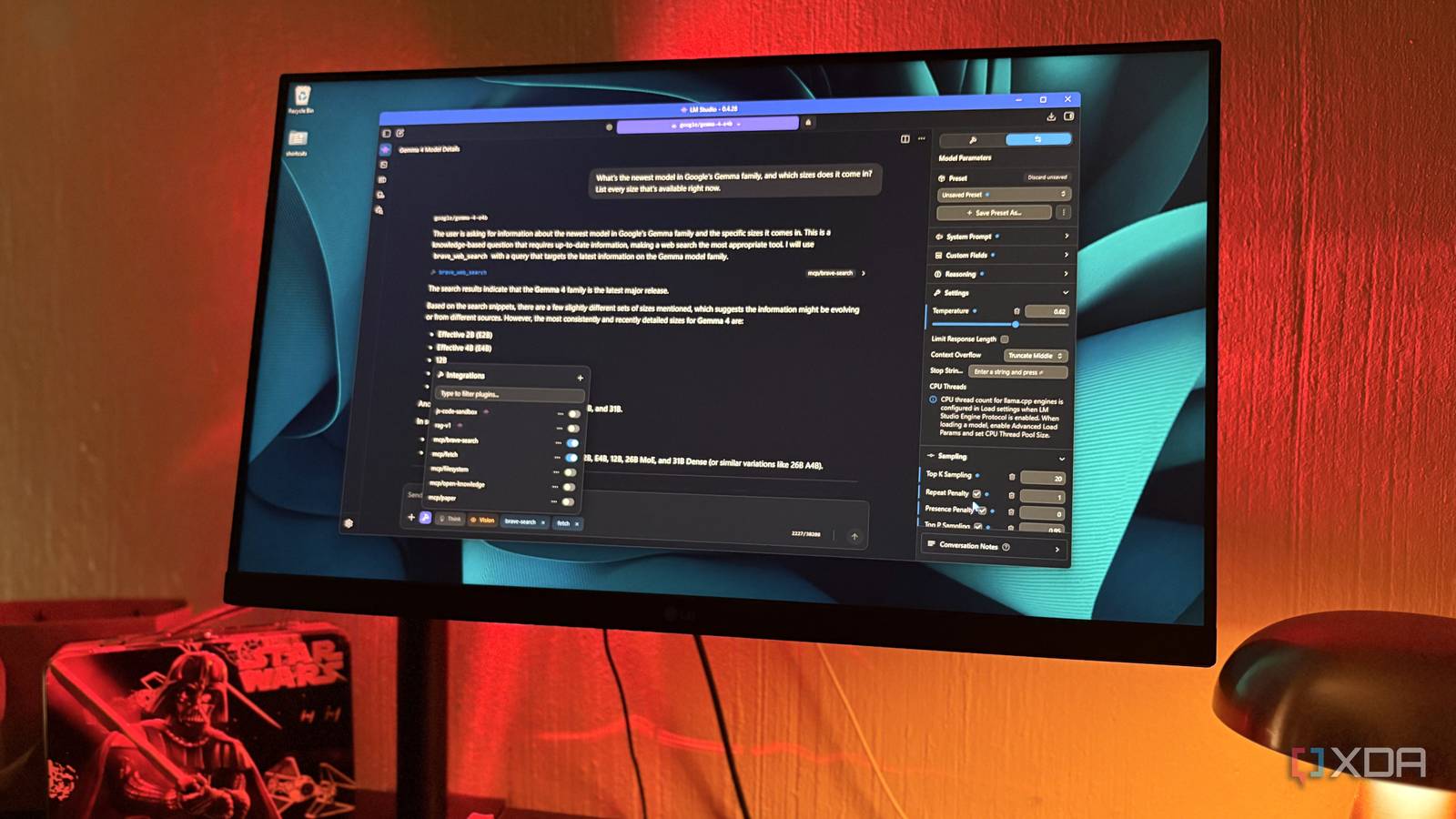
Published Nov 13, 2026, 2:00 PM EST Nolen began their writing career in 2019, with three years dedicated to editing the Creative section at MakeUseOf. Their expertise lies at the crossroads of technology and creativity, covering areas like photography, video editing, and graphic design. Outside of work, you'll often find Nolen diving into a good book, writing their own stories, or playing video games. Most AI subscriptions get marketed on whatever their newest features are, but for the average user, a lot of everyday use is just plain research. That's where most of my Google AI Plus subscription was going anyway. I did later come to find that there are other perks to a subscription beyond more Gemini and NotebookLM usage, but those are special use cases with some of their experimental apps. Looking back at what I actually asked Gemini, most of it was the same few kinds of lookups on repeat. Local models have a reputation for being bad at this. A small model running on your own hardware only knows what it picked up during training, so there's a chance that if you ask about something recent, it will either guess or make something up. A model that has the web is a different story though, and that's exactly what I did with a 4B model. Gemma 4 E4B, on my desktop and my phone It has more in common with Gemini than the size suggests Gemma 4 E4B is the bigger of Google DeepMind's two edge models, built to run on phones and laptops. I run it in LM Studio on my PC at Q4_K_M, a 4-bit quant that my RTX 3070's 8GB of VRAM handles with zero lag or issues. My iPhone 16 runs the model in Noema, a free iOS app for local models. The E is short for effective parameters - it runs with about 4.5B parameters active out of roughly 8B in total, which is how it fits on a phone in the first place. The Google connection actually goes further than the logo. Gemma 4 was built from the same research as Gemini 3, and Google is using E2B and E4B as the foundation for Gemini Nano 4, the on-device model for Android phones. It even lines up with my AI Plus plan on context window, which is how much text a model can hold in one conversation, since Gemini on AI Plus and E4B both top out at 128K tokens. What makes Gemma super useful for research is native tool calling. The model is very good at knowing and deciding when to use an outside tool, like web or filesystem, and also working with what comes back. Tool calling turned out to be its strongest skill, and Google's own benchmarks back that up. On Tau2, which tests whether a model can use tools to finish multi-step tasks, E4B scores 42.2%, against 16.2% for last generation's Gemma 3 27B. Why web search does the heavy lifting Everything Gemma knows on its own stops in early 2025 Google lists Gemma 4's knowledge cutoff at January 2025, which is almost two years ago at the time of writing. The model only came out in April 2026, so anything after early last year essentially doesn't exist in Gemma's eyes. I do like that Gemma is responsible about it though - when I've got Web turned off and ask it something that involves current information, it will usually be honest about not knowing or having the up to date information. So at least I know that it's less likely to make stuff up. Gemini has the same cutoff problem, and Google gets around it with search too. Deep Research browses hundreds of websites to put its reports together, which is still a model calling a search tool, just at a far bigger scale than probably most of our PCs, and it's also not an exposed control like it is with local runners. In LM Studio, web search runs through MCP, and I use two of them. The Brave Search MCP finds pages, but it only hands back links and short snippets. A separate fetch tool opens the full page so the model can read the whole thing. That second tool actually matters quite a bit. A snippet is only a line or two, so models answering from snippets alone often credit facts to the wrong page. Open WebUI, another self-hosted AI chat app, saw this happen so often that it now only cites pages the model has actually opened. Noema keeps all of this inside the app. Web search is just one simple toggle that you don't have to set up with a JSON file, and queries go through a private, no-log relay the developer runs on SearXNG, an open-source search engine that pulls results from other engines. So there's no API key to deal with unlike my Brave Search MCP. I'm also adding here that giving your model filesystem access is ideal for research-based tasks too, or at least using a local LLM app that allows document upload. This way you can give it access to pre-curated resources that might be relevant to your research. Both LM Studio and Noema support document upload, plus I've got a filesystem MCP in LM Studio for batch file work. Trying to catch it out You have to stress-test it Even with Web, local models won't always reliably pull the right sources, if use the tool at all. About half of my local models can't be trusted to use web, fetch, or filesystem. Most of my testing went toward questions a 4B model can't answer from memory. Going off Gemma E4B's training data alone, it would consistently admit to not having the current information. When it had the web, it would come back with the correct information every time. How that information is presented is another story though - this will depend on your system prompt and parameter settings. Something I love about Noema is that it actually adds clickable citations at the end of its web-based responses. It's not perfect though. A community run on the Berkeley Function Calling Leaderboard, which scores how well models call tools, had stock E4B at 84 out of 100 on knowing when not to call a tool. Its score in the web category, where it has to work through several searches to reach an answer, was just 7. That lines up with what I saw. It nearly always searched when it should, then answered off that one search instead of digging further, so I get better answers asking one clear question at a time. Keeping my research local and free The free Gemini tier still includes five Deep Research reports a month, which is probably about how often I need something that big. For everything else, I think the 4B model covers it, as long as it can search and has room to read what it finds.
I replaced my Gemini subscription with a local 4B model for research, and it's shockingly capable
Full Article
Original Source
Read the full article at Xda-developers →KhanList aggregates and links to publicly available news content. We do not host full articles from third-party sources. Always verify important information with original sources.