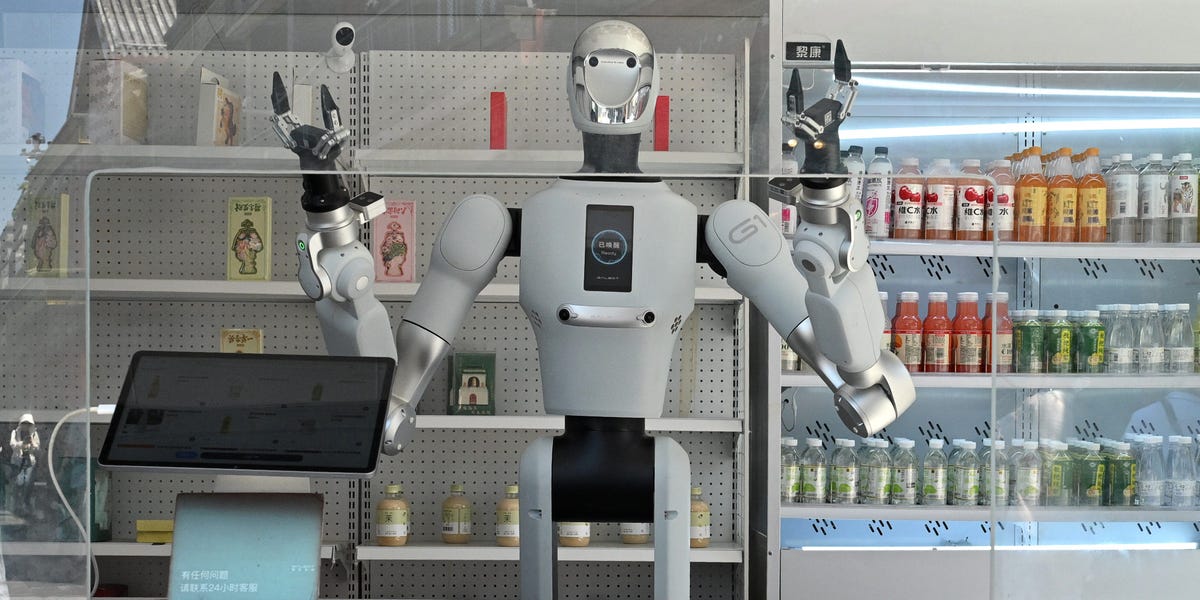
Two economists, Gerry Tsoukalas and Brett Falk, warn that companies could be self-destructing by replacing workers with AI and eroding consumer demand. ADEK BERRY / AFP via Getty Images Economists are warning that AI could push companies into a wave of layoffs that ends in self-destruction.Gerry Tsoukalas and Brett Falk, authors of "The AI Layoff Trap," a research paper published by The Wharton School, said CEOs can become trapped in a race to automate that erodes consumer spending on which their businesses depend."The main question we wanted to understand is who's going to be left to buy products if everyone gets automated and replaced by a robot?" Tsoukalas, a senior fellow at Wharton, told journalist Katty Kay on the New Normal podcast that was posted on Monday.The paper describes a classic economic dilemma: A single company may recognize that laying off too many workers reduces demand for its products, but in a competitive market, every company has an incentive to automate, because failing to do so risks losing to rivals."So no matter what you do, no matter what the other companies are doing, your best strategy is to adopt as much of this technology as possible," Tsoukalas said. "And that's called a dominating strategy in economics."The warning comes as global institutions raise similar concerns about AI's impact on work. In a July report, the World Economic Forum said traditional reskilling programs are struggling to keep pace with AI-driven disruption, adding that jobs are changing faster than workers can be retrained and that it's not economically realistic to keep retraining a large population."The global conversation about AI and the future of work has been asking the wrong question for a decade," the report said. "We keep asking which jobs will survive. We should be asking whether 'jobs' is still the right unit of analysis at all." "The shift from jobs to livelihoods is the structural choice between an economy that deploys humans and one that sustains them," the report added.Tsoukalas said relying on individual companies to voluntarily restrain themselves is unlikely to solve the problem."Waiting for the firms to figure it out for themselves, I think, is the worst possible thing we can do," Tsoukalas said, suggesting that a tax could be imposed on a company for replacing its workforce with AI."You could also provide subsidies to firms that keep their workers instead of firing them," Tsoukalas added. "So there's all sorts of other instruments around this that might not be perfect, but that we could use."A separate World Economic Forum report said that if the global workforce were represented by a group of 100 people, 59 would be projected to require reskilling or upskilling by 2030, while 11 would be unable to receive help, translating to over 120 million workers at medium-term risk of redundancy. Read next AI Layoffs Employment More Labor Market Economy
AI could trigger a layoff trap that even smart CEOs can't escape
Full Article
Original Source
Read the full article at Businessinsider →KhanList aggregates and links to publicly available news content. We do not host full articles from third-party sources. Always verify important information with original sources.