
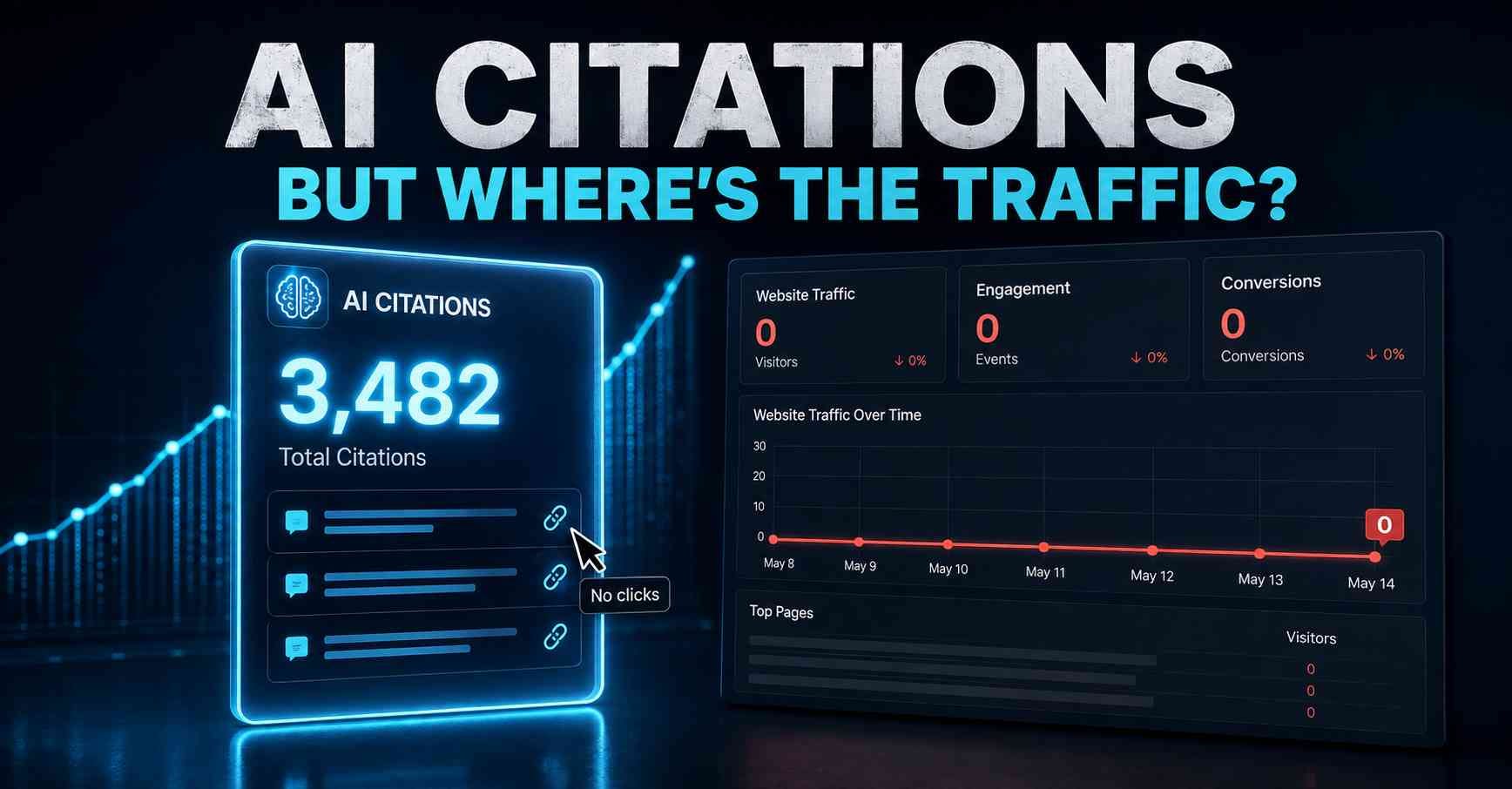
Opinion and insight: Brands are rushing to count mentions inside ChatGPT and other AI platforms, yet many still cannot show whether those citations produce readers, enquiries or revenue. Okay, so you’ve picked up a few AI citations. Great. But are they actually doing anything, or are you just taking screenshots every time ChatGPT mentions your website?AI citations have quickly become another metric for marketers and SEO agencies to parade around in reports. A brand appears in an AI-generated answer, somebody circles the citation in red, and the result is presented as evidence that the latest optimisation strategy is working. That conclusion is being reached far too early. A citation proves that an AI system found, processed and selected a page as a source for a particular response. It does not prove that a real person saw the response, clicked the link, read the page or became a customer. A citation is a retrieval event, not a traffic result There are several steps between content being discovered by an AI system and that content producing anything useful for a publisher or business. The first is retrieval. The model, search index or retrieval system finds a page that appears relevant to a question. The second is attribution, where the platform attaches the page as a citation or supporting source. Only after that comes acquisition, which requires somebody to click through and visit the website. Those steps are being collapsed into a single success metric. A citation count may show retrieval visibility, but it says very little about audience behaviour once the answer has been produced. This matters because many AI visibility tools do not measure genuine user demand. They run their own sets of prompts through different models and record which brands or domains appear. Those prompts can be useful for benchmarking, but they are still synthetic tests generated by the monitoring platform. A website might appear across hundreds of automated prompt variations without being cited in a single question asked by an actual prospective customer. Unless the platform has access to real query volumes, which it usually does not, a citation count cannot tell you how many people were exposed to that answer. AI citation numbers can change without your content changing AI answers are not as stable as traditional search rankings. The same prompt can produce different sources depending on the model version, location, wording, conversation history and information available at the time. One test might cite your article, while the next gives the same information without a link. Another model may use a competitor, a government source or a page that republished the original reporting. This makes citation tracking much noisier than many dashboards suggest. A jump in citations could come from a model update, a change to the monitoring tool’s prompt library or a different method of retrieving sources. It does not automatically mean the underlying content became more authoritative or useful. The reverse is also true. A drop in citations may have little to do with the quality of the page. The model may simply be drawing from a different index or selecting another source during answer generation. If an agency reports that AI visibility increased by 40 per cent, the first question should be how that number was produced. Was the same prompt set used? Were the tests run from the same country, through the same models and with the same account settings? Were personalised answers, browsing modes and model updates controlled? Without that information, the percentage can look far more precise than the measurement really is. Being listed beneath an answer does not mean anyone will click Citation placement also matters. There is a considerable difference between being used as the main source for a claim and being one of eight links pushed underneath a long generated response. Sometimes the AI answer already gives the reader everything they wanted. The citation is technically present, but there is no reason to leave the platform because the question has already been answered. That is the basic zero-click problem being carried into AI search. Publishers spend time and money producing the original information, the AI system summarises it, and the website receives little or none of the resulting traffic. A citation could still contribute to brand recognition, particularly when the company or publication is named directly in the answer. But if that is the argument, it should be measured as brand exposure rather than website acquisition. Calling every citation an SEO success only muddies the result. Visibility, traffic and conversion are different outcomes and should be reported that way. GA4 will not give you the entire picture Measuring AI referral traffic is also more complicated than opening GA4 and looking for a neat channel labelled “AI.” Some platforms pass recognisable referral information, while others use redirects or open links in ways that can strip or obscure the original source. Depending on the platform, browser, app and privacy settings, a visit may appear under referral traffic, an unexpected domain or direct traffic. Channel grouping can make the problem worse. If analytics rules have not been updated, AI referrals may be mixed with other traffic sources and never appear in the report being used to judge performance. GA4 is still useful, but it should not be treated as the complete record. Server access logs can help confirm when a human request reached the page, while landing-page reports can show whether unusual traffic arrived after a page began receiving citations. The analysis should also separate known AI crawlers from human visitors. A burst of requests from a crawler does not mean an audience arrived. Bot activity can increase at the same time as citation visibility and make weak reporting look more convincing than it is. Where possible, publishers should inspect referral headers, request timestamps, landing pages, user agents and subsequent page activity. No single signal will provide a perfect answer, but together they can show whether the citation is producing genuine visits. The landing page still has to perform Even when an AI citation sends traffic, the quality of that traffic needs to be examined. Ten relevant visitors who read the article, subscribe or make an enquiry may be more useful than 500 people who leave immediately. Look at what happens after the click. Did the person land on the right section of the page? Did they scroll through the article, visit another page or return later? Did they complete an action connected to the purpose of the website? A citation may send highly qualified traffic because the user has already asked a detailed question and received an answer pointing to a particular source. That person can arrive with stronger intent than somebody who clicked a broad search result. It can also work the other way. The user may open the source only to check one sentence, then leave within seconds. Without page-level engagement and conversion data, both visits are counted in roughly the same way. This is why raw referral sessions are only the start. Engaged visits, return users, subscriptions, enquiries, assisted conversions and revenue provide a much better view of whether the traffic was worth having. Measure cited pages against a proper baseline The cleanest way to assess AI citation performance is to establish what the page was doing before it started appearing in generated answers. Record its existing organic traffic, direct traffic, referral sessions, engagement and conversions. Then monitor whether those numbers change once citations begin appearing consistently. Cited pages should also be compared with similar uncited pages. The comparison will never be perfect, but it can help separate an AI referral effect from seasonal demand, stronger Google rankings, news coverage or a general increase in branded searches. Timing matters as well. A citation that appears once during a monitoring test should not be treated the same as a page that remains visible across several models and prompt variations for months. Publishers also need to watch for assisted value. A user may discover a company through an AI answer, leave without clicking, then search for the brand later. That influence will be difficult to prove, although increases in branded search, direct visits and returning users may provide supporting evidence. The important part is being honest about the limits of the data. If the connection between the citation and the later visit cannot be established, call it a possible contribution rather than claiming direct attribution. AI visibility has value, but stop pretending every citation is a win AI citations can be useful. They can show that a website is accessible to retrieval systems, that its information is being understood and that the domain is being considered alongside other sources. For publishers, citations may also support authority and brand recognition even when the immediate referral traffic is small. For businesses, a handful of high-intent visits could produce more value than a much larger volume of weak traffic. But none of that should be assumed simply because a domain appeared beneath an AI-generated paragraph. The real question is what happened next. Did anyone visit? Did they read? Did they return, enquire, subscribe or buy something? Did the cited page perform any better than it did before? If you cannot connect AI citations with actual readers, qualified traffic or some form of business value, then you have a retrieval metric. You do not yet have a performance result. People are already treating AI citations like the new number-one Google ranking, complete with colourful dashboards, visibility scores and celebratory screenshots. We should probably learn something from the last 20 years of SEO before turning another easily inflated number into the industry’s latest vanity metric.
AI Citations Look Great, But Are They Actually Bringing You Traffic?
Full Article
Original Source
Read the full article at Hackernoon →KhanList aggregates and links to publicly available news content. We do not host full articles from third-party sources. Always verify important information with original sources.