
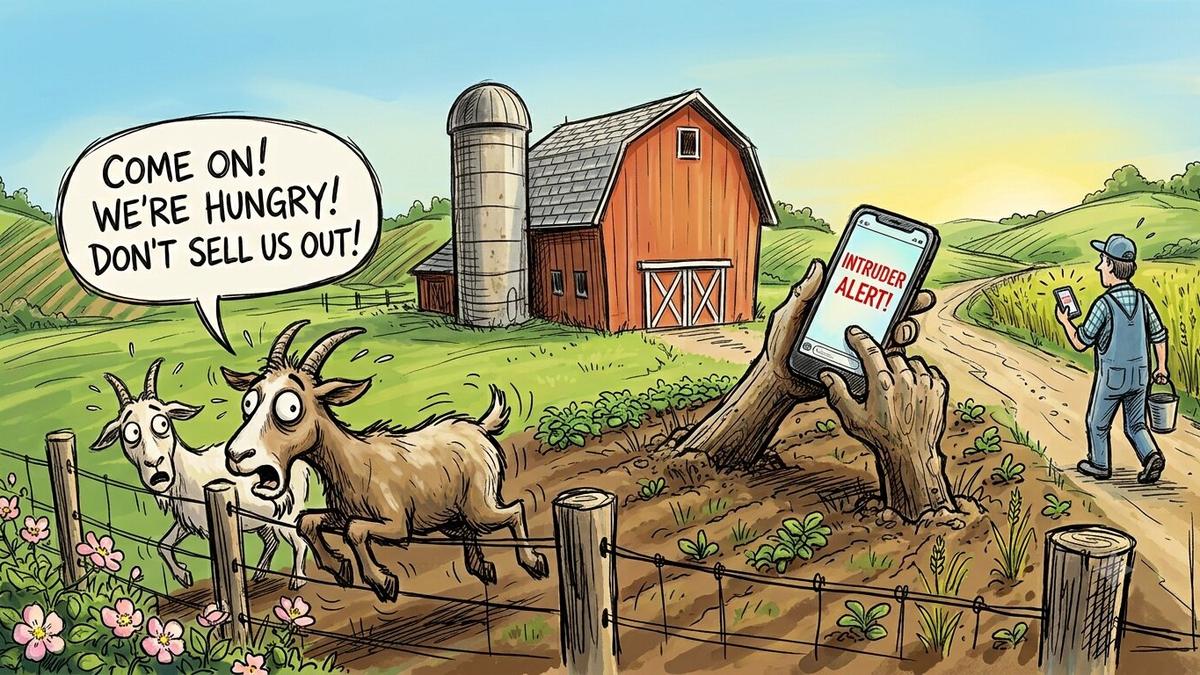
According to the Food and Agriculture Organization of the United Nations, 40% of global food crops are lost each year due to pests. The importance of protecting crops from pests, animal intruders, and over-irrigation holds great importance not just within the boundaries of a farmer’s field, but even the places and actions that lay beyond it. Whenever you wish to ask someone for help or send an important message, giving it directly to the recipient is usually far more efficient than using many middlemen, where the message could easily get changed or altered. The game Chinese Whisper demonstrates this. However, in the real world, inaccurate messages can lead to major consequences. Hearing a message directly from the (reliable) source is the best way to avoid these consequences.In the same way, what if a farm had the ability to call or send out an alert to its farmer when something feels wrong, or tell him or her exactly what it needs? Well, thanks to the work of two seventh-standard students Rohan Lanka and Sarthak, the foundation for this solution may have just taken the first step in its creation! About AgriNovaThe concept of this machine is quite simple. Think of it as a communication device for a farm. Built to be a machine controlled either by Telegram or WhatsApp (the latter currently still in the works), AgriNova allows a farmer to receive messages from their own farm regarding the soil moisture, intruders, etc. Because of this, a farmer can be alerted as and when a problem is detected, and ensure that their farm is in good shape without having to actually go outside. They could also receive messages when they are travelling. The alert can come in the form of a phone call from the farm. Yes, that’s right. A ‘phone call’ from the farm! If there were a problem, the sensors on the farm would detect it, narrow down the issue, and immediately call the farmer to let them know! (From left) Rohan Lanka and Sarthak, Class VII, Army Public School Shankar Vihar, with AgriNova — their ₹2,500 smart farm that texts, and even phones, the farmer — at the Purple Umbrella Festival 2026, New Delhi. | Photo Credit: Special arrangement The inspirationIn an interview with The Hindu TeenDigest, the seventh-standard students behind AgriNova – Rohan Lanka and Sarthak, from Army Public School Shankar Vihar, New Delhi – provided explanations on the inspiration behind AgriNova, as well as the creation process, the obstacles they faced, and their future plans for their machine.Rohan stated that it had been a trip to his hometown that brought attention to the problem. What was witnessed had brought light to the issue. “Some farmers turn on the water supply for their crops and leave it running throughout the night.” This sparked attention to the first problem: “That wastes a lot of water, and most of the crops end up dying,” he explained. Sarthak added that they had learnt of two instances when the farmers lost their crop. “Once, to the stray animals at night,” and second, to the act of “watering by habit, instead of by need.” When plants are given more water than they need, that could lead to many problems, including soil erosion and waterlogging. While there are many other causes for crop loss, these two (stray animals and over-irrigation) were some of the main causes that drew the attention of Rohan and Sarthak and slowly motivated them to build AgriNova. Agricultural runoff is also said to be one of the main sources of contamination of water bodies. So, it is important to ensure that the soil is provided with the right amount of water (not too much) and moisture, which will allow the crop to grow in a healthy manner. The building journey The process of creating AgriNova came with its ups and downs. “We created a blueprint on a piece of paper first before starting,” Rohan explained. They then showed it to the person in charge of their school’s ATL (Atal Tinkering Lab). “He’s the one who supervised us and sent us to the Purple Umbrella Festival, a national-level competition, where AgriNova was selected as a finalist.” The model used to demonstrate the machine, and its various parts. | Photo Credit: SPECIAL ARRANGEMENT The parts: Some of the parts in the model include the following:a. IR sensor: “First,” Rohan began, “we added the IR sensor, just in case somebody comes when they are not supposed to come. It sends an alert to the farmer.” Through this, the farm will call the farmer to “tell them that somebody has entered, and send them a video or a photo.” Thus, the farmer will have a visual warning (as well as evidence) in the case of any unwanted party entering their fields. When it comes to the replication of the model into the field, “if an IR sensor lies, we will remove it.” Sarthak said, emphasising the importance of ensuring the efficiency of their machine. b. Soil moisture sensor & water module: This part of AgriNova answers the problem of understanding the right amount of water a crop requires. “When the soil is detected as dry,” Rohan explained, “it (the machine) just starts spraying water to make it wet again. That’s auto-irrigation.” c. Solar panel: To help farms in sunny and rural areas that don’t have easy access to electricity, this panel became a part of the overall model. The obstaclesThey had faced many hurdles in the process of putting the parts together for the sample model. According to Sarthak, “It did not go smoothly.” Their motion sensor once produced a false alarm which, if replicated in an official model, could be a source of problems for the farmer. “So, we made hard decisions,” he said. They had to make many deletions and “only kept the sensor that told the truth about the farm.” The relay was once wired the opposite way to what the code expected. The water turned on when it was supposed to be off. Both of the circuit boards once vanished during the middle of the demonstration because the USB hub couldn’t generate a proper amount of power. Rohan explained, “My laptop couldn’t provide enough power to the system. So we had to use a mobile charger.”Other problems in the process came in the form of soil leakage in their model, the Python bridge sending the farmer incomprehensible raw data, etc. However, these obstacles did not hinder the efforts of Rohan and Sarthak. In fact, they taught them an important lesson: To trust what the hardware actually does, and not what the manual promises. “We learnt that we should not always trust whatever AI tells us or what’s written online,” Rohan stated. “Because most of the time, they are wrong when we are trying to troubleshoot or understand what’s going wrong with the model. And secondly, we shouldn’t just use any sensor that we find in our lab.” The process would have to include testing out each one. Not every obstacle lies within the boundaries of the invention or creation itself. When it came to working on AgriNova, “We do it at school timing only.” Sarthak said. This, according to Rohan, included lunch break and free periods. “We would miss classes like PT and Music,” Sarthak recalled. They would also, at times, get scolded by their teacher when they missed attendance or zero period. Further plans“The Technology Readiness Level, right now,” Rohan said, “is four to five. Because it is working in our demonstration. When we go to measure it in the field, only then can we take it to TRL six.” The small-scale demos, according to the two young innovators, did not prove much of anything, which is why “We would have to go to a real farm and put it there. Our school has a small herbal garden, so we are planning to put AgriNova there.” One of the reasons for this was to see how much water was saved when compared to if it were done through manual means. When asked if they planned to get a patent for this machine, their answer was a surprising ‘no’. “By choice,” Sarthak stated, “we released everything open-source (MIT) so anyone can build one for only ₹2,500.” Rohan further elaborated on their plans if the machine were to enter the bigger circle. “We are planning to send this to an NIF competition which is happening online. So, if they like the project then they will only patent it for us.” Wanting their model to be public, they plan to make it open source “So that anybody can do what they want with it.” In short, they want their machine to serve as a building block or a strong foundation for other ideas of agricultural development to flourish. While many additions and improvements need to be made to the machine before it can be introduced to an actual farm for a demo, both Rohan and Sarthak hold a strong sense of determination to have AgriNova take the first step in furthering agriculture and protecting farmers’ lands!To learn more about Rohan and Sarthak’s smart farm, visit: https://rohancodesss.github.io/agrinova/
AgriNova: When a farm can text and call you!
Full Article
Original Source
Read the full article at Thehindu →KhanList aggregates and links to publicly available news content. We do not host full articles from third-party sources. Always verify important information with original sources.