
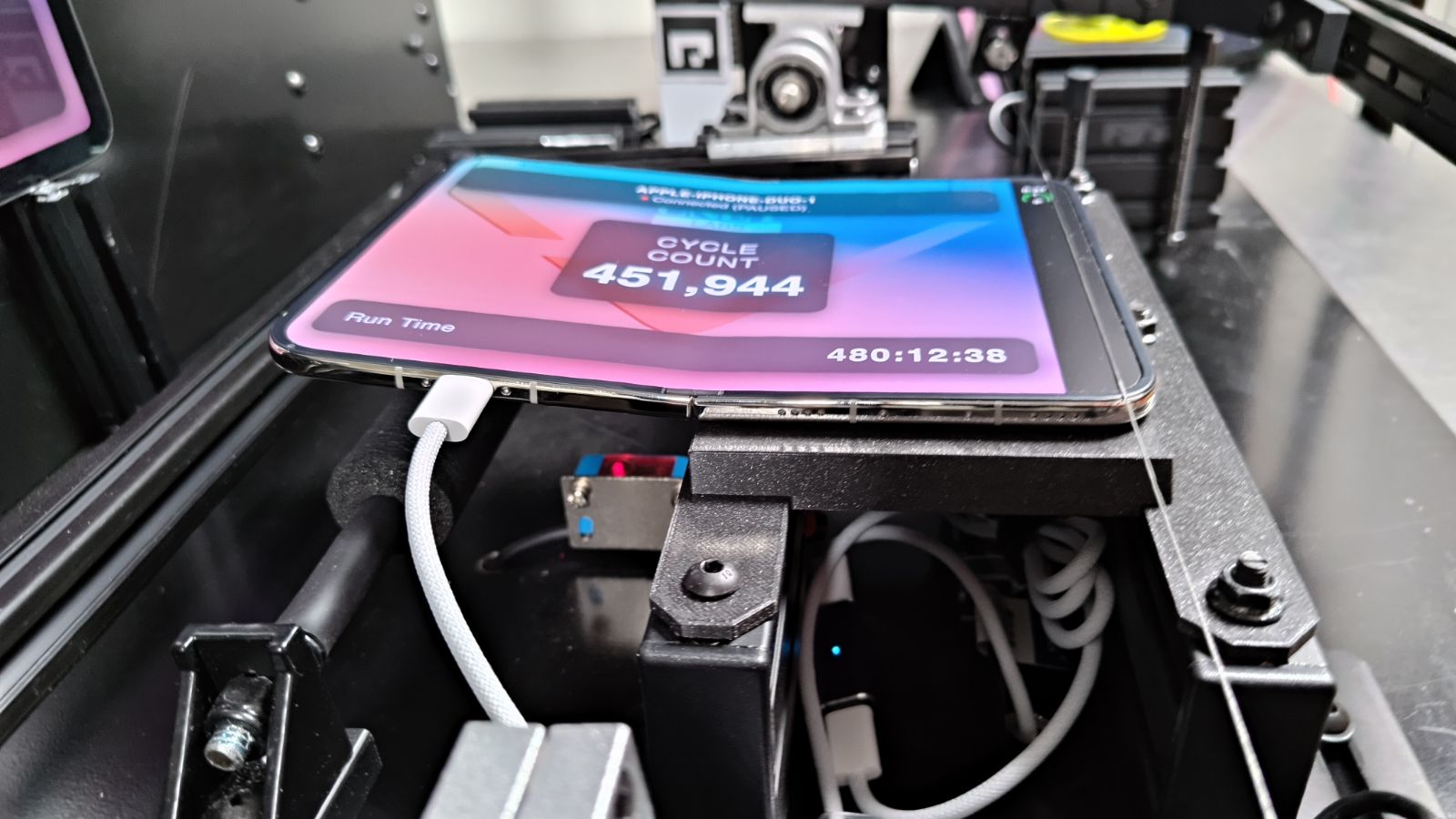
Three weeks ago, we put Apple’s new iPhone Duo on our custom foldable phone testing rig, the Fold-a-Phone, to find out how many times it could fold until it broke. It’s not fully broken yet, but the hinge has started to break down. I initially detected some looseness in the hinge motion yesterday during our afternoon livestream. It became evident that the iPhone Duo was not opening with the same firm sound I was used to hearing. When I left the office last night at 6 p.m., it was still opening completely flat. Now, however, the screen no longer opens all the way flat. Instead, it unfolds most of the way but leaves a few degrees of angle in the hinge. Check out the video below, and tune in to our YouTube livestream later today to see for yourself. After examining the sensor data we’ve collected, and the photos and videos we shoot constantly during the testing process, we determined that changes in the opening force and motion began occurring around the 390,000-fold point on Tuesday afternoon and gradually built until last night. The wire we use to open the phone screen would withdraw before the screen was in the fully open position, but it would then sort of “coast” the rest of the way down. But between 12:30 and 1 a.m. this morning, around 440,300 folds, the screen would no longer have time to open all the way before the Fold-a-Phone caused it to close again. Another view of the iPhone Duo’s not-quite-flat state in the Fold-a-Phone machine. It can still be folded flat by hand.Matthew Murray/CNET How serious is this issue? In the grand scheme of things, not very. The phone still operates and maintains other screen positions without issue. There’s no cracking, signs of a more visible crease or other failures. This issue is not sufficient to meet our established failure conditions in the Duo, which include loss of power, sensors failing to detect the screen where it needs to be within the given timeframe, and screen blackout. The phone is only about 5 to 10 degrees away from the fully open state, and it can still be moved the rest of the way by hand (though without the distinctive snap sound and feel it had earlier). Join CNET’s iPhone Duo livestream on YouTube weekdays from 1 p.m. to 5 p.m. ET, where you can follow along live and watch the Fold-a-Phone do its thing to a Duo. Chances are, if you had bought the phone and encountered this behavior, you might not even notice it at first. And, remember, by the time this started, we’d subjected the iPhone Duo to the equivalent of nearly 12 and a half years of folding (assuming 100 folds per day) – well beyond the number of folds we’d expect from even an avid user. Apple has not publicly stated the anticipated number of folds the iPhone Duo would endure, so we’ve been left to speculate. Guesses within CNET have ranged from 500,000 (matching Samsung’s rating for the Galaxy Z Fold 8) to 1.5 million. But even if we don’t yet know for sure how much worse the hinge action will become, and thus what the final number will be, what we’ve seen today represents the first significant step toward failure. We are going to keep going. And we hope you’ll stick with us, both here and on our daily livestreams, to see what more unfolds. As lab director for the CNET Group, Matthew leads the Labs team, which helps coordinate and conduct product testing for CNET and other Ziff Davis editorial brands including PCMag and ZDNET. He previously spent eight years as head of testing at Future plc, and before that eight years as an analyst and writer at PCMag. His technology writing has also appeared in publications including Computer Shopper, ExtremeTech, Tom's Guide, Laptop and Backstage. See full bio The Latest from Matthew After 3 Weeks and More Than 451,000 Folds, the iPhone Duo’s Hinge Is Finally Starting to Fail Why We’re Folding the iPhone Duo Hundreds of Thousands of Times: 16 Questions, Answered We’ve Folded the iPhone Duo Almost 400,000 Times. How Much More Can It Take?
After 3 Weeks and More Than 451,000 Folds, the iPhone Duo’s Hinge Is Finally Starting to Fail
Full Article
Original Source
Read the full article at Cnet →KhanList aggregates and links to publicly available news content. We do not host full articles from third-party sources. Always verify important information with original sources.