
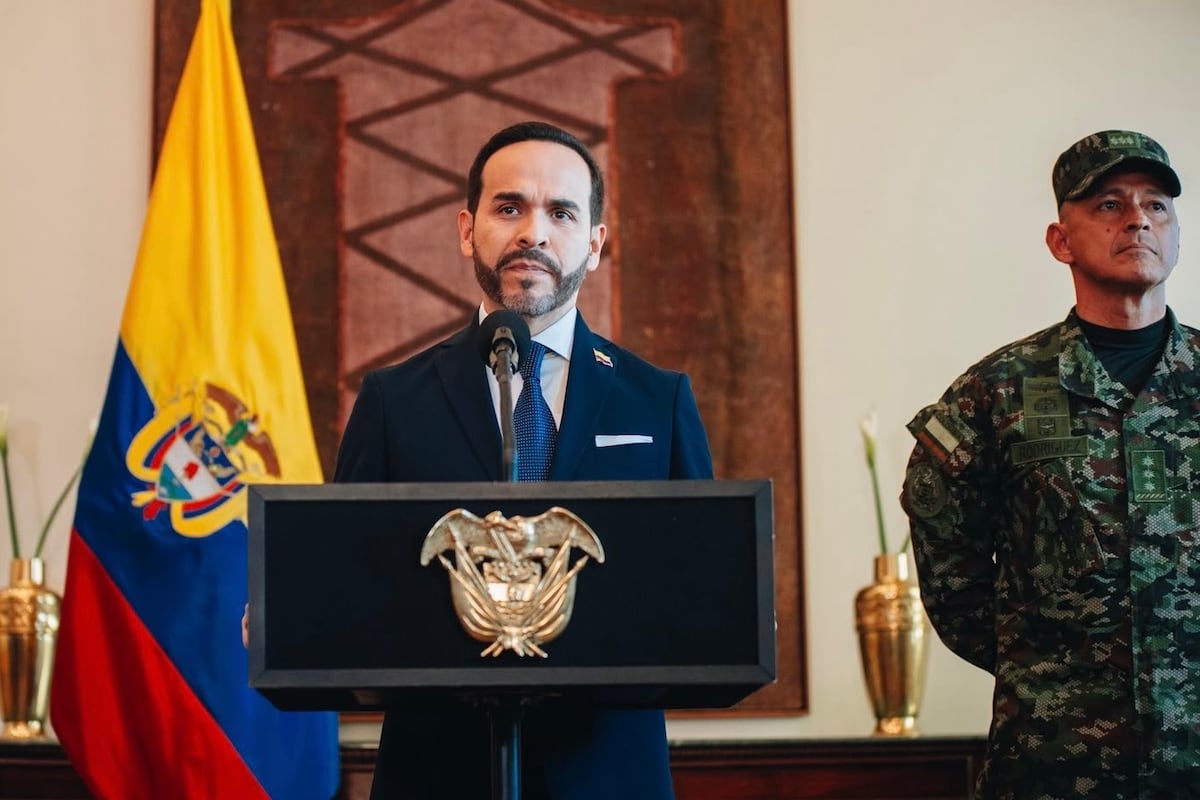
Colombian President Abelardo de la Espriella on Sunday ordered the start of police operations to pursue and deport irregular migrants, a complete reversal of the policy the country that has received the largest share of the Venezuelan diaspora has followed for more than a decade. “Begin coordinated operations to find illegal immigrants, first those committing crimes, second those who have not regularized their status and who, within the timeframe, will have to be deported,” he said during a security council meeting in Barranquilla, the Caribbean city he has effectively turned into an alternate capital of the country.The far-right head of state, who has been in office for less than three weeks, said his order must begin to be carried out this week. “I will not accept any illegal immigrants, wherever they come from. They will have to leave and be deported. It is a political decision I am taking responsibility for,” added the president, a criminal lawyer by trade. The announcement was preceded by nationalist remarks: “Colombians first, Colombians second, and Colombians third.” Although he did not say so explicitly, the announcement particularly affects the 2.8 million Venezuelans living in Colombia, who make up about 90% of the country’s immigrant population. Of those, 848,000 are in an irregular situation in Colombia, according to official data from Colombia’s immigration agency, and 193,000 of them are children and adolescents.Ronal Rodríguez, spokesman and researcher at the Venezuela Observatory of the University of Rosario, says the announcement represents a paradigm shift in how Colombia’s last three governments received and cared for the migrant population from the neighboring country. “It is dangerous for the president to join a discourse that stigmatizes migrants by insisting they are illegal. That discourse has existed in the region, and, unfortunately, it has gained ground worldwide, but Colombia had distanced itself,” the expert explains by phone.In the wake of the Venezuelan migration crisis that began in 2015, which has seen more than 7.8 million people leave the country, Colombia created legal and social instruments to regularize the population influx. Under centrist, right-wing, and left-wing governments, it became a global example of good migration regulation practices and absorbed nearly a third of that diaspora. Rodríguez insists that there are no illegal immigrants in Colombia, only people in irregular situations. “The government lumps all migrants together and talks about criminality clearly tied to irregularity. That is not the case in Colombia: a person who is in an irregular status is not a criminal,” he insists.De la Espriella’s decision to pursue and deport almost one million foreigners with irregular migratory status has drawn criticism from the political opposition. Congresswoman María Fernanda Carrascal, of the leftist Historic Pact, the party of former president Gustavo Petro, says the announcement is not only disastrous but also cruel. “Linking irregular migrants to criminality solely because they have an irregular migration status is an affront to human rights, and an absurd claim lacking any evidence,” she says in conversation with this newspaper. “They seek to portray migrants as scapegoats, as targets, with the intention that society directs its discontent at them.” The Bogotá representative says the announcement is dangerous: “More than opening the door to xenophobia, it consciously deepens the xenophobia that already exists in part of Colombian society.”The shift in the relationship with migrants aligns with the anti-immigration policies of far-right governments on the continent, such as those of Donald Trump in the United States; José Antonio Kast in Chile; and Javier Milei in Argentina, which have sought mass deportations purportedly to improve security in their countries. Rodríguez says Colombia cannot address the migration issue the same way as Argentina because it shares a living 1,378-mile border with Venezuela. Added to that is the complex relationship with the Venezuelan government led by Delcy Rodríguez. “Colombia is a very complex country where migrants have also been victims of illegal actors.”Andrés Sampayo, who holds a doctorate in political studies, shares concerns about what government actions against the Venezuelan population in Colombia could produce. “I hope the migration operations do not become a large-scale persecution of our Venezuelan brothers, who contribute about $3 billion annually to the Colombian economy through consumption, taxes, and entrepreneurship,” he wrote on his X account.Sign up for our weekly newsletter to get more English-language news coverage from EL PAÍS USA Edition
Abelardo de la Espriella orders immediate deportation of irregular immigrants from Colombia: ‘It’s a political decision’
Full Article
Original Source
Read the full article at English →KhanList aggregates and links to publicly available news content. We do not host full articles from third-party sources. Always verify important information with original sources.