
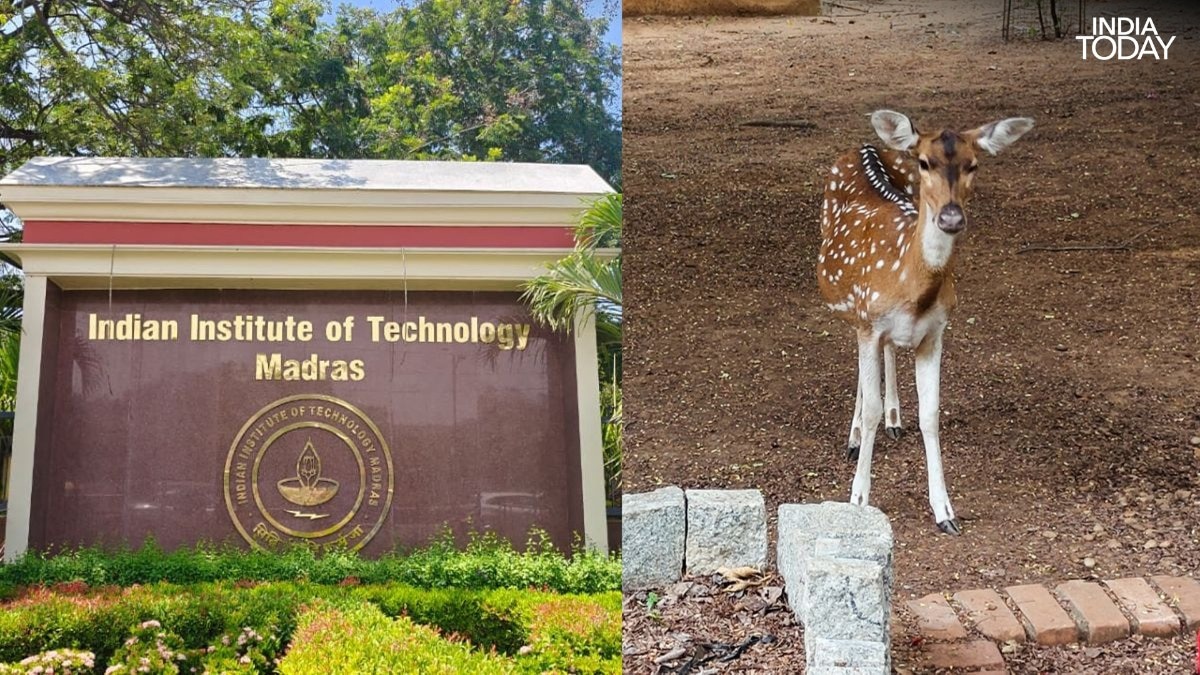
For a little over a week in the middle of August, I lived at the Taramani Guest House inside IIT Madras, and each morning, I woke to a silence I had almost forgotten existed. Not the silence of a shut room in a city, that flat, airless hush.This was a forest's quiet at first light, a living thing, threaded with birdsong and the small stir of leaves and the sound of the campus somewhere far off, only beginning to stir. I would open my door to air that was cool and green and washed clean, and for a moment, before the day and its interviews began, I would simply stand there and breathe it in.On one of those first mornings, walking out of the guest house, a spotted deer crossed the road ahead of me and stopped, unbothered, to look. I stopped too. A spotted deer wanders past parked cycles on the IIT Madras campus, a green enclave carved from Guindy that is as much forest as institute. (Photo: Radifah Kabir/India Today) Behind it, the trees stood thick and unhurried, the light falling soft and green through the canopy, and somewhere beyond them, in a laboratory I would visit later that week, a team was quietly turning a human brain into a map, one cell at a time. I had come to report on the future. I had not expected to find it hidden inside a forest. By the end of the week, I had begun to think I was looking at something larger than a campus. I was looking, I suspect, at a glimpse of the university of the future, a place that does not only teach, but builds. And it was hard not to wonder, walking those green roads between one laboratory and the next, whether this is the model the rest of India's universities have been waiting for.Let me tell you what I saw.FLYING TAXIS, ROCKETS AND A BRAIN MAPPED CELL BY CELLAt the institute's newer Discovery campus, set well apart from the main one, the frontiers turned to air and space, and I found myself sitting inside the full-scale prototype of a flying taxi. Built by The ePlane Company, it has 10 rotors, each mounted on its own wing so that no single failure can bring it down, and its makers walked me through seven separate layers of safety, ending on a line I have not been able to shake: with a flying machine, they told me, the take-off is optional, but the landing is not. What moved me most was not the machine but the dream behind it. The professor who leads it cares less about ferrying the wealthy over traffic than about building an air ambulance cheap enough for an ordinary family, so that a two-hour crawl to hospital might one day take 15 minutes. A subscale prototype of IIT Madras's electric flying taxi. (Photo: Radifah Kabir/India Today) That same Discovery campus is home to two more frontier ventures. On it, Agnikul Cosmos is 3D printing rocket engines as single whole pieces, no welds, no hundreds of parts, and has built India's first private launchpad beside the national one.And close by sits a vast ocean wave basin, run by the National Technology Centre for Ports, Waterways and Coasts, where engineers can raise a 12-metre wave to test how a harbour or an offshore structure will behave before a single stone of it is laid. To stand among these teams is to watch a country learn, in real time, how to reach the sky, space and the sea on its own terms. The ocean wave basin at the Discovery campus, where engineers can raise a 12-metre wave to test a harbour before it is built. (Photo: Radifah Kabir/India Today) And then there was the brain. Back on the main campus, in one laboratory, an entire human brain was being turned into a digital atlas, sliced into sections thinner than a strand of hair and rebuilt, cell by cell, into something no one has ever fully seen. Inside the brain-mapping lab at IIT Madras, human brains at different stages of development, part of an effort to chart the organ cell by cell. (Photo: Radifah Kabir/India Today) The team had built the machine to do it from scratch, during the pandemic, when the world had bolted its doors. I thought about the patience that must take, the long, unglamorous years of it, and how little of that patience ever reaches the news.A FOREST FULL OF THE FUTUREThose were the headline wonders. But the deeper marvel of the place was that they were not the exceptions. In room after room, the same thing was happening.A young team showed me a device that reads the age of your arteries, not your age in years, but the hidden age of the vessels that carry your blood, which can run alarmingly ahead of the rest of you. The ARTSENS kit developed at IIT Madras, a probe, cuffs and a tablet that together read the true age of a person's arteries in about five minutes. (Photo: Radifah Kabir/India Today) In about five minutes, with a probe at the neck and soft cuffs on the limbs, it measures how stiff your arteries have grown, and stiffening, I learned, begins as early as our twenties, long before cholesterol or blood pressure sounds any alarm. You may be 30, one of them told me, and already carry the arteries of a 50-year-old. They are now setting out to measure this across the whole country, to draw India's first map of its own vascular health.In another building, I stood before rows of freezers holding cancer, thousands of tissue samples donated by patients, kept at temperatures cold enough to still time itself.Here, scientists have sequenced the tumours of Indian patients and found mutations that seem to belong to us alone, genetic signatures the cancer drugs of the world, built on other bodies, were never designed to fight. And here, in a sentence delivered so casually I almost missed its weight, a professor told me his team is now testing whether one of those Indian signatures might become a vaccine. A cancer vaccine, shaped for Indian bodies. Still early, still in animals, but real.And still it kept coming. A seat that can feel a lorry driver falling asleep, and wake him before the road does. The IntelliSeat, built at IIT Madras, reads a driver's fatigue through sensors hidden in the seat back and base, no wires, no electrodes. (Photo: Radifah Kabir/India Today) A microprocessor, designed in India, whose hardest problem turned out to be not the engineering but the winning of trust.A musical fountain built to calm anxious students, waiting now for an artificial intelligence nimble enough to conduct its water in time with the music.A laboratory given wholly to the physics of heat, where they study why an electric scooter can burst into flame in a 45-degree summer, and how a single misting droplet of water can carry heat off a scorching chip better than a whole bucket poured over it, the same science that keeps a spacecraft from cooking in the sun.The professor who runs it told me that he spends his spare hours forecasting the monsoon on an ordinary desktop and gives the predictions away free, simply because he believes ordinary people deserve to understand the rain.There was more still. In one chemistry lab, particles, so small they are measured in billionths of a metre, were being tuned to lift arsenic and other poisons out of water, cheaply enough to reach a village well. In another, robots crawled along pipes and rails, listening, with sound too high for us to hear, for the hairline cracks that come before a collapse. Near the coast, a team was coaxing electricity from the plain rise and fall of the tide. And in one long corridor, stood what looked like a museum of power itself, a line of every kind of battery the country might one day run on, from the cells in our phones to the ones being built to hold a nation's electricity.I saw a bedside robot built to carry stroke therapy to people who cannot reach a hospital, and a professor 3D-printing instruments in plastic so that no child is ever priced out of music. And in a department of the humanities, where I had not thought to go looking for science at all, a scholar was teaching people who cannot see to make photographs, through sound, through touch, through the plain physics of how light falls.I have left things out. That is the truest measure of the week. There was simply more discovery than one reporter could hold.A UNIVERSITY THAT BUILDS, NOT ONLY TEACHESSomewhere between the flying taxi and the freezers full of cancer, I understood what made the place different, and why the phrase university of the future kept returning to me.A traditional university teaches. You attend, you learn, you leave with a degree and, if you are lucky, a job. What I saw at IIT Madras was something else; a university that builds. Its laboratories do not stop at publishing papers; they make devices, and then they make companies to carry those devices into the world. The flying taxi, the rockets, the artery scanner, the wheelchairs, the water purifiers, none of them is content to remain an idea. Each is being pushed, deliberately, from the laboratory bench towards a real person who needs it. A homegrown rocket takes shape at the Discovery campus, where an IIT Madras-incubated team is learning to reach orbit on India's own terms. (Photo: Radifah Kabir/India Today) The engine of this is a rare thing. On the main campus, much of it sits within walking or cycling distance. Research laboratories, prototyping workshops, a startup incubator and industry partners, all part of one connected ecosystem, so that an idea can travel from a student's sketch to a working machine to a founded company without ever leaving the institute. The incubation ecosystem here, anchored by the IIT Madras Research Park, has nurtured well over a thousand companies. Students do not only sit in lecture halls; they build, they test, they fail, they try again, learning the way an apprentice learns, with their hands. The main entrance to IIT Madras, a campus that is as much forest as institute, and where some of the next century is being quietly built. (Photo: Radifah Kabir/India Today) I trained as an engineer myself, five years ago, before writing pulled me away, and I recognised something in those workshops that the lecture hall never gave me, the particular joy of a thing that works, held in your own hands.Much of this momentum has gathered under the institute's director, Professor V. Kamakoti, who has pushed IIT Madras to think of itself not merely as a place of learning but as an engine of invention, from indigenous microprocessors and medical devices to space and the sea. Under his watch, the institute has leaned harder into turning research into real products and companies, the very quality that makes it feel less like a traditional university and more like a workshop for the country's future. Prof. V. Kamakoti, director of IIT Madras, under whose watch the institute has leaned harder into turning research into real products and companies. (Photo: Radifah Kabir/India Today) That, more than any single invention, is what other Indian universities might take from this place. Not the specific rocket or the specific scanner, but the model beneath them, an education built on doing rather than only listening, on solving real problems rather than only passing examinations.If the university of the future is one that turns knowledge into things that change lives, then I spent a week walking through an early draft of it.THE RHYTHM OF THE DAYSAnd yet, for all its ambition, the place never felt like a machine. It felt like a forest, because it is one.IIT Madras is not a cluster of buildings with a few trees around them. It is a green enclave carved from Guindy, one of the few national parks in the world to sit inside a city. Spotted deer graze on the verges while students cycle past without a glance. Blackbucks, the males dark and spiralling-horned, move across the open ground with a grace that stops you mid-sentence. The main campus is made for moving on foot and on two wheels, and between interviews I walked, and I cycled, riding under old trees from one laboratory to the next, arriving at each conversation with my mind swept oddly clear. A rare white blackbuck on the IIT Madras campus, among the wild creatures that share this forested enclave carved from Guindy. (Photo: Radifah Kabir/India Today) The days had their own small mercies, and I loved them for how ordinary they were. There was a Cafe Coffee Day on campus where everything came at gentle, subsidised prices, and I would fold into a chair there between interviews with a coffee that cost almost nothing, listening to students argue about things I could not follow.And at night, absurdly and wonderfully, Blinkit would still find me at the edge of the forest, ferrying cat food and treats to the gate at midnight, the modern world reaching one thin, blinking hand in among the trees. It made me laugh every time, that a place so wild could also be so easy to live in. Campus residents: a cat and her kittens settle in among the greenery of IIT Madras, one more corner of a campus shared with its wildlife. (Photo: Radifah Kabir/India Today) I will not romanticise the rest, because it does not need it. Days spent walking and cycling in the open, largely unplugged, did what such days do. My focus sharpened. My sleep deepened. The low static of being permanently online, which most of us no longer even notice, simply lifted. There is real science behind why movement and sunlight and green space steady the mind, the rise of serotonin, the quieting of the body's stress response, the sharpening of attention and memory. I did not need the studies. I could feel it happening, interview after interview, day after day.And there were the people. I am used to experts in this profession. I have interviewed many of them over the years, and I have learned to expect brilliance. I did not expect so much warmth. The professors gave me their time with a generosity that humbled me, explaining, patiently and plainly, the work of their lives. The Gajendra Circle at IIT Madras. A musical fountain was recently built there. It is a flash of colour and old-world calm on a campus quietly building the next century. (Photo: Radifah Kabir/India Today) Several of them, describing a device or a discovery, cared visibly less about the credit than about the good it might do, and asked me, more than once, to make sure a younger colleague's name appeared before their own. I have thought a great deal, since, about that particular kind of grace, and about how much of the future is quietly built by people who do not much mind who gets the applause.A MIDNIGHT RIDE THROUGH THE FORESTOne night, unable to sleep and unwilling to waste the quiet, I took a cycle out at midnight.The campus at that hour belongs to no one and to everyone, the roads empty, the dark warm and enormous, the trees breathing all around me. I rode with no destination, just the small hiss of the tyres and the sound of my own heart. I fell once, clumsily, in the dark, and picked myself up laughing, the sting on my palm somehow part of the joy of it.There was nowhere I had to be and no one watching, only the forest and the night and the small machine of my own body moving through it, and I remember thinking that I had not felt so unburdened in years.A SUNRISE BY THE SEAOn one of my last mornings, before first light, I made my way out to the coast.I went too close to the water, the way you do when you cannot tell where the sea ends, and a wave came in fast and high and very nearly took me with it as it drew back, so that, for one wild, electric second, I understood exactly how small I was against it. I stayed anyway, a little shaken, and waited. And the sun came up.It rose out of the Bay of Bengal slowly, then all at once, spilling gold across the water, and I watched it alone on an empty, beautiful beach with the whole astonishing week behind me. I am not sure I have ever felt more purely, more foolishly alive than I did in that hour, watching the same sun climb out of the same sea that it has climbed from for longer than there have been eyes to watch it.WHAT CAME BACK TO MEIt is a strange thing, how a place can return you to yourself.Somewhere in the rush of city years, the noise and the deadlines and the permanent hum of being reachable, I had lost a certain stillness without ever noticing it go. The trees, the animals, the long green light, the smell of the ground after rain, all of it reached in and loosened something I had held tight for a long time. I would be walking to an interview on artery ageing or brain mapping, and a certain quality of shade would stop me where I stood, and for a moment, the hurry would simply fall away.The campus kept doing this. It kept handing me back pieces of myself I had misplaced in the noise of ordinary life.The work sharpened me too, in ways I am still counting. A week of dense, technical, unfamiliar science, explained by some of the finest minds in the country, is its own kind of schooling. I learned to listen more carefully. To ask simpler, better questions. To sit with a thing I did not understand until it began to give way, rather than reaching too soon for the easy version. Every professor was, without meaning to be, a teacher, and I came away a more careful reporter than I had arrived.THE STONE THAT FACES THE SEAOn my last stretch, I went to Mahabalipuram, an hour or so down the coast, where the land runs out into the Bay of Bengal.There, at the water's edge, stands the Shore Temple, granite raised by the Pallavas around 13 centuries ago, one of the oldest stone temples in South India and part of a group of monuments the world has agreed to protect as a UNESCO World Heritage Site. It has faced the sea for some 1,300 years. Salt wind has blurred its carvings. The waves have come and gone 100 million times against the same shore. And still it stands, patient, weathered, unhurried, keeping its long watch over the water. Mahabalipuram's Shore Temple, UNESCO-listed granite that has faced the Bay of Bengal for some 13 centuries, where the writer's week ended. (Photo: Radifah Kabir/India Today) I stood there a while, the spray coming off the sea, and thought about the week behind me. About a brain being mapped cell by cell, a rocket printed whole, a flying taxi built for the poor, and the slow, patient people building all of it inside a forest full of deer. This temple has watched 13 centuries of human striving pass across this coast. The campus I had just left is where some of the next century is being quietly assembled. And between the ancient stone and the humming laboratories lay the same stubborn human impulse, to make something that outlasts us, something for the people who will come after.I had gone to IIT Madras to gather stories, and I had gathered far more than I could file. But the thing I carried home was not a story. It was a conviction, half-formed on that first morning and grown firm by the sunrise on that beach, that if a university can teach and build at once, can hold a forest and a rocket in the same green city, can pursue a flying taxi, a cancer vaccine and a musical fountain all at once, then perhaps we have already glimpsed what the university of the future looks like. A spotted deer pauses behind a tree on the IIT Madras campus, one of the many that roam this forested enclave carved from Guindy. (Photo: Radifah Kabir/India Today) It is not a blueprint on somebody's desk. It is standing, right now, in a forest in Chennai, and the deer are still crossing its roads at dawn.- EndsPublished By: Radifah KabirPublished On: Sep 7, 2026 08:00 IST
A week inside IIT Madras: Living among flying taxis, rockets and brain maps
Full Article
Original Source
Read the full article at Indiatoday →KhanList aggregates and links to publicly available news content. We do not host full articles from third-party sources. Always verify important information with original sources.