
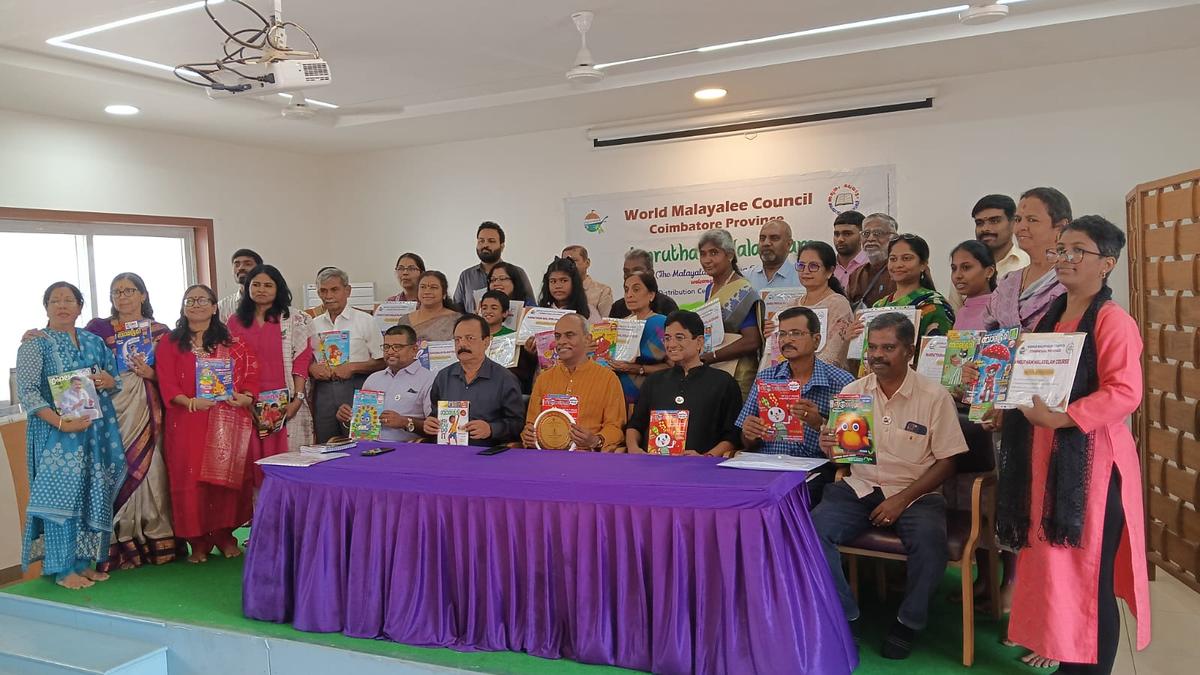
When Jnanpith Award, the prestigious national literary honour, was first presented in India, the first ever honour went to an eminent writer from Malayalam — G Sankara Kurup for his collection of poems titled Odakkuzhal (The Bamboo Flute). “Many other literary giants like SK Pottakad, Thakazhi Sivasankara Pillai, MT Vasudevan Nair, and ONV Kurup won the honour in the later years. Any new experiment in the world of literature is reflected first in Malayalam,” says award-winning teacher EC Sabu over phone from his home town Pala in Kottayam. He prepares for the upcoming fifth batch of Amrutham Malayalam, an online eight-month certificate course offered by the World Malayalee Council, Coimbatore Province.“The virtual learning programme is a positive story to have emerged out of the pandemic,” says Vijayan Cheruvassery, general secretary of the Council, reflecting upon the beginnings of online classes. “It was a thumping success. Overall, we are getting a section of society that is united by a love for Malayalam, its culture, literature and also movies. Our Council is spread across 80 countries and we have been getting students from South Africa, Dubai and Australia too. It is about building confidence to learn a new language,” he adds.What makes the classes memorable is Sabu’s teaching. He goes beyond grammar and vocabulary and intersperses lessons with poems, songs, quotations, proverbs, literary references and stories about Kerala’s folklore.. E C Sabu often recites poems and songs during the sessions, giving students an experience of the rhythm and musicality of Malayalam | Photo Credit: Special Arrangement He often recites poems and songs during the sessions, giving students an experience of the rhythm and musicality of Malayalam. With over 35 years in active teaching, he has been honoured with many awards with a recent one being at the 49th Kerala Association for Non-formal Education and Development (KANFED) meet.The class brings together students of different ages, professions, linguistic backgrounds and geographical locations. For I Ravi, Malayalam was a language he could speak a little, but never read with confidence. For R Lakshitha, a Class VI student, it was a completely unfamiliar script. Their ages, backgrounds and reasons for learning the language may be different. But they share one thing: all of them discovered that Malayalam was not as difficult as they had imagined, thanks to the teaching methods of Sabu.Ravi, a retired bank manager and now a practising lawyer, had attempted to learn Malayalam a few years ago. He gave up halfway, finding the conventional approach of starting with the alphabet intimidating. Sabu turned that method on its head. “He introduced letters through words and gradually took us to the alphabets. This removed my fear about learning the language,” says Ravi, who hopes to read original works of writers like Sugathakumari and K Satchidanandan.For Gokulkumar D, the course became his first serious learning experience nearly a decade after college. He began reading Malayalam name boards during a trip to Varkala and even tried reading the lettering on KSRTC buses. The programme also challenged the idea that learning a new language is something reserved for the young.Manivannan Shanmugam, another retired bank manager, enrolled for Sabu’s online course when he turned 73. “I eagerly wait for the 11am class every Sunday,” he says. He watches Malayalam news bulletins and films to keep pace with the language. For R Vani from Ellithorai near Coonoor, Malayalam began as a fascination with the language’s pronunciation, rhythm and conversational style.“I never imagined, even in my dreams, that one day I would be able to read and write Malayalam,” she says. Today, she can do both. The experience has inspired her to introduce Malayalam to her 10-year-old daughter as well. “Languages do more than help us communicate. They connect people, cultures and hearts,” she says.For Manikantan VAJ, receiving the Malayalam course completion certificate in his post-retirement phase was a delightful experience. “The programme deserves appreciation, especially Sabu Sir, who introduced us to the language with humility, devotion and patience. His engaging sessions made learning Malayalam a truly cherished experience,” he adds.Pooja Srinivas Nair, who joined from Dubai, says learning the language was a challenge. “As a Malayali I could neither read nor write Malayalam fluently. My sister-in-law Dr Jayanthi Pradeep, a student in the previous batch and WMC member recommended the course. Dr Sabu Sir’s passion, patience and dedication made the journey enjoyable and achievable. It brought me closer to my dream of reading and writing Malayalam fluently.”For Sabu, a vibrant classroom makes not just learning but also teaching an enjoyable experience. “There is unity and oneness among non-native speakers while learning a new language. For the aged, it keeps them engaged and active. Malayalam has the maximum number of letters among Indian languages and serves as a gateway to learning Sanskrit and Hind. We hand hold them not just for eight months but over a long time by constantly sending them reading materials,” says Sabu. Reflecting on the course that marks a student’s lifelong relationship with Malayalam, Sabu says, “It is their excitement that keeps me inspired.”For details on the course, call Sabu at 9486477891/ 6380701846 or Vijayan Cheruvassery, general secretary of the World Malayalee Council, Coimbatore Province at 9994531441
Learn Malayalam: A novel teaching method to learn the language in eight months
Full Article
Original Source
Read the full article at Thehindu →KhanList aggregates and links to publicly available news content. We do not host full articles from third-party sources. Always verify important information with original sources.