
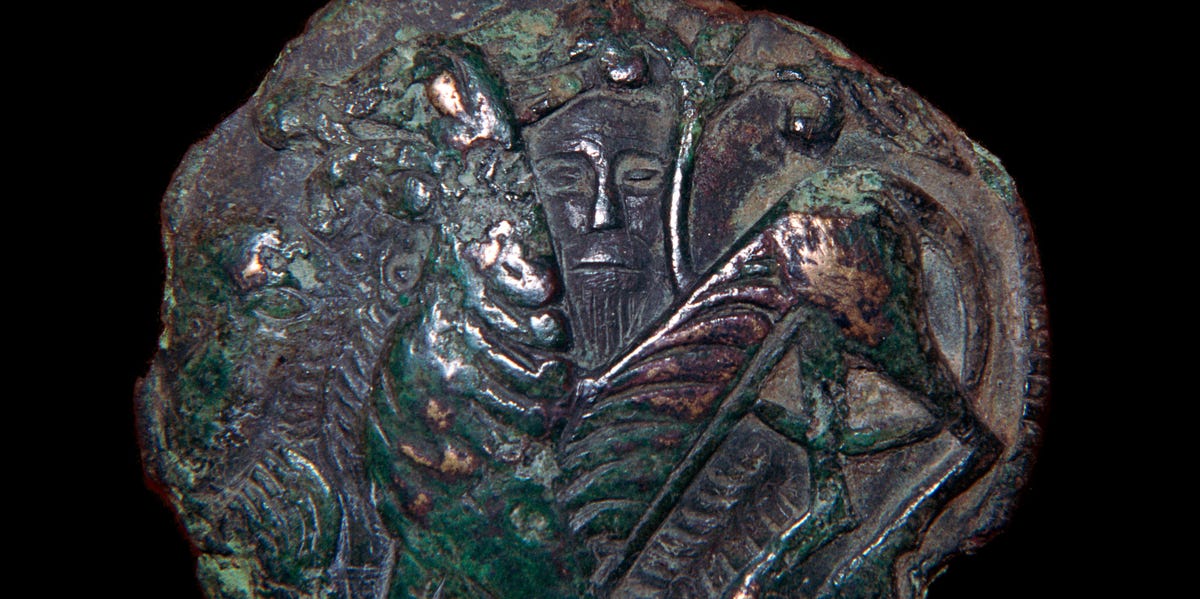
4 min readTwo metal detectorists searching the Isle of Man received double the surprise when they uncovered a 1,100-year-old double grave. It contained rare brooches typically worn by Scandinavian women and a sword that, according to one expert, would once have gleamed with a “bright silver” pommel. The site also produced intricately decorated trading weights, a Viking axe head, balance scales, and a ceremonial bronze ladle.“This is an extraordinary discovery and one of the most significant groups of Viking Age objects found on the Isle of Man,” Allison Fox said in a statement. Fox is curator for archaeology at Manx National Heritage, a museum and heritage trust on the Isle of Man, a self-governing British Crown dependency in the Irish Sea between Great Britain and Ireland. “What makes it particularly exciting is the combination of finds, which gives us a rare opportunity to explore the lives of some of the island’s earliest Scandinavian settlers.”Experts believe the metal detectorists, Daniel Crowe and Rhett Britton, came upon the double grave of a man and a woman who were buried with some of their finest possessions: three brooches for her and a sword for him. Fox said the date of the brooches suggests the grave may be the “earliest known female Viking Age burial” on the island. Together with the other finds, she said, the objects “help us build a picture of the people who lived here more than a thousand years ago, how they traded, and the connections they maintained across the Viking world.”The find dates to around 900 C.E. That places it at the early end of the Viking Age on the Isle of Man, just as Scandinavian communities were becoming established there. Some of the objects are also the first of their kind found on the island.Museum experts believe the Vikings first arrived on the island during the ninth century. Recognizing the strategic importance of its location in the Irish Sea, they established trading links before settling there. A rich Viking heritage remains across the island, and burials found in the past show evidence of pagan traditions. Viking influence still runs through Manx culture today. Tynwald, the island’s parliament, was founded during the Viking Age and is known as one of the world’s oldest continuous parliaments.After making their discovery, Crowe and Britton didn’t try to clean the objects. Fox says this has allowed experts to fully appreciate the objects’ intricate details. She added that the brooches still have soil inside them, and the team is carefully excavating it in hopes of finding traces of textile.Two of the brooches are a matching pair of oval “tortoise” brooches, the kind Scandinavian women wore to fasten their dresses at the shoulders. Both are covered in intricate interlocking animals, a hallmark of Viking art. According to Manx National Heritage, only one other pair like them has ever been found on the Isle of Man, and that was found by Daniel Crowe’s own father, John Crowe, along with fellow metal detectorist Craig Evans. The new pair is likely about 50 years older, which is why experts think this grave may be the island’s earliest known female Viking burial. The third brooch, decorated with spirals and a glass center, is the first of its kind found on the island.The sword is the type a man would have carried, and it’s the 13th Viking sword found on the Isle of Man. Although the blade is badly corroded and parts of it are missing entirely, Fox said in a video from the heritage group that the pommel still shows “signs of the really intricate decorating that would have been on the pommel when it was buried.” X-ray analysis revealed traces of silver and copper wire inlaid into the iron, which makes it one of only three swords found on the island with such decoration.“When this sword was buried,” she said, “this top part of the sword would have been really bright silver, a really high-status object.” In addition, traces of wood show that the sword’s handle was covered in wood rather than thread or horn.Although 1,100 years in the ground caused much of the sword’s damage, experts believe the Vikings broke it on purpose as part of a burial ritual.Because the brooches were found alongside the sword (items linked to a woman and a man, respectively), a double burial seems likely. Experts said, however, that they can’t be sure whether the grave goods came from one grave or from two graves placed close together.Beyond the burial itself, the decorated lead weights and bronze balance scales found at the site highlight the Isle of Man’s role in Irish Sea trade. The weights are the first of their kind found on the island. One of them has a decorative bronze fitting, with artwork typical of Britain and Ireland, that may have been taken from another object.The bronze ladle, another first for the island, was likely used in ceremonies.Despite all the experts have gleaned from the discovery, there’s still much to be learned. “Although the original burial site has been disturbed,” Fox said, “further research may reveal much more about these objects and the people who owned them.”Tim Newcomb is a journalist based in the Pacific Northwest. He covers stadiums, sneakers, gear, infrastructure, and more for a variety of publications, including Popular Mechanics. His favorite interviews have included sit-downs with Roger Federer in Switzerland, Kobe Bryant in Los Angeles, and Tinker Hatfield in Portland.
A Viking Couple’s Grave May Reveal Who Really Settled This Strategic Island 1,100 Years Ago
Full Article
Original Source
Read the full article at Popularmechanics →KhanList aggregates and links to publicly available news content. We do not host full articles from third-party sources. Always verify important information with original sources.