
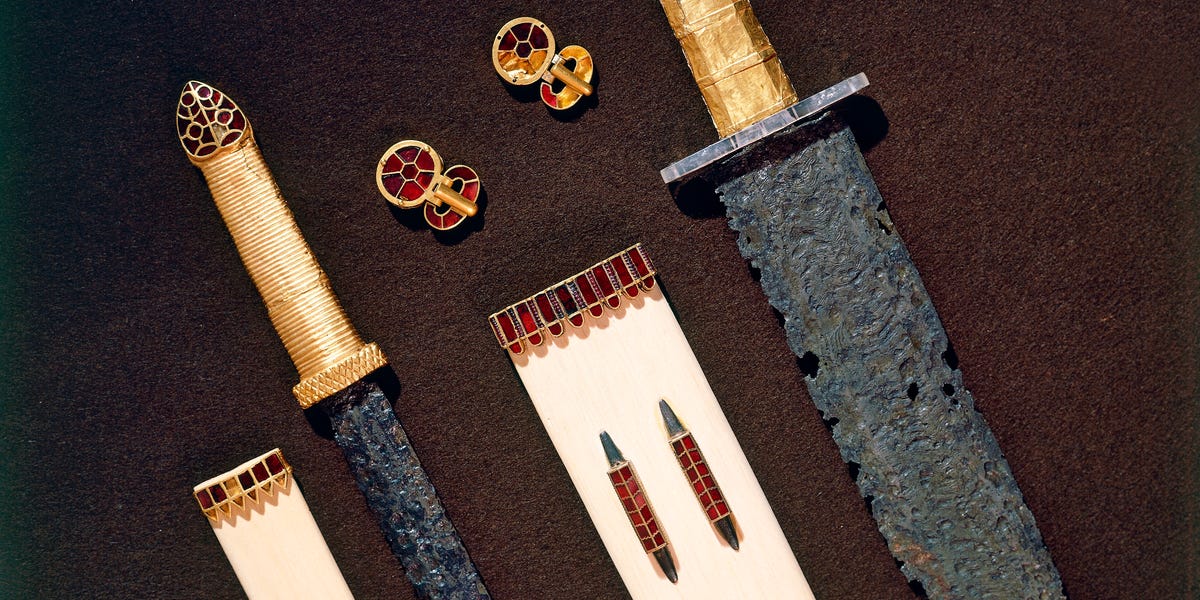
Archaeologists with the French National Institute for Preventive Archaeological Research (Inrap) were excavating ahead of a residential construction project near Colmar, on the banks of the Ill River in eastern France. According to a translated statement, they found both a Gallo-Roman village occupied from the first to the third century C.E., and a fifth-century funerary complex containing 14 human burials and two horse burials.The human burials included 11 adults or older adolescents and three children. Human bone fragments found west of the necropolis suggest that more burials may lie beyond the site’s boundaries. The burial pits were typically quadrangular or trapezoidal in shape and sized to fit the person buried inside. Some of the pits were also filled with artifacts.Those artifacts caught the archaeologists’ attention. Two graves contained high-quality goods associated with warriors, including a sword partially preserved in a wooden scabbard, a single-edged knife, a shield, and a barbed javelin. The Inrap experts said the grave goods match those of Germanic chieftains, whose peoples allied with and joined the Roman army in the region near the Empire’s Rhine frontier during the fifth century.The weapons and the clothing both featured decorative elements made of gold and silver and inlaid with garnets, further evidence of the high status of those buried.Two graves associated with women also produced impressive finds, including silver-gilt bow brooches, silver bird-shaped brooches, glass-bead necklaces, belt buckles, and a bone comb. Even the horses received grave goods: harness equipment was buried with both animals.The skeletons, however, told a grimmer story, with signs of injury and poor health found throughout the 14 burials. At least two of the deceased had fractures that were never set, and one of these likely left a man’s lower leg useless. Two other individuals had bone injuries likely caused by edged weapons. “The complete absence of perilesional bone remodeling suggests that death followed these violent acts rapidly,” the experts wrote.The team was surprised to find so many injuries linked to violence in such a small sample of burials.The fifth-century funerary complex was the excavation’s most striking discovery, but it wasn’t the only one. The team also uncovered part of the Gallo-Roman village’s core, including a residential district and a network of streets, showing that people lived there continuously from the first to the third century C.E.Human activity at the site began in the middle of the first century C.E., and the site was most densely occupied from the second into the third century. Houses built of perishable materials stood on stone footings and were arranged along a street network that changed over time. Archaeologists also found hearths and wells, along with other structures that they said may have been used for industrial work.After the village declined, a layer of silt covered the area. The silt shows only occasional use and little human activity through the fourth century, until the burials appeared in the fifth century.Because evidence from this era is so rare, the funerary complex helps shed light on the poorly understood transition between the end of the Western Roman Empire and the Merovingian era in the Alsace region. “The exceptional nature of this find stems, in particular, from the scarcity of sites that document Germanic settlements during the specific chronological period in the region,” the statement reads. “These new findings will undoubtedly provide a fresh impetus for examining the region’s settlement dynamics, as well as the profound upheavals that shaped this territory during the second half of the fifth century.”Tim Newcomb is a journalist based in the Pacific Northwest. He covers stadiums, sneakers, gear, infrastructure, and more for a variety of publications, including Popular Mechanics. His favorite interviews have included sit-downs with Roger Federer in Switzerland, Kobe Bryant in Los Angeles, and Tinker Hatfield in Portland.
These 1,500-Year-Old Warriors Were Buried With Riches. Their Wounds Paint a Darker Picture.
Full Article
Original Source
Read the full article at Popularmechanics →KhanList aggregates and links to publicly available news content. We do not host full articles from third-party sources. Always verify important information with original sources.