
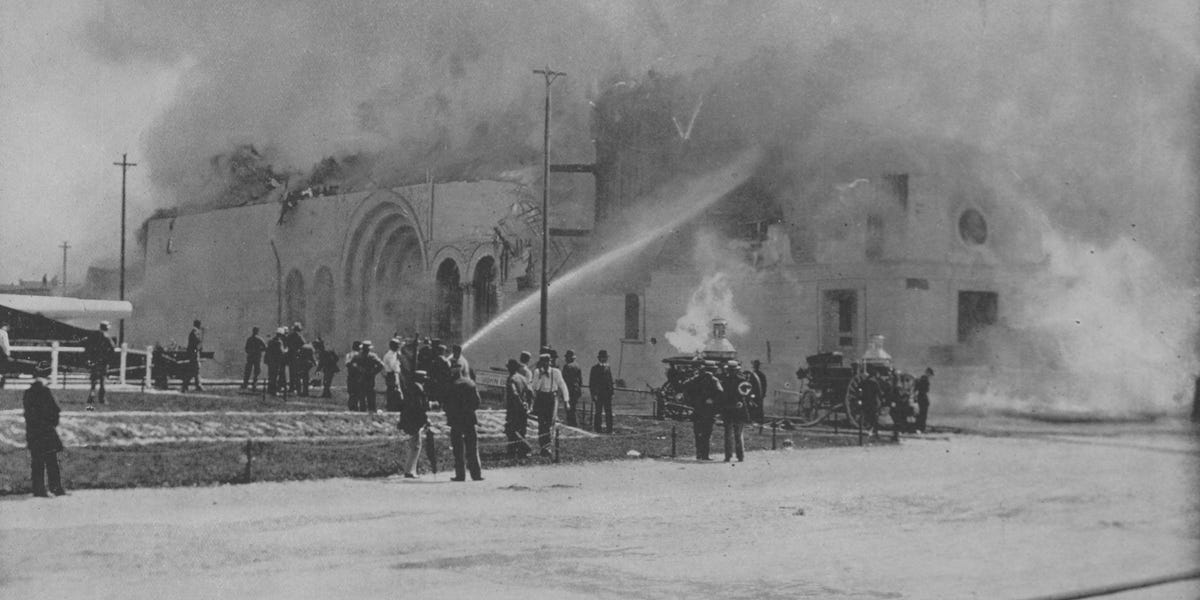
4 min readA deadly fire devouring a mega-fridge dubbed “The Greatest Refrigerator on Earth” might sound tragically ironic. Extreme cold isn’t supposed to cause extreme heat, but that’s exactly what happened when the massive cold storage facility at the 1893 World’s Fair was consumed by a raging inferno. The blaze was triggered by a cosmetic flourish—a wooden sheath built around the smokestack so that fairgoers would never have to look at naked steel.The Cold Storage Warehouse was one of the most immense structures at the fair. It towered six stories above the fairgrounds and could hold thousands of pounds of food and a built-in ice skating rink. When it was initially built by the Ice and Refrigeration Machine Manufacturers with Hercules Iron Works, the massive size of the structure and its refrigeration units demanded an iron chimney 200 feet high. But that chimney was doomed.On the afternoon of July 10, 1893, smoke began billowing ominously over the fairgrounds. Thomas Barbour Bryan, one of the fair’s organizers and its first Vice President, spotted it mid-conversation with former Cornell College president William Fletcher King. It was then that he realized the Cold Storage Warehouse was burning. Helpless to staunch the flames, Bryan and King looked on in shock. The building wasn’t just for ice skating and storing perishables. Its upper level was a turret that featured seven stories of platforms with a view of the fairgrounds, and as the lower levels burned, many visitors were trapped on these platforms with no escape route. Some of them would leap straight into the mouth of the fire.“In a few seconds the whole lower part of the building was wrapped in flames. We were horrified at seeing people jumping off into the yawning flames below,” King recalled in his 1915 memoir Reminiscences. “We were utterly powerless to render any help. Mr. Bryan seemed to convulse with the horrors of the scene. The terrible catastrophe was soon over.”There seems to have been an abundance of allegedly fireproof buildings (not unlike unsinkable ships) around the turn of the 20th century, and the 1893 World’s Fair was built with exactly that brand of confidence. Chicago spent $30 million—over $1.1 billion today—to put on a spectacle featuring exhibitors from more than 60 countries and over 200 buildings, their exteriors made over in white plaster to create the illusion they had been carved from marble.Because a column of drab gray steel would prove too unsightly, the warehouse chimney was disguised by a wooden tower with a decorative dome on top. A minor fire sparked in the cupola about a month before the disaster should have been a warning. When the fair’s own fire department rushed to put it out, they were skeptical about the safety of something that their chief saw as “a miserable firetrap and will go up in smoke before long.”Then, on July 10, the big fire struck. When flames broke out at the dome’s base, fire engines rushed to the scene, and firefighters climbed toward the blaze, hoses in hand. They soon found themselves trapped on a narrow ledge several feet below the dome. The crowds that had come to be dazzled now watched in helpless horror.In The Book of the Fair, published the following year, historian H. H. Bancroft described the event as “a scene of horror such as few have ever witnessed.” Frantically seeking a way out, one fireman tried to descend on a hose, while another used a rope, but both snapped, sending the men careening into the flames. Other firefighters fell from those perilous heights or leapt eighty feet down to the roof. Then came a sickening crack: the tower split down the middle, taking with it the men who had survived until then.In the weeks that followed, investigators uncovered a bitter truth: the disaster had been entirely preventable. Their work revealed an error in the architecture. Not only was the steel smokestack more than a foot shorter than the building, but the safeguard required for the woodwork surrounding it had been omitted by the builders.Nearly $100,000 in donations—over $3.2 million today—poured into a relief fund, though no amount could answer for the seventeen lives lost. A copper statue of Christopher Columbus, which had emerged almost unscathed, became a grim memorial to the thirteen firefighters and four civilians who perished. What was especially eerie in the aftermath of the fire was the sight of a smoking flagstaff, the only other thing left standing in the refuse. Smoldering remnants of what was once a banner atop it read, “This building is absolutely fire-proof.”Elizabeth Rayne is a creature who writes. Her work has appeared in Popular Mechanics, Ars Technica, SYFY WIRE, Space.com, Live Science, Den of Geek, Forbidden Futures and Collective Tales. She lurks right outside New York City with her parrot, Lestat. When not writing, she can be found drawing, playing the piano or shapeshifting.
A Tiny Architectural Mistake Turned a World’s Fair Attraction Into a Deadly Trap
Full Article
Original Source
Read the full article at Popularmechanics →KhanList aggregates and links to publicly available news content. We do not host full articles from third-party sources. Always verify important information with original sources.