
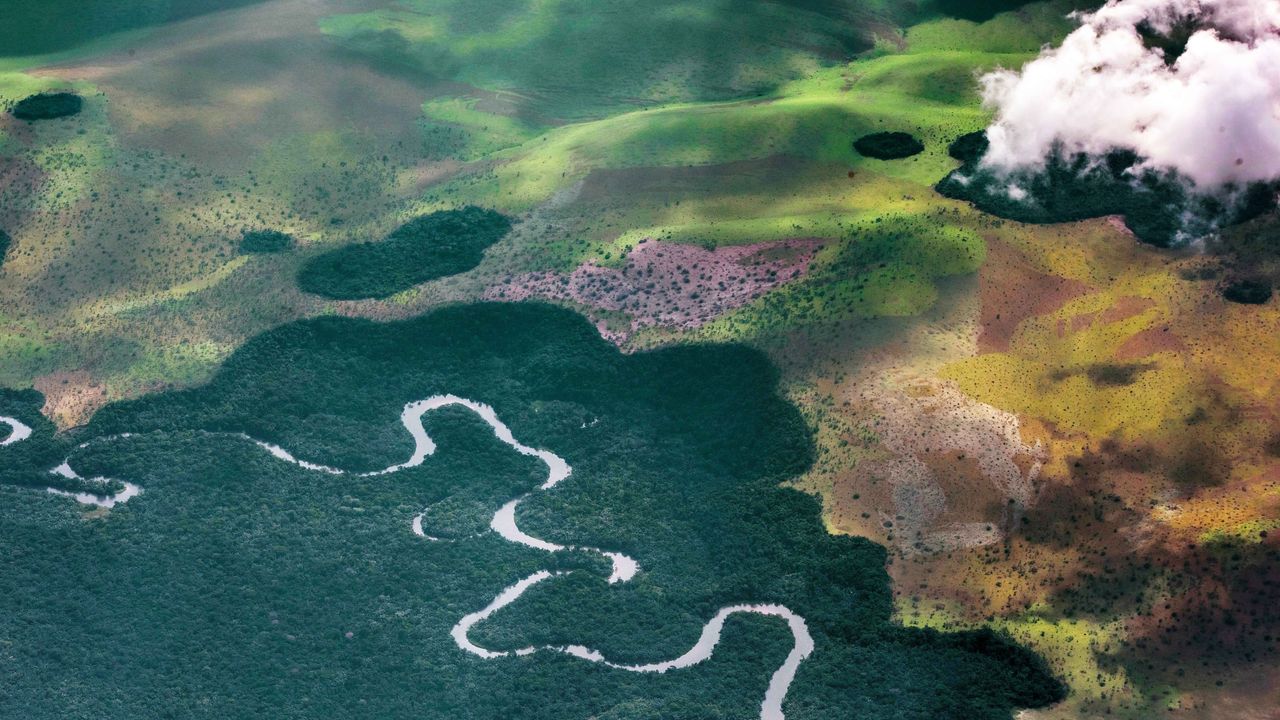
‘Extreme athlete’ Ash Dykes and his Congolese guide Obed Temba Tuyumvire on the story they had hoped to tell through their arduous adventure.Last month the Welsh adventurer and self-described extreme athlete Ash Dykes was paddling along the placid waters of the Sangha River, a tributary of the Congo River flowing through Cameroon, Central African Republic, and Republic of the Congo, when something stirred underneath his vessel, kicking up bubbles. Dykes, with the local guide Obed Temba Tuyumvire and cameraman Will Perez, had just pushed off on a kayaking trip through the Congo Basin, the world’s second-largest rainforest and a critical ecosystem for humans and wildlife alike. The team knew they might encounter lowland gorillas, or perhaps forest elephants, as they made their way nearly 500 miles down the river. Perez then brought up another possible cause for the sudden ripples: a hippo. If the travelers had happened upon a hippopotamus, as many locals had warned them about, they were in immediate peril.In October, adventurer Ash Dykes, local guide Obed Temba Tuyumvire, and cameraman Will Perez embarked on a 500-mile kayaking trip in Republic of the Congo. Will PerezWhen Dykes posted the minute-and-a-half-long video of this “encounter” in the Sangha—cause still unknown—the post racked up over 8 million views on TikTok. The thousands-deep comments section, full of viewers hooked as to what might happen next, burst with theories: Some swore that Mami Wata, a water spirit said to frequent the riverbanks, had caused the sudden movement. One user mused that the three men were in “a real game of Hungry Hungry Hippos,” while others zoomed in on Perez’s visibly tense expression. Another user quipped: “I quit my job to focus on this expedition.”Though intended as a joke, the latter reaction succinctly illustrates the attention this trip has garnered on social media. For weeks millions of viewers were glued to the team’s frequent TikTok dispatches—which they later fleshed out into a longer YouTube series of deep dives. The videos documented the logistical hurdles in reaching the Sangha; their trudging amid the heat and threat of parasites and disease; their day spent with the Ba’Aka people, a seminomadic Indigenous tribe in Dzanga-Sangha Protected Area, where they foraged for wild coconut and joined a traditional hunt; and extended stretches of the three bobbing through calm waters. Those following online celebrated alongside the men when they spotted forest elephants, and their pulses quickened when they outran a swarm of bees chasing their kayaks. When the team went abruptly silent for a prolonged stretch, following a power bank failure, viewers worried that something catastrophic had happened.The Congo Basin is the world’s second-largest rainforest and a critical ecosystem for humans and wildlife alike. GettyThe Sangha expedition—or “mission,” as Dykes has dubbed it—was the first leg in an ambitious undertaking called Project 6. The venture involves the Welshman—who’s made a career of adventure travel and breaking world records (such as becoming the first person to walk the length of the 4,000-mile-long Yangtze River, which took him nearly a year)—traverse “extreme” parts of the globe by performing intensive feats of athleticism. He will soon cross Kyrgyzstan on horseback in subzero temperatures for the second installment of the project; he is revealing ensuing stops one by one.“I'm fascinated with corners of the world that I am unfamiliar with and learning from the people there that call it home,” Dykes says. “Then [it’s] mixed in with the challenge of: Can I do what is deemed impossible, or can I do what people have tried to do before but failed to complete?”Aside from accomplishing the athletic challenge of constantly paddling down the Sangha every day for weeks, Dykes says he aimed to showcase the beauty of the Congo Basin, and its inhabitants, in a responsible way—stressing to viewers that “you can go to places like this as long as you put the right preparation in,” he says.Video on TikTok and Youtube showed the trio of Tuyumvire, Perez, and Dykes on their river adventure. Will PerezDykes is quick to credit those who made the Congo Basin excursion possible—especially Tuyumvire, who works in conservation advocacy and ecotourism through his Kigali-based company, Kumbukumbu Tours. Born in a forest village near Virunga National Park in the Democratic Republic of Congo, he fled the region following the civil war and lived in a refugee camp for over a decade before founding his tour company in 2015; he says those experiences shaped his belief that responsible tourism can be a means of helping make a local impact, particularly for young people. Tuyumvire agreed to join Dykes’s excursion because he saw an opportunity to tell meaningful stories about the Congo Basin for a larger audience.“Because we have been surviving these out-of-context stories or even more exaggerated stories,” says Tuyumvire. “I myself feel the responsibility to always say yes to someone who has the microphone, and I tell the right context.”Ahead of the excursion Tuyumvire worked with Dykes to pick the specific location for the journey and scouted out the upper headwaters of the Sangha. Tuyumvire offered context and commentary in videos throughout the trip, speaking about the critical endangerment of forest elephants, the deforestation threatening the Congo Basin, and noting that women were on the front lines of hunting when they met the Ba’Aka people.Yet straddling the line between education and entertainment for a predominantly TikTok viewership resulted in unexpected tensions. Internet connectivity posed a challenge due to the forest canopy; still, Dykes insisted the journey be “as live as possible” online. “I can’t be claiming that this is a lifetime expedition and then we use either recycled content or we go dark,” he says.Forest elephants are among the wildlife that inhabits the Congo Basin through which the team traveled. Obed Temba TuyumvireWhile a plurality of viewers seemed genuinely fascinated by the three-week-long trip, even during less-exciting moments, Dykes noticed that some expressed a morbid glee for destructive content. Dykes says that some online commenters even started to bet money on how the trio might die in the Congo Basin, perhaps at the hands of a hippopotamus or a crocodile. “I think people are lost or confused as to what is a video game and what is a movie, and then what is reality,” he says. “So it's almost like this disconnect where people just wanted to be entertained: ‘If I'm going to the Congo, I want to see you escaping wildlife, wrestling.’” Tuyumvire saw the conflicting responses from viewers as “another kind of challenge for me to…create a story that will continuously be fed to the audience, but that will not also be overcrowded by too much exaggeration.”Others have criticized Dykes, drawing parallels between him and other foreigners entering so-called forbidding places and, intentionally or not, reinforcing outdated tropes. Guy Dieudonne Moukandi N'Kaya, a lecturer and researcher at Marien Ngouabi University in Brazzaville, Republic of the Congo, says that Dykes’s trip through the Sangha felt honest in that it showed the “tense coexistence” between humans and wildlife in the region. Yet the way Dykes framed the expedition gave N’Kaya pause: Leading up to the trip, Dykes noted in a TikTok teaser that he would be “dropping into the heart of darkness,” a phrase culled from Joseph Conrad’s controversial, turn-of-the-20th-century novella about a Belgian trading company siphoning resources from the Congo River. N’Kaya says that descriptors such as “heart of darkness” and “unexplored,” which Dykes has also used in some of his posts, erase the presence of those who have long lived within the region: “The Sangha is not empty,” N’Kaya writes over email. “For centuries it has been traversed by people in dug-out canoes—fisherfolk, traders, and families.”The water of the Sangha River, a tributary of the Congo River, is tranquil—but the threat of disease-carrying bugs, dangerous wildlife, and the physical challenge of traveling 500 miles on human power made this one of Dykes' six missions. Will PerezWhile Dykes emphasizes that he wanted to raise awareness of the Congo Basin, which is under dire threat of deforestation, some viewers have questioned whether the adventure has truly benefited the region—or whether it’s more of a boon to his Project 6 venture. The Congo Basin has long grappled with interlacing issues including extreme poverty, corruption, and illegal mineral mining, which Tuyumvire says stem from the legacy of colonialism and slavery. “People are poor in the sense that they are ready to sell anything they are able to, to be able to just survive,” Tuyumvire says. “People seeing a white person in this region, it brings memories of the past: ‘This guy’s coming for timber. This guy’s coming for minerals.’ Things that really don't give them any kind of hope to develop the area. And that itself, the mindset, is a threat to the forest.”After returning from the trip in late October, Tuyumvire has been resting and resuming his routine following the physical demands of kayaking. He’d never kayaked at length before a few weeks ago; he says his real motivation was to “share the stories and to try to transform the adventure into something impactful.” The widespread interest in the videos hasn't translated to bookings of his tours, but that was never the goal: “The audience we had is not an audience of travelers, to be honest,” he says. He has been reflecting on how, in hindsight, he wishes he had created a stronger call to action so that TikTok viewers’ curiosity could have a direct impact on the region. (Alongside his tours Tuyumvire helps run the Congo Rainforest Fund, a local NGO that works with local communities to understand threats to the forest and create solutions, such as shoring up educational efforts and job opportunities.)But he believes that broadcasting the journey did help viewers further understand a place that they may not have been familiar with. “[The] Congo Basin has been represented as a difficult place to access, a difficult, complex place to understand,” Tuyumvire says. “So people were saying, ‘Finally, someone is going to give us the real information’…we want to see them in the reality."Paula Mejía is a Colombian American writer and editor from Houston, Texas. Her work has appeared in the New Yorker, GQ, New York Magazine, Texas Monthly, and other publications. She is based in Los Angeles. ... Read More
A TikToker Went Viral for Kayaking 500 Miles of Congolese River—and Started an Even Bigger Conversation
Full Article
Original Source
Read the full article at Cntraveler →KhanList aggregates and links to publicly available news content. We do not host full articles from third-party sources. Always verify important information with original sources.