
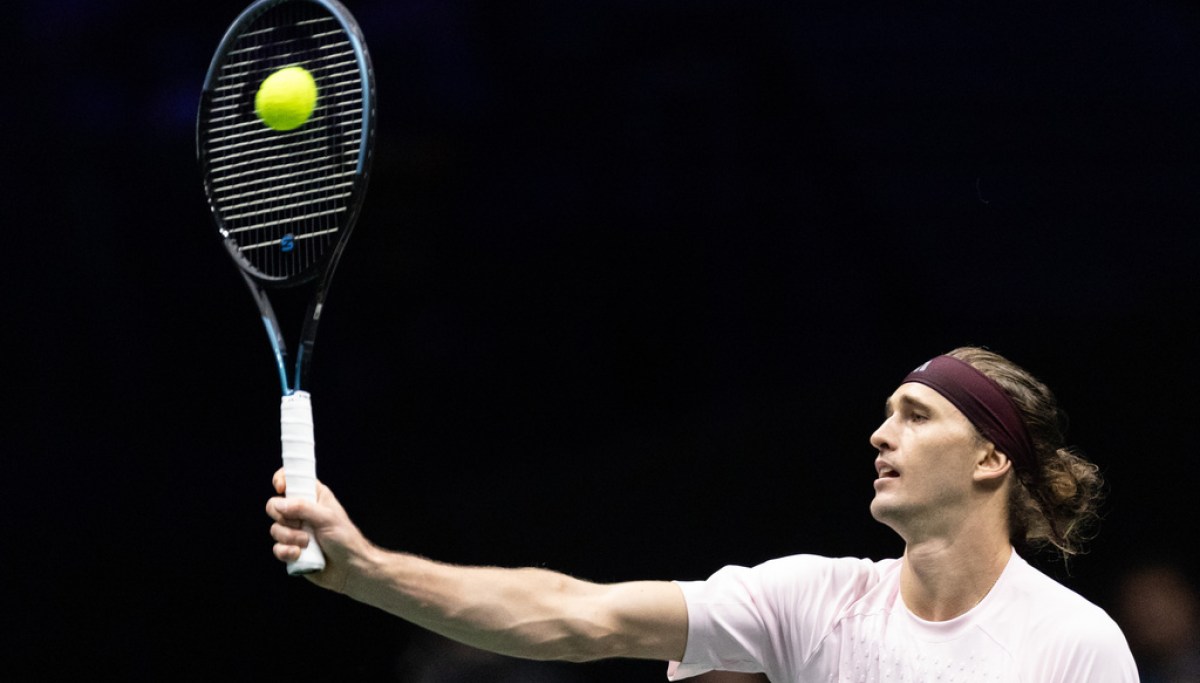
It says something about how unique this past year in tennis was when one of the sport’s greatest of all time (Serena Williams) can attempt a comeback, and this story still wouldn’t crack the top five of the most interesting things that happened in tennis in 2026.That’s partly due to the fact that Williams failed to win a singles match and only played a handful of doubles matches during said comeback (though her U.S. Open match with her sister Venus drew over a million viewers — no small feat for a doubles match). It’s also because some genuinely incredible things happened this year in tennis.Another in the ranks of the greatest of all time, 39-year-old Novak Djokovic, continued to defy Father Time by making the semifinals of two of the year’s four Grand Slams, and beating then-World No. 2 Jannik Sinner in one of those semifinals in an eye-poppingly good match that was one of the year’s best. Meanwhile, Elena Rybakina defeated Aryna Sabalenka in two different Grand Slam finals and became the first player from Kazakhstan to attain the sport’s highest ranking. (All right, everyone — in your best Borat voice, all together now: “Ve-ry nice!”) And Spain’s Carlos Alcaraz became the youngest-ever player to accomplish the career Grand Slam when he won the Australian Open in January, completing the cycle of winning the sport’s four majors at the ridiculously young age of 22.If you’re keeping track so far, that means this was a tennis season during which some of the sport’s biggest names — Serena, Djokovic, Alcaraz, Rybakina — all made headlines. And yet not one of those famous names will go down as the year’s best player. In fact, none won the year’s best match. That’s how crazy a year 2026 was in tennis. “Wawa-wee-wa!” OK, that’s the last Borat reference, I promise … well … second-to-last. Cut me some slack: It’s not every year that a player from Kazakhstan becomes the top-ranked player in one of the world’s most widely played sports.Player of the Year: Alexander Zverev Imagine you had an older brother you could never beat in one-on-one basketball. Then the day comes when he goes off to college. “Finally,” you say to yourself, “now I can be the best basketball player in this house.” But then your dad remarries, and into the house comes your new stepbrother. You start playing with him, and even though he’s two years younger than you, you discover you can’t beat him. “What is it going to take for me to be the best basketball player in this house?” you cry to the sports gods over your cursed fate.Alexander Zverev plays his men’s singles match against Lorenzo Musetti on day three of the Paris ATP Masters 1000 tennis tournament at the Plenitude Arena in Nanterre, on the outskirts of Paris, France, on November 4, 2026. (Ibrahim Ezzat/NurPhoto via AP) This was poor Zverev’s life on the ATP Tour for the better part of the past decade. Arriving on the scene during the end of the Big Three’s reign, Zverev — the 6 feet, 6 inch German who can serve like Pete Sampras and pound away from the baseline like Andre Agassi — won several Masters 1000 tournaments, made three Grand Slam finals, and won two dozen other titles. But he could never beat Roger Federer, Rafael Nadal, or Djokovic when it mattered most. When two of those titans of tennis finally retired, and Djokovic started to age, Zverev surely was thinking that his day had finally come. But then came along two younger players — Sinner and Alcaraz — whom he couldn’t beat in the biggest moments of Slams either.It was looking like Zverev was going to go down as the best player of his generation to have never won a Slam, one of the most dreaded honors a player can earn. But a strange thing happened on the way to Zverev’s seemingly unavoidable athletic epitaph. For once in his career, he got a little lucky: Alcaraz suffered a wrist injury prior to this year’s French Open that would keep him out of Roland Garros. And during the tournament, the heavily favored Sinner collapsed out of nowhere in the second round. At long last, Zverev had his chance, and he made the most of it. He finally won his first Grand Slam, then backed it up by making the finals of Wimbledon, winning the U.S. Open, and finishing the year as World No. 1.Breakout Player of the Year: Rafael Jodar There is and will only ever be one “Rafa,” but now, as Yoda would say, “There is another” — a gangly player from Madrid no one outside of diehard Spanish fans thought would become this good this quickly. Last year, he was ranked No. 283 and had never played a main draw match in a major. He’s now in the top 10. Yes, the top 10. And he’s only 20 years old. Like Zverev nine years ago, the question will not be whether Jodar can win Slams, but when he’ll start winning them.Match of the Year: U.S. Open quarterfinal — Ben Shelton def. Carlos Alcaraz, 6-7(5), 6-1, 6-3, 1-6, 7-6(7) In a match that had as many plot twists as a Breaking Bad episode, Ben Shelton announced himself to the tennis world as the American who’s most likely to become the country’s first male Grand Slam champion since 2003. But as undeniably dynamic as this match was, what unfortunately will be most remembered about it will be not how it was played but when it started (close to midnight) and when it ended — 3:33 a.m., making it the latest-ending match in the tournament’s history. I love late-night U.S. Open tennis as much as anyone — it’s one of the things that makes the U.S. Open unique, and (in my opinion) the sport’s best Slam — but even I have to admit that they should have found a way to start the tournament’s marquee match a little bit earlier. (That said, did I stay up till 3:33 a.m. to watch it? Do you need to even ask?)Shot of the Year: Gael Monfils’s leaping crosscourt forehand winner during his first-round U.S. Open victory over Paraguay’s Adolfo Vallejo. Monfils, one of my 10 favorite players of all time (and the first player to win this award when this column debuted in 2019), retired after the Open. We’ll miss you, La Monf!THE FIVE DAYS THAT MADE US BELIEVE IN SPORTS AGAIN Moment of the Year: Nick Kyrgios getting busted for doing cocaine. Least surprising drug suspension in sports history?Bold Prediction for 2027: The U.S. Open figures out how to schedule primetime matches during actual primetime. As a great man once said, that would be … “ve-ry nice!”Daniel Ross Goodman (@DanRossGoodman) is a Washington Examiner contributing writer and teaches theology and religious studies at St. John’s University. His next book, Dante’s Guide to Life: How The Divine Comedy Can Change Our Fortunes, Our World, and Ourselves, will be published this fall by Angelico Press.
The year in tennis 2026
Full Article
Original Source
Read the full article at Washingtonexaminer →KhanList aggregates and links to publicly available news content. We do not host full articles from third-party sources. Always verify important information with original sources.