
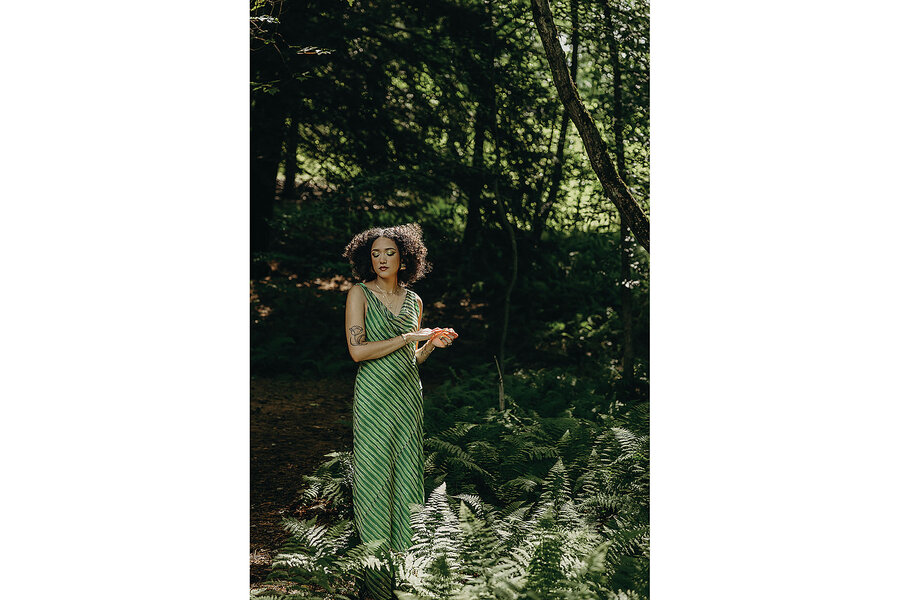
When Kimaya Diggs gets inspiration for a song, she heads straight to her basement. Guitars lean near dark blue walls covered with art portraits made by friends. A drum kit sits near a small piano while strings of lights hang across the exposed ceiling. In one corner, a mini studio room holds microphones and a sound mixer. The basement inside her western Massachusetts home gives her a berth in which to bring ideas to life without renting studio space. The setup, she says, “represents a lot of independence.”A decade ago, Ms. Diggs may have resisted the idea of winding up in Massachusetts after college. Her family was still there. The New England surroundings she’d known since childhood – where she often felt pigeonholed as a person of color in a predominantly white neighborhood – hadn’t changed. But after spending her college years in Pennsylvania, the musician returned to the Bay State with a newfound confidence. “I needed to learn how to fit in as the new version of myself,” says Ms. Diggs, who has played support slots for artists including Mavis Staples, Emily King, Trombone Shorty, and Tank and the Bangas.The independent singer-songwriter has penned a love letter to the place where she was once hesitant to return. Her third studio album, “Green,” released Oct. 2, wrestles with a question she’s grappled with for a while: What makes somewhere home – the place itself or the people we find there? The musical artist has found pieces of the answer in New England’s evocative landscape and in the creative community she spent years building around herself.Ms. Diggs grew up making music alongside her two sisters, playing instruments such as cello, violin, and viola. She was surrounded by a musical community she remembers as supportive, but there were few people of color who shared her racial and cultural background. As a daughter of a Black father and an Indian mother, Ms. Diggs spent much of her childhood wondering where she could find a sense of acceptance. “Did I need to see myself reflected to feel a sense of belonging, or could I find it in the people and the land around me?” she remembers asking herself.College gave the artist a different experience by which to evaluate that question. She formed meaningful relationships with a diverse group of friends. Yet those connections largely felt one-on-one rather than part of a broader community.Returning to western Massachusetts, Ms. Diggs was determined to feel more comfortable in the place where she had grown up. Nonetheless, she still faced moments when she felt like an outsider. Cara TotmanKimaya Diggs' third studio album, “Green,” was released on Oct. 2. “I’ve been asked to work with nonprofit organizations in the past. And in some cases, it felt tokenizing because I was only asked to give input on the experience of Black or women artists in the area,” she says. “In some of those cases, it felt that I was there to check a box ... and then they’re like, ‘Thanks for your piece. Anyways, we’re going to continue on business as usual.’”Those experiences find their way into “Green.” On one of her tracks, “A Sense of Place,” the artist explores the racial isolation she felt in New England.“She is able to hold so many emotional realities in one song that might seemingly contradict each other,” says singer-songwriter Chelsie Field, whose stage name is Wallace Field. “So she has songs about grief and heartbreak and loss, and yet she always, somehow by magic, seems to pull [in] threads of understanding and joy.” Ms. Diggs resolved to make western Massachusetts her home. She and her partner, also a musician, bought a house in Northampton five years ago. The couple has since turned their basement into a studio and practice space where other bands can rehearse.“It’s hard to talk about the [Pioneer Valley’s] music scene separately from Kimaya because to me, she is the music scene,” says Ms. Field, who has known Ms. Diggs since helping her make a live music video seven years ago.When Ms. Field later began performing her own music, Ms. Diggs welcomed her into the local scene, helping her book gigs, sharing stages with her, and also teaching her to “bring others up as well.”Some of Ms. Diggs’ sense of belonging comes from the local fauna and flora. The songwriter recalls looking out at her backyard one day and realizing that she recognized the plants around her. “I know every facet of this land just from growing up here,” she says. “I didn’t study it. It’s just like an instinct to me.”That familiarity extends to the changing seasons. Each interval made her pay more attention to the rhythms of the year: what grows when, what disappears, and what eventually returns – something she says helped inspire her latest album. The title, “Green,” comes from a brief moment each spring when the leaves seem to emerge at once and “the whole world just turns green suddenly.” “I feel like that’s a moment filled with so much possibility and so much potential,” says the artist. “I wanted the album to represent that moment where anything is possible.” While making “Green,” Ms. Diggs was eager to move into another stage of music-making. The songwriter, who knew little about production when she first started recording, co-produced the album and also engineered about a quarter of the record. The songwriter’s debut album, “Breastfed,” had softer instrumental arrangements. On “Green,” Ms. Diggs’ vocal style has risen to a new tonal level. “She’s taking greater vocal risks and pushing her vocal range,” says Ms. Field. “That just makes me feel like she has more confidence in who she is, what she has to say, and how she’s going to say it.” Deepen your worldviewwith Monitor Highlights.Politics with respectGet political stories with respectful analysis.There‘s a world of new ideas in everyBooks newsletter.There‘s more to life, enrich yours withCulture & Learning weekly.Follow humanity‘s discoveries withScience & Nature stories in your inbox.Gain a spiritual perspectivefrom the stories in your inbox.Want to understand the deeper impact of critical events? Learn the Monitor‘s insight.Already a subscriber? Log in to hide ads. On paper, Ms. Diggs is a fully independent artist with no management team or label. In reality, she says, “I have a wonderful community behind me.” A long list of 82 western Massachusetts artists contributed to “Green” in some way.“Home is in the people and it’s in the land,” she says. “It is in what you’re willing to learn from nature and it is in what you’re willing to give to your community because I found whatever I give, I get back tenfold or more.” ALREADY A SUBSCRIBER? LoginReal news can be honest, hopeful, credible, constructive.The Christian Science Monitor was founded in 1908 to lift the standard of journalism and uplift humanity. We aim to “speak the truth in love.” Our goal is not to tell you what to think, but to give you the essential knowledge and understanding to come to your own intelligent conclusions. Join us in this mission by subscribing.
A songwriter asks, ‘What makes a place feel like home?’
Full Article
Original Source
Read the full article at Csmonitor →KhanList aggregates and links to publicly available news content. We do not host full articles from third-party sources. Always verify important information with original sources.