
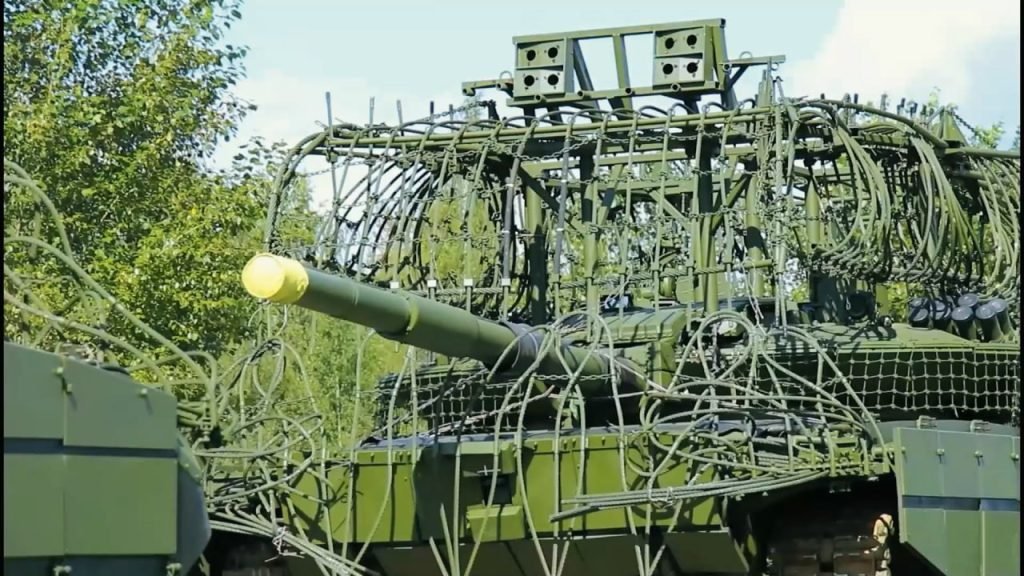
Every day, the Ukraine Battlefield update newsletter offers a clear look at how the war is unfolding on the ground. Subscribe for free here to get the full text delivered to your inbox. A Ukrainian general said that disabling enemy equipment was not as easy as it might seem. This is confirmed by the case of a Russian tank that travelled 15 km near the front line. Russia sent new tanks to the front in September — how are they currently protecting them? Some analysts are sceptical that Russian mechanised assaults will be more successful in the coming months. Map of the day: Ukrainians liberated a village near Kupiansk. Chart of the day: Last week, Ukrainians liberated more territory than Russia captured. Videos of the day: A Russian soldier in a mobile team failed to spot a drone; a hundred drones wait on a road; an F-16 strikes a Geran-5; a view of a similar operation from the cockpit of a MiG. The current war has significantly limited the use of armoured vehicles. Mechanised assaults have become rare partly because vehicles are almost always hit by FPV drones. “Under current conditions, tanks have gradually moved not only to the back seat, but all the way to the third row,” Ukrinform quoted Viktor Trehubov, spokesman for Ukraine’s Joint Forces operational group, as saying. This has been the reality at least since last year. But many are waiting for tanks to “strike back” and for either side to improve them enough to make them more widely usable at the front again. In recent days, there has been an intense debate over whether Russia is approaching that point. The discussion was prompted by Ukrainian general Denys Prokopenko, commander of the newly formed Azov grouping responsible for defending part of Donbas. Last week, he said he expected Russia to attempt mechanised assaults in the autumn. And, he said, stopping Russian equipment was not so straightforward. “When you see a video of a burning tank online, believe me, it was not hit by one, two, or three drones. Destroying enemy equipment prepared for a mechanised breakthrough is not as easy as it seems,” Prokopenko said. He added that Russia was “skilfully upgrading its tanks with active protection, electronic warfare systems and mine-clearing equipment”. Russia recently released a video that purportedly shows that tanks can survive longer at the front than before. The video says that a Russian T-90 tank, commanded by Russian soldier Denis Dmitriev, was able to travel 12 km through a dangerous zone despite being hit by 40 drones. How did it manage this? The tank had a cage around its turret reinforced with steel wires. It was gradually hit by drones, damaging its gun barrel and reducing the crew’s ability to observe its surroundings. But the tank remained operational. 1/ A rare look at a modern armored assault on the Donetsk front.Russian T-90s from the 228th Guards Motor Rifle Regiment, 90th Guards Tank Division, reportedly broke through defensive positions and cleared a route for lighter vehicles to follow. pic.twitter.com/1wzbqVY7iH— H. Memarian (@HEMemarian) September 21, 2026 Things became more serious when the tank was struck by munitions dropped on it by a Ukrainian Baba Yaga bomber drone. The soldiers had to open the hatches and leave the vehicle. The crew then hid in vegetation for three days and eventually used bad weather to return to Russian positions. Let us set aside for now how much credence can be given to the Russian account of the events. According to Tass, Dmitriev said that after the Baba Yaga strike, the tank was burning only on the outside; they returned inside, fired another 10 rounds and drove the tank back. However, video geolocation north of Pokrovsk suggests that it actually travelled not 12 but as many as 15 km. This confirms that it endured longer than is usual during Russian attacks. On the other hand, according to this map, the tank never left Russian positions — although Ukrainian drones often operate deep inside Russian-held territory, meaning it was under fire. define breakthrough?they barely reached the FLOT of their own infantry in shakoveit did survive 30 FPVs and larger drones and covered around 15km under fire after UA started engaging against it around Novoeconomichke before being destroyed pic.twitter.com/jCkW4aG33J— imi (m) (@moklasen) September 22, 2026 This is not the first time Ukrainians have had to make a greater effort to stop a Russian armoured vehicle. Christophe Tymowski, a former Swiss army officer who writes for a military magazine, wrote that in one case, Ukrainians reportedly had to deploy 125 drones to stop two or three tanks. How Russian tanks are protected when sent to the front: On 12 September, Russian ground forces received a new batch of Russian-made T-90M and T-72B3M tanks produced at the Uralvagonzavod plant. As Sam Cranny-Evans wrote, the editor of the Calibre Defence website, they were fitted with a so-called “tsar tent”. This is a large structure above the turret, made up of steel bars and rubber strips, added to the turret’s protective frame. It allows the crew to retain good visibility and turret rotation while increasing the tank’s protection. According to Cranny-Evans, the new Russian tanks also have “comprehensive Kontakt and Relikt explosive reactive armour suites”. The Russian Military Informant channel showed what such tanks look like. While crews previously improvised such measures themselves, anti-drone protection is now largely fitted at the factory. As it noted, some of the delivered tanks were also equipped with the new Arena-M protection system. It works by detecting an incoming projectile or drone and firing counter-munition to neutralise it before it hits the tank. We first saw this system at the front in July. And although Ukrainians have managed to stop tanks equipped in this way, it made a difference: they had to make a greater effort — and use more drones. It has also been reported that by 2027 these Arena-M systems are expected to have 36 projectiles rather than 12. In addition, the new Russian tanks have mechanical and electromagnetic mine-clearing systems. Protecting the tank itself is only one part of the solution for surviving in the killing zone. “The most important developments concern tactics. Russian infantry seek to penetrate as far as the positions of Ukrainian drone operators, while artillery attacks their launch zones. Armoured vehicles can then be deployed in several waves: the first wave forces defenders to expend their drones and anti-tank ammunition, while the next seeks to exploit their exhaustion,” Christophe Tymowski wrote. “How Russia deploys its tanks is just as important as how it protects them,” wrote Sam Cranny-Evans of Calibre Defence. Some believe that if Russia can move one tank 15 kms, deploying more of them could create problems for Ukraine on a particular section of the front. There have even been claims that this marks the “end of the era” in which tanks and other armoured vehicles were unable to survive at the front. According to several analysts, however, that is a premature assessment. Overall, many remain sceptical that Russia has improved its tanks and the way it deploys them sufficiently for breakthroughs to become more frequent this autumn than they have been in recent months. Jakub Janovský, who analyses equipment losses for Oryx, wrote that even in the past, Ukrainians had to hit so-called turtle tanks a similar number of times as they do now. “The number of hits needed to disable a vehicle — after which you have ample time to destroy it permanently — is much lower than the number needed to destroy it completely,” he also wrote. He added that, just as tank protection is improving, so too are the quality and quantity of drones. They carry larger payloads than in the past, and their numbers at the front are also rising — as one of the videos of the day illustrates particularly well. For now, what Ukrainian commander Trehubov said still appears to hold true. The only exception in which Russia can launch larger-scale tank assaults is when it has massive support from its own drones, or when weather conditions are unsuitable for deploying Ukrainian drones, such as during rain or fog. Map of the day Ukrainians liberated territory near the village of Zapadne, north of Kupiansk. This was shown by the Ukrainian DeepState UA account, which updated its map. In total, it attributed seven square kms of newly liberated territory to Ukraine. Map from Sunday and Tuesday. Source: DeepState UA There has been less reporting on Kupiansk in recent months. Russia is trying to push Ukrainians from the eastern bank of the Oskil river south of the city. Ukraine is responding with attacks in the north, where it has had limited success. As Ukrainian analyst Bohdan Myroshnikov wrote, Ukraine has achieved “significant tactical successes and cleared Zapadne” in the direction of Zapadne and Dvorichna. It is also pushing directly towards Dvorichna, where it has likewise achieved “some successes”. “The key point here is forcing the battle for Dvorichna. It is the main hub for logistics and the concentration of forces for further attacks on both banks of the Oskil,” the analyst wrote. He added that successes north of Kupiansk might not immediately affect the situation in the south, but could eventually have an impact there too. It should be recalled that Ukrainians drove a large part of the Russian garrison out of Kupiansk around the turn of the year, but even DeepState UA shows that the city itself cannot be considered securely under Ukrainian control. Chart of the day According to the Ukrainian Oko Hora account, Ukrainians liberated more territory over the past week than Russia occupied — 23 square kms more in total. The liberation near Kupiansk is not yet included in this figure. Ukraine was helped by the fact that it began publicising its successes north of Lyman, which was also reflected by the DeepState UA account, whose figures are used to produce this chart. It was the fifth week this year in which Ukrainians advanced more than Russia. Russia advanced last week mainly around Dobropillia and west of Pokrovsk. Overall, this direction saw the highest number of clashes. Russian advance by week Amount of territory occupied by Russia per week. The figures are in square kilometres. Source: Oko Hora/Datawrapper. Videos of the day The purpose of a Russian mobile team is to monitor the skies and shoot down incoming Ukrainian drones. This Russian soldier on a road in Crimea, however, was not doing his job well enough. A drone struck him from behind while he was unaware. A Russian mobile fire group machine gunner keeps a watchful eye on the sky over the highway to Crimea, searching for Ukrainian drones. pic.twitter.com/1UdTv4H6hb— Special Kherson Cat 🐈🇺🇦 (@bayraktar_1love) September 22, 2026 This footage is so extraordinary that one might doubt whether it is real. Dozens of Ukrainian drones are sitting on the ground on a road near Lyman — we counted more than a hundred. They are waiting for approaching Russian soldiers or equipment. Seen from above, they resemble an army of mosquitoes. On Tuesday, we wrote in the Ukraine Battlefield update that Ukrainians were beginning to succeed in shooting down jet-powered Gerans with interceptor drones. However, there are not enough of them yet. Ukrainian fighter jets are currently the main weapon protecting cities from jet-powered drones. This video shows an F-16 fighter jet shooting down a Geran-5. Here, meanwhile, is footage directly from the cockpit as the pilot of a MiG-29 fighter jet shot down a Russian drone — although it is unclear whether it was jet-powered. What are the losses No update on Wednesday By Tuesday (22 September), Russia had verifiably lost 24,138 pieces of heavy equipment — compared with 24,098 on Monday (14 September). Of these, 19,105 (19,065) were destroyed by Ukraine, 1,000 (1,000) were damaged, 1,194 (1,194) were abandoned by their crews and 2,839 (2,839) were captured by the Ukrainian army. This includes 4,448 (4,447) tanks, of which 3,353 (3,352) were destroyed in combat. Ukraine lost 12,175 (12,143) pieces of equipment, of which 9,579 (9,551) were destroyed, 702 (698) damaged, 695 (695) abandoned and 1,199 (1,199) captured. This includes 1,464 (1,462) tanks, of which 1,125 (1,120) were destroyed in combat. Note: Neither side regularly reports on its own deaths or destroyed equipment. Ukraine publishes daily figures for Russian casualties and destroyed equipment, which cannot be independently verified. This overview uses data from the Oryx project, which has compiled a list of equipment losses documented exclusively by photographs since the start of the war.
A Russian tank survived 40 drone strikes, suggesting mechanised warfare could make a comeback (Ukraine Battlefield update, Day 1,672)
Full Article
Original Source
Read the full article at Euobserver →KhanList aggregates and links to publicly available news content. We do not host full articles from third-party sources. Always verify important information with original sources.