
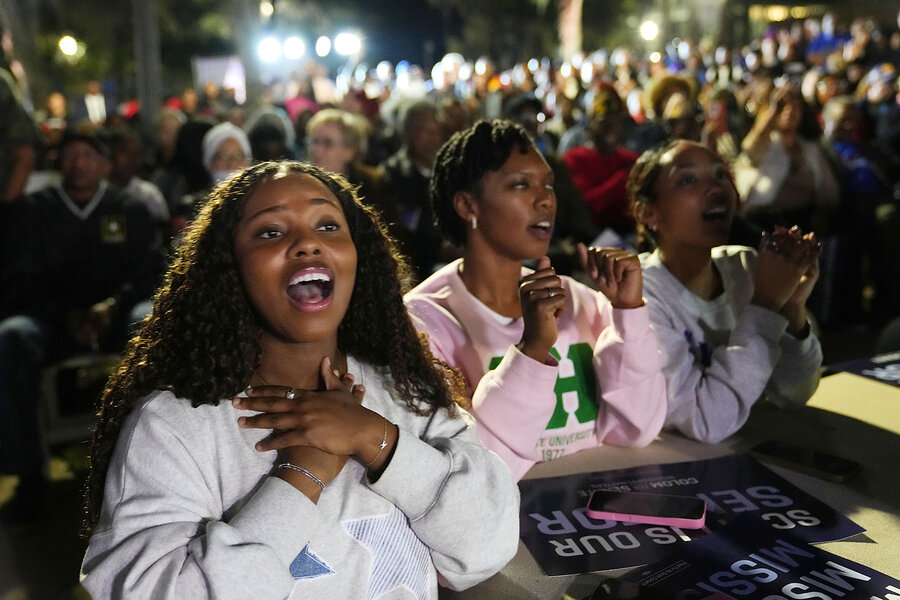
It’s difficult to quantify what Scott Colom’s win for Mississippi means because it’s difficult to quantify all of that joy and all of the hardship behind it. But I will try.For the first time in nearly a century and a half, since the tail end of Reconstruction, Mississippi has elected a Black U.S. senator. Mr. Colom’s pending Senate seat in the state with the highest Black share of the population was seen as a Republican formality, even in the midst of a blue wave. But political logistics and statistics barely scratch the surface of Mississippians’ imagination – or the senator-elect’s tenacity.It’s important to acknowledge that in some ways, I don’t know what I don’t know. I’ve never been to Mississippi, only near it or through it. I have listened to and read intently the words of some of the state’s prominent voices – writers such as Kiese Laymon and Black women who asked out loud about the water in Jackson. What I do know is what it means to be born of the children of Reconstruction – of reconstructions, really. Talking about reconstructions conjures up the names of Fannie Lou Hamer, of Medgar Evers – the names we know, and don’t know, who gave up their lives for liberation. Talking about reconstructions reminds us of the courage of Freedom Summer, of multicultural collegiate coalitions working to pull apart the wings of Jim Crow through Civil Rights and voter registration efforts in the Mississippi of 1964.In that regard, this is a moment for all of us. MS NOW (formerly MSNBC) interviewed a white Mississippi mother following Mr. Colom’s victory speech. “I’m overjoyed. I think that Scott and [wife] Nadia Colom represent the very best of Mississippi,” she said. “Mississippi and her people are so much better than some of the garbage that comes out of the halls of power. … He is going to be a senator for all Mississippians.” Ellen Schmidt/APScott Colom and his wife, Nadia Colom, take pictures alongside their daughters in Jackson, Mississippi, Nov. 11, 2026. Mr. Colom’s victory was so narrow, it wasn’t called until a week after Election Day. Yes, a nationwide blue wave among voters helped. But he won because he did the legwork. He walked the line where people were entering a Trump rally, seeking common ground. Video ads made concerns such as food prices resonant. (“Game Day shouldn’t break the bank,” he said in one.) The slogan “Mississippi matters” showed a commitment to focus on a brighter future for the state – and to frame the state’s troubled past not as a local blight but as something the whole nation owns.And now there’s that line that brings everything back to center, to Black voters, to the ambivalent struggle – the “first Black since Reconstruction.” The first Black senators from Mississippi, Hiram Revels and Blanche Bruce, were the first Black senators in America, period. Baked into this history is bitter betrayal, because after their peers across the South helped to craft state constitutions that sought to make life better for all people, Black leaders were pushed aside by angry mobs fueled by racism. It is a betrayal that persists, when people and political parties insist that the South has been spoken for and decided. The last year Mississippi had a Black U.S. senator was 1881. That’s 145 years ago. Sit with that for a moment.Sit with the elders who are still here, including Medgar Evers’ widow, Myrlie Evers-Williams. One of Mr. Colom’s ads featured Evers’ house and legacy, in which the spirit of the slain Civil Rights worker is very much alive.I sat with the elders last year at Claflin University in South Carolina, heard their rugged memories, and was inspired by their unrelenting hope and love for community. They recalled the influence of college students and young people on the Mississippi Freedom Democratic Party, founded in 1964 and an antithesis of the segregationist politics of the Mississippi Democratic Party of that time. Eugene Smith/AP/FileEd Wilson (left), Peggy Sharp, and Cordell Reagon read about the finding of the burned car of three Civil Rights workers in Mississippi during Freedom Summer, June 24, 1964. The South has never truly been spoken for by those who seek to disregard Black people. The region’s residents have proved able to speak for themselves. The state constitutions of 1868 speak to a post-Civil War people who demanded America be better than a country accepting chattel slavery. The Civil Rights Movement of the 1950s and 1960s demanded America live up to the promises of Reconstruction and its principles of freedom in general. Its heroes gave up their lives, and by virtue of their legacies continue to shape the nation today.I heard Mississippians' bated breath exhale when the Senate race was called for Mr. Colom. I saw the tracks of their tears as clearly as I saw the paths that our ancestors had carved out for us. Mr. Colom’s campaign accomplished the feat with the spirit of African peoples – understanding the power of legacy, of tribal support, and of humor. The “pick another protein” political ad that poked fun (and aimed accountability) at Sen. Cindy Hyde-Smith’s response to rising beef prices became a commercial to remember. “Pick another protein? How about we pick another senator?” became a rallying cry that echoed across the state, and beyond. Deepen your worldviewwith Monitor Highlights.Politics with respectGet political stories with respectful analysis.There‘s a world of new ideas in everyBooks newsletter.There‘s more to life, enrich yours withCulture & Learning weekly.Follow humanity‘s discoveries withScience & Nature stories in your inbox.Gain a spiritual perspectivefrom the stories in your inbox.Want to understand the deeper impact of critical events? Learn the Monitor‘s insight.Already a subscriber? Log in to hide ads. For a moment, I was going to say I’d seen it before, comparing it to previous political watershed moments of recent memory. But this feels like something different. It is the notion of taking Nina Simone’s famous Mississippi pejorative in a protest song and using it as an affirmation.In other words, it is the African and American practice of not only making the best of a bad situation, but making it into a delicacy. Making it into democracy. That’s what Mr. Colom’s win means for all of us, and especially for Black people. ALREADY A SUBSCRIBER? LoginReal news can be honest, hopeful, credible, constructive.The Christian Science Monitor was founded in 1908 to lift the standard of journalism and uplift humanity. We aim to “speak the truth in love.” Our goal is not to tell you what to think, but to give you the essential knowledge and understanding to come to your own intelligent conclusions. Join us in this mission by subscribing.
A remarkable Senate campaign shows how ‘Mississippi matters’
Full Article
Original Source
Read the full article at Csmonitor →KhanList aggregates and links to publicly available news content. We do not host full articles from third-party sources. Always verify important information with original sources.