
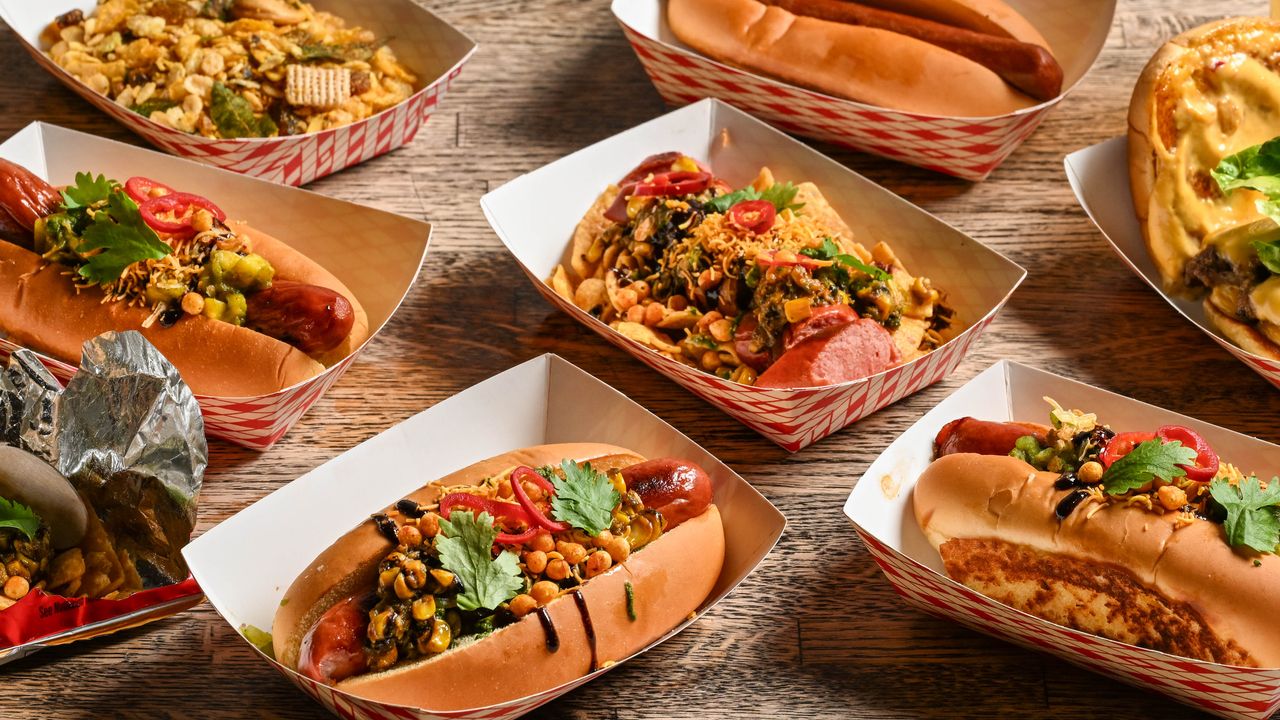
From hot dogs topped with bhel puri to tikka-smothered halal hot chicken sandwiches, chefs are blending Pakistani flavors with the American foods and formats they grew up around.Evan SungIn the summer of 2017, journalist and chef Pervaiz Shallwani and his wife, Laena McCarthy, hosted a hot dog cook-off for a friend’s birthday. Their contribution: a dog topped with bhel puri, a popular South Asian street food snack of crispy puffed rice, diced red onions, and tomatoes, and a mix of tangy and spicy chutneys. The combination—Chicago hot dog meets Karachi street food—was a happy accident, and the start of something larger to come.Shallwani’s father migrated from Karachi to the US in 1971, part of a wave of Pakistanis that began to arrive in the United States in increasing numbers by the 1970s. The community settled around major urban centers, particularly New York City, Chicago, and Los Angeles, and later Washington, DC, and Houston. The small number of Pakistani restaurants that began to emerge during the 1980s in these immigrant hubs either hid behind the label of "Indo-Pak" or "Indian"—a category that had gained mainstream acceptance through takeout staples like butter chicken and chana masala—or catered exclusively to Pakistanis concentrated in immigrant enclaves like Hillcroft in Houston, Little Pakistan in Coney Island, and Devon Avenue in Chicago.While some Pakistani restaurants, like the wildly popular Aga's in Houston, recently logged as the busiest single-location restaurant on Uber Eats, and the beloved James Beard Award-nominated Zareen's Kitchen in Palo Alto, have expanded beyond a primarily Pakistani clientele, they have been the exception. The Pakistani community has long lived in the shadow of the far larger Indian American community, the second-largest immigrant group in the United States. But with the growth of the diaspora from 32,600 in 1980 to nearly 680,000 today, Pakistani restaurants are increasingly feeling the glow of the spotlight.Pitmaster Zain Shafi has shared Pakistani flavors through Texas barbecue, learning at the acclaimed Goldee's before launching his food truck Sabar (pictured above). @sabarbbqMuch of this shift happened after the pandemic. The nature of Pakistani restaurants that have begun emerging in the past four years are not just fine-dining contemporary restaurants in the mold of the recent West African food movement or the Filipino scene that boomed in the 2010s, but something scrappier: a fast-casual form that introduces bold Pakistani flavors through distinctly American formats. Hot dogs topped with spicy, tangy chaat. Also: New York-style chopped cheese with chapli kabab. Crispy buttermilk-brined hot chicken seasoned with a medley of South Asian spices. Say hello to the Pakistani-American kitchen.In Fort Worth, for pitmaster Zain Shafi, barbecue was the means. Shafi had never eaten barbecue while growing up in Texas because it was difficult to find halal options, but when he finally did, “it blew my mind,” Shafi tells me. While also supporting his family’s furniture business, Shafi went down a rabbit hole of barbecue, which led him to get his start at the acclaimed Goldee’s, before launching his own venture: a food truck called Sabar, which from 2023 to 2025 offered halal Pakistani-inspired barbecue creations that included a sausage with seekh kebab seasoning and a smoked tandoori turkey, complete with classic sides like raita, the ubiquitous tangy yogurt, lentils, and naan. “In the midst of Islamophobia in Texas, food was a good stepping stone to introduce Pakistani food to people,” Shafi says. “It broke the ice.”Namkeen's ten current locations are known for their savory sandwiches, but they also serve hot chai, kulfi shakes, and gulabi waffles for dessert. NamkeenNamkeen's halal hot chicken sandwiches are paired with Pakistani flavors like mint chutney and tikka sauce. NamkeenRemixing familiar favorites has been the key in how Pakistani-American food is breaking the ice. Usman Chaudhry, an accountant by training, moved to the US from Pakistan in the early 2000s with his parents and siblings. He had been thinking about opening a restaurant when a space opened up in Chatham, New Jersey, in the fall of 2020. He and his wife Amena jumped at the opportunity and launched Namkeen with his brother. The family's goal was straightforward: bring high-quality halal hot chicken to the Tri-State area, with big flavors in a casual space. The tight menu focused on variations of Nashville-style hot chicken: their signature Clucking Waffle Sandwich (hot fried chicken sandwiched between jalapeño-and-cheddar Belgian waffles), the Tikkaville Sandwich (fried chicken layered between a rich tikka sauce, coleslaw, pickled onions, and a mint chutney on a brioche bun), and Chicken Tikka Mac & Cheese, a classic mac and cheese with fried chicken and a savory tikka sauce.Opening during the height of COVID might have seemed like a risky proposition, but Namkeen drew masked lines out the door almost immediately after launch. Its takeout- and delivery-friendly model made it suited to the moment, but its tight, replicable menu also translated naturally into a franchising model. Namkeen has since expanded to 10 locations across three states as well as Canada, and the Chaudhry brothers have launched a second concept, Ori's Cheesesteaks in Chatham, serving premium halal ribeye cheesesteaks.If Shafi’s entry point to Pakistani flavors was Texas-style barbecue, and Chaudhry’s Nashville-style hot chicken, at Nishaan in the East Village, it is the New York City bodega staple, the chopped cheese sandwich. Founded by Zeeshan Bakhrani, the tiny 600-square-foot counter at 160 First Avenue has become one of the most talked-about new openings in the city. Nishaan's signature is Pakistani chopped cheese—heavily seasoned chapli kebab, chopped on a griddle with peppers and onions, finished with lime-cilantro sauce and tamarind chutney. The menu also includes bihari barbacoa tacos, Pakola soft-serve (a nod to the iconic green soda beloved across Pakistan), and elote chaat inspired by the Mexican flavors that Bakhrani was surrounded by during his childhood in Chicago.Nishaan in New York City gives the bodega classic chopped cheese sandwich a twist, with chapli kebab stepping in. @ayman_visualsBakhrani's path to Nishaan was anything but straightforward. After being laid off from his job in IT product management in 2024, he began creating food content and experimenting with various mashups like mango lassi pie or elote chaat. He secured a booth at Smorgasburg, then earned a spot on Season 18 of the Food Network's The Great Food Truck Race in 2025. "It was a fun bootcamp," Bakhrani says. "Half of the items I sell now, I made over there." The Nishaan team won the $50,000 prize, becoming the show's first all-Halal Food Truck to win. The competition gave Bakhrani the proof of concept he needed to sign a lease on his first brick-and-mortar location.Since then, he has become one of the most energetic and visible champions of Pakistani cuisine in New York City, which has emerged as a hub for the new generation of Pakistani restaurants redefining the cuisine in America. Bakhrani has been actively building community through frequent collaborations, Pakistan Day block parties, and a rotating menu of inventive, nostalgic takes on Pakistani flavor. When someone questioned whether leading with the Pakistani label would help him during the competition, his response was simple: “It won't hurt me either.”Proudly owning the label "Pakistani" is a 180-degree shift from a generation ago. Saud Khan, the founder of Kaafi, a Pakistani chai café in Harlem, was raised in the restaurant business. Born in Peshawar, he moved to the United States at the age of five and grew up helping in his father’s restaurant in upstate New York. Khan had no intention of following in his family’s footsteps, but while sitting in a café one day, he found himself wondering why there couldn't be a Pakistani one—a space centered on chai and Pakistani-inspired snacks. That question led him to open two cafes across upstate New York before eventually making his way to New York City, where the market felt more ready.Kaafi began welcoming guests to its Harlem location in 2024. "As soon as the doors opened, it was a success story," Khan says. Khan believes there has never been a better time for South Asian restaurateurs in New York City: “Maybe it’s because of [Mayor Zohran] Mamdani—a lot of South Asians are doing more restaurant work here than anywhere else,” Khan shares, “We are having a moment right now, we just need to lock in.”Chaat Dog is known for its bhel puri hot dog, which features the South Asian street snack as a topping. Sukhbir ChannaChaat salt fries (pictured) and desi poutine are also on the menu at Chaat Dog. Anthony ScerriBut before Kaafi, Nishaan, and Namkeen in New York, there was BK Jani, which translates roughly as Brooklyn Sweetheart. Founded by Sibte Hassan in 2015, it was an early sign that New York City would become the heart of this movement. Now, joined by this next wave of restaurants, it's still doing what it started over a decade ago.With a background in the creative arts, Hassan had no plans to enter hospitality, but after moving from Lahore, one of Pakistan's premier culinary cities, he was deeply underwhelmed by what he found in New York. The Pakistani restaurants he encountered were, by design and necessity, built to feed the city's cab drivers for under $10, rather than sourcing and serving premium ingredients. After a series of patio grilling nights spent feeding his friends, Hassan came across a former pizza parlor in Bushwick. "I started learning on the go," he told me. "I didn't even know what grill to get. I would go to shops and ask them, and they would make fun of me." Through trial and error, Hassan learned both the operational realities of running a restaurant and developed BK Jani's menu, which focused on premium halal burgers rooted in Lahori flavors. The initial reception was muted. Two months after the formal launch, Hassan would open at noon and close at 10 p.m. without a single customer. He was close to accepting a buyout offer when Ligaya Mishan's review in the New York Times landed, calling Hassan the "Midas of Meat." "I've been busy since then," he says.Like his counterparts at Namkeen and Nishaan, Hassan was intentional in choosing the fast-casual format. His explanation was direct: "It's easy. Very easy." He also felt it kept the focus where it belonged: on the food. BK Jani was always about premium halal ingredients, done right.As for the response to Shallwani’s bhel puri dog at his friend’s cook-off back in 2017? The praise was immediate. That spontaneous event was the genesis of Chaat Dog, the hot dog pop-up he launched in 2022, a joyous blend of his Chicago upbringing in the suburbs of the self-proclaimed hot dog capital of the country, with his Pakistani heritage. Shallwani was initially uncertain how other South Asians would react to chaat on a hot dog, but the response gets at the nerve of this trend. "They felt seen," he says. Chaat Dog has since opened its first permanent brick-and-mortar location inside Time Out Market in Brooklyn, and continues to do pop-ups across the city.Shallwani believes what is happening with Pakistani-American cuisine is not fusion so much as the continuation of a very American tradition. "You know what you know, you take what you can find, and you adapt it over time," he says. "Every immigrant group that comes here makes American food their own. That's what defines American food." Pakistan and its flavors are now firmly in the mix.Maryam Jillani is an international educator and food writer based in Manila, Philippines. She founded the website Pakistan Eats that won Saveur's Editors’ Choice for Best Food Culture in 2018, and was selected by the Library of Congress to be part of its Food and Foodways Web Archive in 2021. ... Read More
A New Generation of Pakistani-American Restaurants Is Forging Its Own Path
Full Article
Original Source
Read the full article at Cntraveler →KhanList aggregates and links to publicly available news content. We do not host full articles from third-party sources. Always verify important information with original sources.