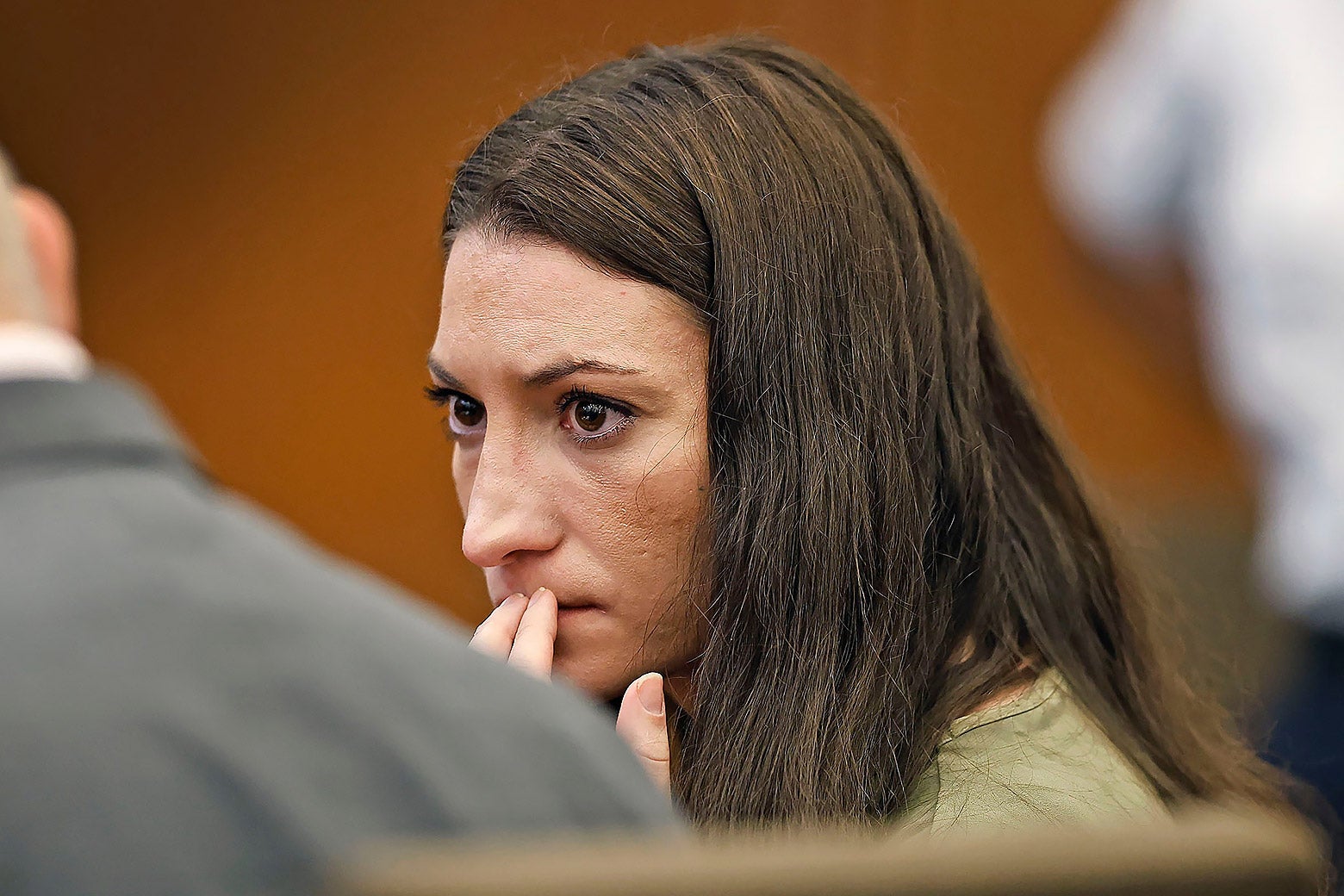
Family Like Lindsay Clancy, I experienced postpartum psychosis. Only luck saved my kids. Greg Derr/The Patriot Ledger/USA Today Network via Reuters Connect Sign up for the Slatest to get the most insightful analysis, criticism, and advice out there, delivered to your inbox daily. This week begins the triple-murder trial of Massachusetts mother Lindsay Clancy. A labor and delivery nurse, Clancy sought psychiatric treatment after struggling with maternal mental health issues following the birth of her third child. After being prescribed a growing list of medications, and with symptoms worsening, she admitted herself into an outpatient program for postpartum depression and, later, a residential program at McLean Hospital, outside Boston. Then, in January 2023, just weeks after her release from McLean, she strangled her three children—5-year-old Cora, 3-year-old Dawson, and 8-month-old Callan—and attempted to kill herself. It’s the worst crime we can imagine. But as a survivor of postpartum psychosis, it’s easy for me to envision my own break with reality ending in tragedy instead of in a psych ward. My 2-year-old daughter saw my symptoms more clearly than I did. “Mama, are you sad?” she asked, playing with the last of her noodles while I stared at her across the tiny breakfast bar where we served most of our meals. I had just put her 8-month-old sister to bed. My husband was out of town for work. There was something about my toddler seeing me so clearly that made the undercurrent I’d been masking impossible to contain. Tears started to run down my cheeks. I turned away, wiped my face clean, and spun back around, letting out my most convincing no while forcing a smile. The only thing I’d been able to vocalize at that point was I don’t feel like myself. It was something I had said to my husband five months before, as we drove back to New York City after a weekend getaway. A weekend of lying by a lake in New Hampshire that was the exact opposite of the pressure cooker of the city. “What do you mean, you don’t feel like yourself?” he had asked. Our girls were napping in the back seat. “I don’t know. I just feel anxious and a bit sad.” I couldn’t put words to the weight that settled on my chest as we drove down the highway. I’d gone back to work after our second baby a month prior and, sleep-deprived, hormones raging, I was struggling to keep it all afloat: two babies, a stressful job, no family support in the city. We agreed that if I wasn’t feeling better in two weeks I’d go see a therapist. But talking about my thoughts and feelings was contrary to my Midwestern Catholic upbringing, and once back in New York, we were too busy keeping all the balls in the air. Seeing a therapist felt part luxury, part another task on the list for two stretched-thin parents—either way, it was an indulgence we couldn’t afford. Plus, we’d never heard of something called postpartum psychosis. Many two weeks passed. I kept going. Five months later, there I was, not quite myself enough that my 2-year-old could recognize it but visibly fine to most. A few days after my daughter’s question, it was as if I fell off a cliff. Although postpartum depression is experienced by 1 in 5 women, who have symptoms like lack of interest in the baby, crying or sadness, and indifference about things they used to enjoy, postpartum psychosis is a psychiatric emergency experienced in 1 or 2 per 1,000 births. It’s often characterized by a break from reality, including things like delusions, hallucinations, and paranoia, as well as insomnia, rapid speech, and racing thoughts. The condition is highly treatable if properly recognized. It took two months, and a whole lot of self-advocacy, for me to land in the chair of the psychiatrist who finally named mine. Descending the subway stairs one December Friday, I popped in my headphones and hoped to relax into a mindless commute after a stressful week at work and a day of feeling off at the office: unable to harness my brain to focus, worried that my colleagues were talking about me, and dealing with weird thoughts. Stepping onto the train, I felt everyone’s eyes on me. For a moment, I chalked it up to my bright orange winter hat. But looking around the subway, I caught more strangers’ eyes, our glances meeting for a second before they looked away. I went from having a nagging feeling that something was off to being convinced I was being followed. Seconds later, as I watched fellow commuters’ eyes dart away from mine, back to their phones, earbuds in their ears, I believed that it was more complex: They were taking direction and communicating my moves. I was being surveilled. It was as if my rational brain—the one I’d spent a lifetime trusting, even collecting fancy degrees for—had been left behind with the shutting of the subway doors. It’s hard to describe what comes next without sounding cliché, as if years of watching shows like Homeland and movies like The Firm were guiding my thoughts away from what was really happening to a diabolical alternate reality. Completely terrified but uncertain as to why I’d been targeted and what I was up against, I noticed my heart starting to pound and my brain moving at warp speed, trying to figure it out, find a way out. It used its power to knit together disconnected details quick as lightning to form a terrifying new sense of truth. I switched trains and removed my hat, trying to lose the people I thought were following me. Unsure what else to do, I continued to a happy hour with old friends as planned. For a moment, I was relieved to see familiar faces, but just as quickly, the spectacle on an unfamiliar face jumped to the center of my brain: a phony disguise. It wasn’t an innocuous happy hour; it was a recruitment event. And when a friend asked who was watching my daughters, I figured she was threatening me—that I had to join or my children would be killed. I pictured my girls at home, moments away from death. I came up with the first excuse I could think of to leave and walk-ran through the streets of the Lower East Side back home. As I picked up the pace and crossed the street at odd times, trying to lose whoever might be tailing me, I worried I was too late. Nearly breathless, I threw open the apartment door, and the first words out of my husband’s mouth were “Why are you home?” Hearing him, my heart sank. Instead of asking why I had left a gathering of friends I rarely saw, I believed he was asking why I hadn’t joined the scheme. That he was in on it. It was 6 p.m. on a Friday. I spent the next 16 hours trying to figure out how deeply he was implicated. If he was more on our side or theirs. If I could escape our 750-square-foot apartment with two babies on a December night unnoticed. The battle was at first internal: me not revealing what I thought I knew, while trying to assess where his loyalties ultimately lay. He was uncertain why I was acting strange, with no idea about the plot in my mind. When morning came, I hadn’t slept and was no closer to finding a way out, and the battle became external. I landed punches on his face, trying to get to our children; he called for help, now certain I wasn’t well. For the 20 minutes before the police arrived, our apartment was a war zone, each of us operating in two different realities, each trying to safeguard our children. I raced between our bedroom door to get to our girls to “save” them from the cult I believed was closing in and then to the front door to get to the roof of our building to show I’d be willing to jump—a last-ditch effort to prove my loyalty to the scheme we were up against and spare our lives. He raced to the front door to stop me from leaving the apartment, then bounded back to the bedroom door to keep me from the kids. Luckily, he was quicker and stronger every time. At the time, I thought he was costing us our lives. Now I know he saved them. Lindsay Clancy’s devastating case has captivated headlines. If you read the comments on those stories, they represent a mix of “Give her the death penalty and move on already” and “She was crying for help—the system is to blame.” The only possible upside of this tragedy is a renewed spotlight on maternal mental health. If we harness this moment, the attention could finally translate into things like diagnostic status for postpartum psychosis—an illness that has been documented since the time of Hippocrates but is still not included in the Diagnostic and Statistical Manual of Mental Disorders—along with more knowledge of and better care for the condition. Nowhere in any of the comments sections I’ve seen does it say That could have been me. But for me, it feels like a haunting truth. If you are pregnant or just had a baby and need support, the National Maternal Mental Health Hotline (1-833-TLC-MAMA) provides free, confidential support 24/7, and Postpartum Support International holds free online support groups and features other specialized resources for those who’ve experienced postpartum psychosis and other maternal mental health issues. Get the best of news and politics Sign up for Slate's evening newsletter. Family Health Mental Health Women’s Health
A Mom Is on Trial for Killing Her Three Children. That Could Have Been Me.
Full Article
Original Source
Read the full article at Slate →KhanList aggregates and links to publicly available news content. We do not host full articles from third-party sources. Always verify important information with original sources.