
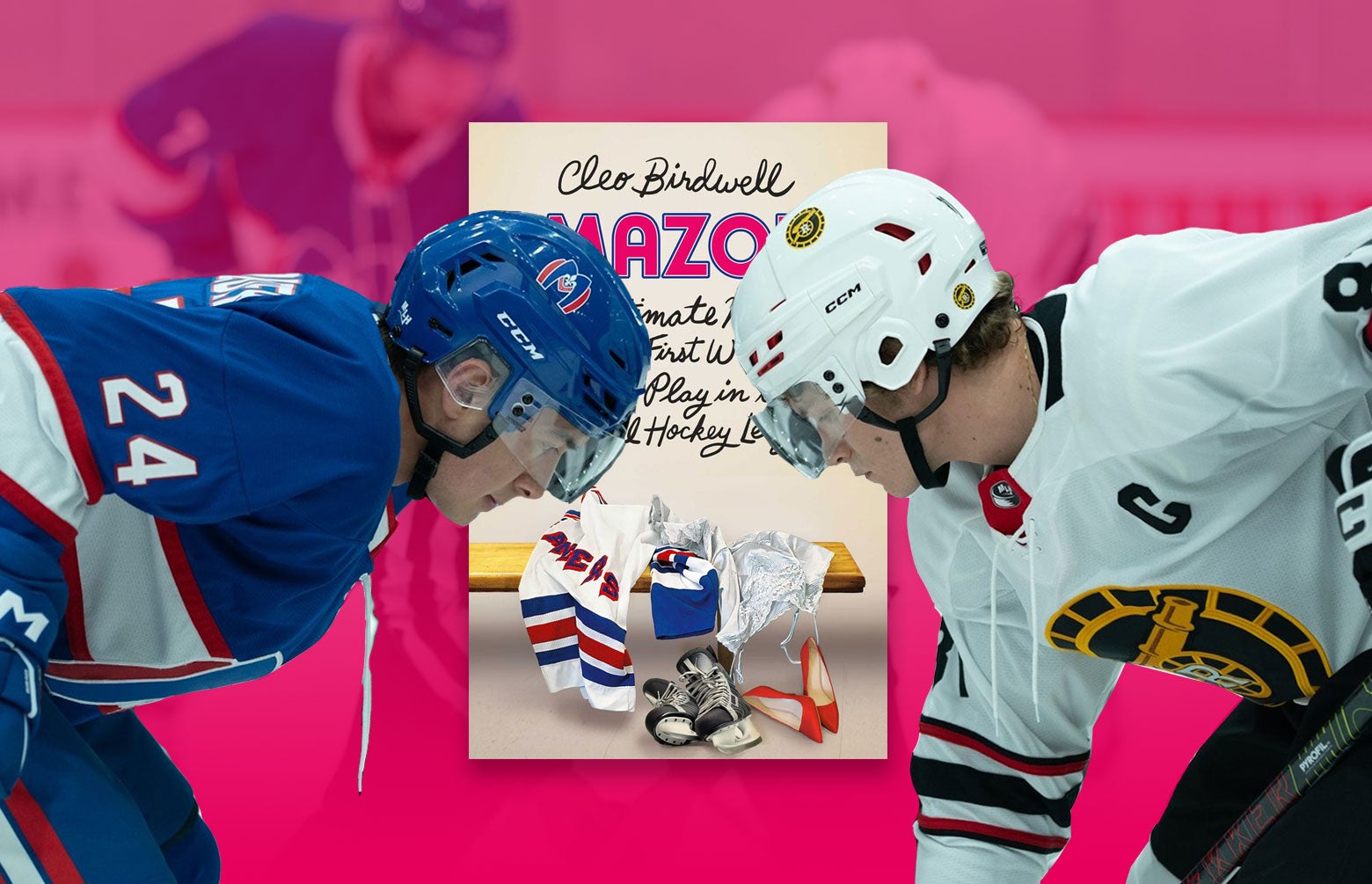
Books After More Than 40 Years, the Original Hockey Sex Romp Can Finally Be Read Again Don DeLillo’s Amazons, published under the pseudonym Cleo Birdwell, might be his best book. Photo illustration by Slate. Images via HBO Max/Crave and Simon & Schuster. Sign up for the Slatest to get the most insightful analysis, criticism, and advice out there, delivered to your inbox daily. “I just want to play hockey,” says Cleo Birdwell, the fictional narrator of the faux autobiography Amazons: An Intimate Memoir by the First Woman Ever to Play in the National Hockey League, a book published in 1980 and out of print for decades thereafter, despite its initial success. When Amazons first came out, the model who posed as “Birdwell” for the book’s cover turned up to promote it at the American Booksellers Association convention, despite the fact that everyone already knew that Birdwell—or any female player in the NHL—did not exist. In an even weirder twist, some astute critics soon identified the actual author of Amazons: novelist Don DeLillo, best known at the time for Ratner’s Star. Yet in the years that followed, as DeLillo’s reputation flourished, the literary lion refused to acknowledge any responsibility for this satirical sex romp of a book. Until now, that is. Amazons has finally been republished with DeLillo’s blessing, albeit with an opening page reproducing a business card the author used to hand out to nosy journalists, reading: “I DON’T WANT TO TALK ABOUT IT —Don DeLillo.” Once accessible only as a coveted secondhand copy of the first edition (a good friend gave me one for my birthday ages ago) or as a pirated e-book, this strange but highly amusing artifact of late 1970s literary culture has just been made available to one and all. The ostensible reason for Amazons’ resurrection is the success of the hockey romance Heated Rivalry, a TV phenomenon based on the bestselling male/male romance novel by Rachel Reid. Probably the only readers who will be more bewildered than those who picked up Amazons almost 50 years ago expecting it to be about hockey will be contemporary readers who open it looking for romance. DeLillo—who is now 90 and has not published a new novel since 2020’s The Silence—once enjoyed a degree of stature and veneration in literary circles that is hard to convey to anyone under, say, 35. The novels he published during the 1980s and ’90s—including The Names, Libra, White Noise, and, above all, Underworld—were revered as deep, perceptive depictions of the state of postmodern America, a culture saturated by mass media and consumerism to the degree that reality had become detached from itself. Young, ambitious novelists ranging from David Foster Wallace to Jennifer Egan cited him as a major inspiration. In the aftermath of the 9/11 attacks—a time before everybody everywhere responded to major events all at once—people struggled to comprehend how an unfathomable slaughter could resemble a scene from a Hollywood blockbuster. In those days, the author everyone most wanted to read on 9/11 was DeLillo, who seemed to grasp better than anybody else the collapse of the boundary between engineered spectacle and truth. Perhaps this bafflement seems quaint now, when all memory of that boundary has vanished. Slate receives a commission when you purchase items using the links on this page. Thank you for your support. Amazons is not the sort of book you want to have on your résumé once you have been enshrined as a highbrow cultural oracle, which explains why DeLillo later insisted that it not be included in lists of his previous works. It’s a silly, very funny novel—DeLillo’s funniest, with the possible exception of White Noise—that vaguely resembles Candy, a clever pornographic 1958 retelling of Voltaire’s Candide, also written under a pseudonym, by Terry Southern, who co-wrote the screenplays of such classics as Dr. Strangelove and Easy Rider. As narrator, Cleo spends almost none of the book describing her experiences in the rink and instead offers up a string of sexual adventures that are less arousing than absurd, with a series of men who embody a whole host of late-20th-century erotic neuroses. Cleo sleeps with one man who can’t get an erection if he has just ridden in an elevator with a hockey player notorious for the generosity of his endowment, or if Cleo mentions Watergate. “It’s the central fact of the decade,” he explains. “No male American has emerged unscathed. We lost so much, in so many ways.” Another won’t touch her with any part of his body but his hands, and won’t let her touch him at all, leading to one of many daffy midtryst quarrels in which Amazons abounds: “You are doing manual. I am doing nothing. It is not even manual-manual. It is not even pure manual. It is half-manual. It is manual-nothing.” “If it is manual-nothing, you may as well say it is nothing. By definition, something times nothing is nothing.” “I’m not saying it is nothing. You are bringing in arithmetic.” One partner can get off only after murmuring to her in French for an hour, and yet another needs her to recount in exhaustive detail the Capraesque Christmas traditions of her idyllic Midwestern hometown. Cleo approaches all of these encounters not with passion or love but with a sort of bemused curiosity. This, it must be said, shows little insight into female psychology or sexuality, but then, none of DeLillo’s other, more serious novels feature much of that either. Amazons can also be as eerily prescient as DeLillo’s later novels. Cleo gets signed by the New York Rangers and moves to Manhattan. She meets a doctor whose artsy wife complains that his entire career consists of going on TV and “telling America we don’t really know what disease is.” One of Cleo’s lovers lives in an apartment so pristinely minimalist he won’t let her set down a glass: “Nothing can go on that table,” he tells her. “It took me the better part of a year to find that table. It’s the perfect table for that quadrant of space, and nothing can go on top of it.” He also doesn’t have a bed, explaining, “I could never countenance a bed in a space like this. A bed is like a major appliance except that it doesn’t do anything. A bed does nothing to streamline the way we live.” The dialogue in Amazons has a tumbling, witty authenticity, and the novel is rich in barbed little observations that have barely aged over the decades. At a restaurant Cleo patronizes, “the waiter came back with the captain, who moved in a sinister glide, his right hand over the left part of his abdomen, as if that was where his phoniness hurt him most.” She recalls that her father “would be purposely unfunny. This lack of funniness was supposed to be funny, but it hardly ever was.” When the TV doctor’s 10-year-old daughter shoots her a devastating look, Cleo notes, “If you’ve never had a betrayed child give you that look, you don’t know the first thing about guilt or shame. My brother was a little master of that kind of look. He went around searching for situations that might lend themselves to the betrayal of a child.” Apart from the implausibility of her love life, Cleo Birdwell makes excellent company. She has a sharp, omnivorous, and compassionate interest in other people. She sympathizes with a member of the “new breed of sportswriter” who hates “hockey, baseball, football, track and soccer” and totes around an 800-page manuscript of his magnum opus—an exposé of the snowmobile industry, which he claims is mobbed up the wazoo. The closest she has to a boyfriend is a guy with a Tourette’s-like disorder called Jumping Frenchmen (believe it or not, a real thing) whose treatment requires that he sleep around the clock for five solid months in a life-support cube Cleo has to install in her apartment. Every woman she knows finds this addition strangely compelling and asks how she can get a sleeping boyfriend too. Amazons doesn’t really go anywhere. Cleo laments her inability to land on “some major thematic material” amid the “space junk” of her experiences as she tours major American cities with her team (most of the novel takes place in hotel rooms) through a series of ferocious blizzards. But that free-floating space junk is exactly the source of Amazons’ charm. It’s a meal made of canapés—exquisitely evoked settings, giddy parodies of pretentious urbanites, surprisingly astute snapshots of male narcissism, and hilarious conversations. I’ll argue that Amazons could be DeLillo’s best book (OK, maybe after White Noise) simply because it’s his least self-important. Whatever wisdom he had to impart about the postmodern experience has become increasingly irrelevant in a post-postmodern (hypermodern? Whatever) world shaped by a medium, the internet, in which he has no experience or interest. But the “space junk” in Amazons has aged remarkably well, grounded as it is in ordinary human folly and misadventure. That’s the stuff that all the best comic novels are made of. Just don’t expect much in the way of hockey. Books Dating and Relationships Sex Slate Book Review Sports Hockey
A Literary Great Wrote a Hockey Sex Romp and Refused to Claim It for Decades—Until Now
Full Article
Original Source
Read the full article at Slate →KhanList aggregates and links to publicly available news content. We do not host full articles from third-party sources. Always verify important information with original sources.